
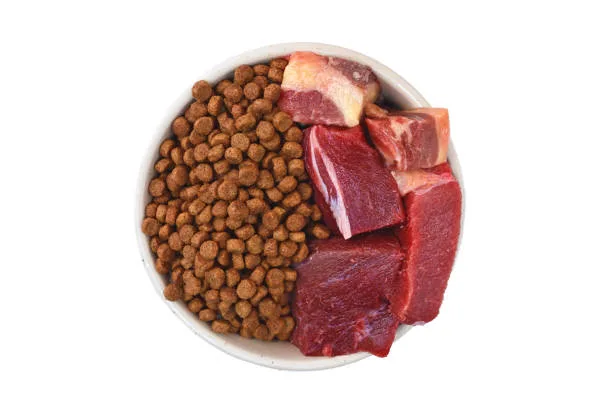
What a Wolf Actually Eats First
There's a reason wildlife researchers documenting wolf kills in the field note something consistent — the organ cavity gets opened before anything else. Liver, kidneys, heart, spleen. Gone quickly, consumed deliberately. The muscle meat comes later, sometimes much later, sometimes not at all if the pack is well-fed.
Dogs aren't wolves. That distinction matters and shouldn't be glossed over. But they share an evolutionary digestive architecture that developed over hundreds of thousands of years — one that was never designed around the contents of a plastic bag filled with processed kibble. Whatever modern convenience pet food has delivered, it's also quietly stripped something out. And that something is organs.
This isn't nostalgia for a wilder era. It's basic nutritional logic. The case for dog food with organ meat isn't built on instinct or trend — it's built on what organs actually contain, and what most commercial diets consistently fail to deliver.

The Quiet Deficiency Most Pet Owners Never Notice
Here's the uncomfortable truth about the majority of mass-market dog food: the nutrient profile on the back of the bag looks complete because it's been made complete — artificially, after the fact, through synthetic vitamin and mineral supplementation added back in after heat processing has degraded much of what was originally there.
That's not a conspiracy. It's just how the industrial food production process works. High heat, long shelf life, wide distribution. The math requires it.
The problem is that synthetic supplementation is not the same as whole-food nutrition. Bioavailability — meaning how much of a nutrient the body can actually absorb and use — differs dramatically between isolated synthetic vitamins and the same nutrients arriving embedded in the food matrix they naturally occur in. Heme iron from liver absorbs at a completely different rate than ferrous sulfate from a supplement. Preformed vitamin A from kidney behaves differently in the body than beta-carotene from plant sources.
These aren't minor, theoretical differences. Over months and years of feeding, they compound.
What's Actually Inside an Organ — And Why It Matters
Organ meat isn't just "extra protein." That framing massively undersells what's happening nutritionally.
Liver is the place to start because it's the most concentrated nutritional source in the animal kingdom. Full stop. Preformed vitamin A — not the plant precursor, but the ready-to-use form — exists in liver in quantities that no muscle cut can touch. B vitamins across the full spectrum, including B12 and folate. Heme iron for blood health. Copper, zinc, selenium. And a collection of unidentified growth factors that nutritional science hasn't fully mapped yet, which is a humbling thing to acknowledge but important. Real food frequently outperforms the sum of its measurable parts.
Too much liver, though, causes problems. Vitamin A toxicity in dogs is real and documented. Liver is powerful precisely because it's concentrated — which means balance isn't optional.
Heart often gets mislabeled as a muscle rather than an organ, and while it is technically cardiac muscle, its nutritional profile is far closer to organ meat than to a chicken breast. The reason heart matters specifically is taurine. An amino acid that dogs synthesize but may not produce in sufficient quantities under certain dietary conditions. Taurine deficiency has been directly linked to dilated cardiomyopathy — a serious, potentially fatal heart condition. This isn't theoretical. Veterinary cardiologists have been actively studying the connection for years, particularly in breeds that shouldn't statistically be developing DCM. Heart meat also carries CoQ10, an antioxidant compound that supports cellular energy production in ways that are hard to replicate through supplementation alone.
Kidney brings riboflavin, B12, and selenium in generous quantities. It's intensely flavored — the kind of smell that makes humans step back and dogs step forward immediately. That palatability isn't accidental. There's a deep biological recognition happening.
Spleen is less commonly discussed, probably because it's harder to find in mainstream markets. But for dogs showing signs of fatigue, poor coat condition, or recovering from illness, spleen's iron and zinc density makes it genuinely therapeutic. Not as a replacement for veterinary care — as nutritional support alongside it.
Lung sits lower on the nutritional hierarchy compared to liver or kidney, but it's exceptionally well-tolerated digestively. For dogs with sensitive stomachs being introduced to organ meat for the first time, lung is often the easiest entry point. Light texture, high protein, low disruption.
The Raw Feeding Question — Honest Rather Than Evangelical
Raw organ meat comes with genuine benefits and genuine risks. Both deserve acknowledgment.
On the benefits side: bioavailability is at its peak in raw food. Heat degrades certain enzymes and heat-sensitive B vitamins. Moisture content in raw food supports kidney function and digestion in ways that dry food simply can't match. Advocates of raw feeding cite these points accurately.
On the risk side: raw organ meat can carry Salmonella, E. coli, and in some cases parasitic contamination. The risk isn't uniform — sourcing quality, freezing protocols, and the individual dog's immune status all factor in. But it's not dismissible, particularly in households with immunocompromised people, young children, or elderly family members.
Gently cooked organ meat is a reasonable middle ground most veterinary nutritionists will support. The majority of nutritional value survives moderate heat. Pathogen risk drops substantially.
Freeze-dried organ products are shelf-stable and convenient, and good-quality ones preserve nutrients reasonably well depending on processing temperature. The key is scrutinizing the sourcing and processing method rather than assuming freeze-dried automatically equals nutritionally intact.
Finding Quality Sources — Which Is Where Most People Get Stuck
This is the practical friction point that doesn't get discussed enough.
Not all organ meat is created equal, and the sourcing matters more than most pet food marketing suggests. Grass-fed, pasture-raised organ meat carries a different fatty acid profile than feedlot-sourced organs. The animal's diet directly affects the nutritional composition of its tissues — including its organs.
For pet owners who want to incorporate raw or lightly cooked organs directly rather than through commercial products, sourcing locally is often both better and cheaper than expected. Ethnic grocery stores frequently carry fresh liver, kidney, and heart at low cost. Local farms and butchers often have organs they'd otherwise discard.
Searching for raw dog food near me can be a useful starting point for finding specialty pet food suppliers who carry pre-formulated raw blends with organ meat already balanced into the mix. These products exist on a wide quality spectrum — the ones worth using will clearly list organ sources, percentages, and sourcing practices. Vague language on the label is a reliable indicator of vague standards in production.

How Much, How Often — The Practical Framework
The rough guideline widely referenced in raw and whole-food feeding communities: organs should represent approximately 10–15% of the total diet, with liver specifically kept to around 5% or less. These numbers approximate what the body composition of a prey animal actually looks like — the proportions that a dog's digestive system developed alongside.
They're not rigid clinical targets. Individual variables — age, breed, size, activity level, existing health conditions — mean the ideal ratio shifts from dog to dog. A working breed running fifteen miles a week has different nutritional demands than a senior dog sleeping most of the day. A veterinary nutritionist who specializes in whole-food or raw feeding can provide genuinely individualized guidance worth the consultation cost.
For owners not ready to build a full organ-inclusive diet from scratch, starting with organ-based toppers or treats two to three times per week produces measurable benefit over time. The coat usually shows it first — a shift toward deeper color and increased shine that commercial food alone rarely produces. Energy levels and digestion tend to follow.
The Bigger Picture
Something worth sitting with: the pet food industry is enormous, sophisticated, and — in many respects — genuinely well-intentioned. The science of formulating complete-and-balanced kibble is real science. Nobody should dismiss it wholesale.
But "complete and balanced" is a regulatory floor, not a ceiling. It describes the minimum nutrient thresholds required to prevent deficiency disease in the average dog. It doesn't describe optimal nutrition. It doesn't account for bioavailability differences between synthetic and whole-food sources. And it doesn't explain why so many dogs on technically complete diets still present with dull coats, poor energy, chronic digestive issues, and early-onset inflammatory conditions.
Organ meat doesn't fix everything. It's not a cure. But it fills a gap that most commercial diets leave open — the gap between surviving on adequate nutrition and genuinely thriving on excellent nutrition.
That gap shows up slowly, over years, in ways that are easy to miss until they're hard to ignore.