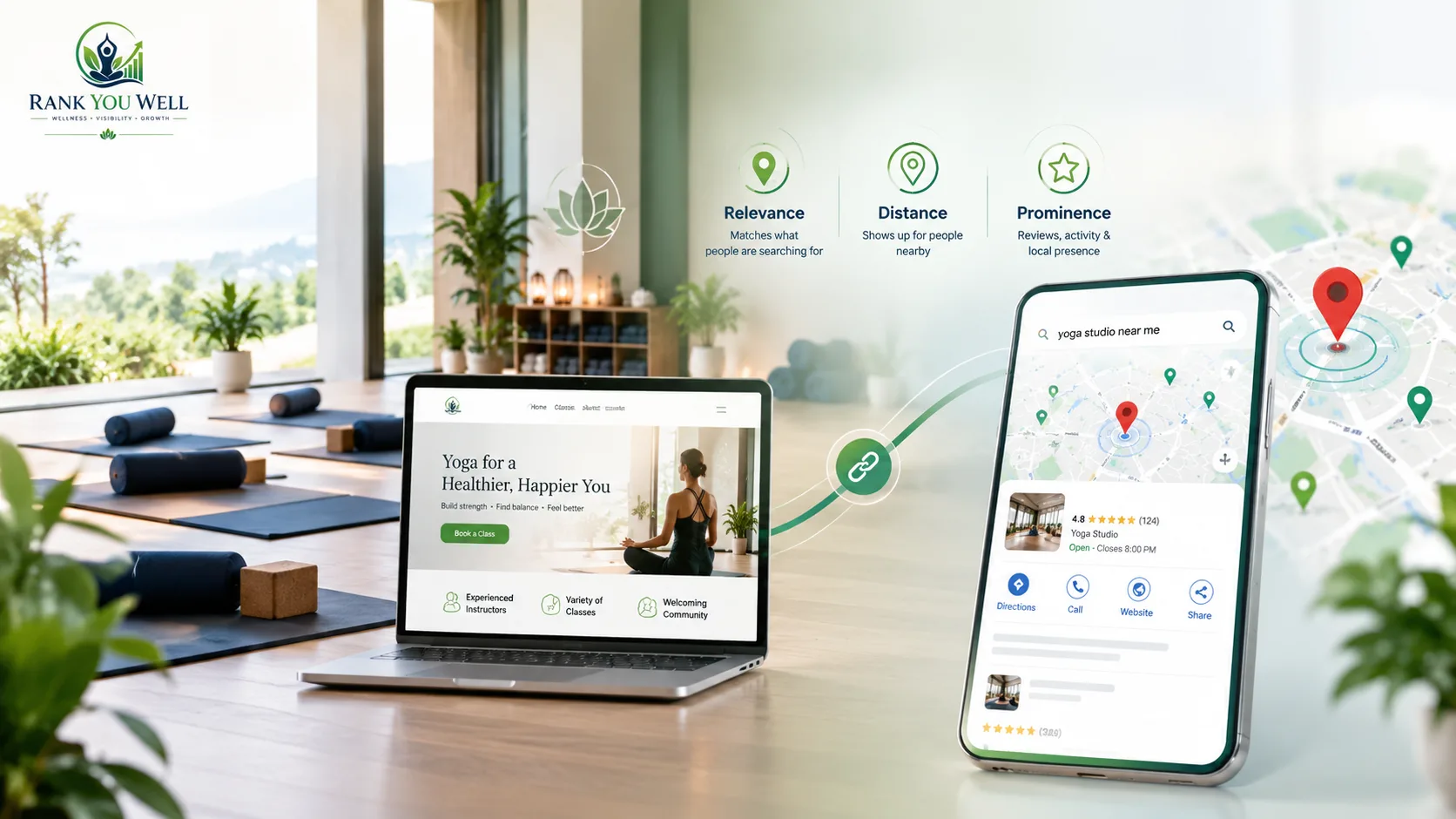
A yoga studio can have a beautiful website, experienced instructors, and happy students — and still struggle to appear when someone nearby searches for a yoga studio. The reason: organic website SEO and local Maps visibility overlap, but they aren't the same thing. Google states that local results are based primarily on relevance, distance, and prominence — the website is one input, but the Business Profile, reviews, and broader business information all factor in separately.
This matters most for yoga studios specifically, since students often search with strong local intent — "yoga near me," "beginner yoga near me," "hot yoga in [city]." If a studio isn't visible in those local results, a potential student may never reach the website at all.
Two Different Discovery Paths
"Yoga studio near me" and "what should I expect at my first yoga class" trigger very different results — the first surfaces a map and local listings, the second surfaces informational content. A website can perform well for informational searches while the Business Profile stays weak for local ones. That doesn't mean the website is bad; it means the two systems need addressing together, not as one problem.
Relevance: Does the Profile Match What People Search For?
Google says relevance comes from how closely a Business Profile matches a search, and that complete, detailed information helps make that match. For a yoga studio, that means going beyond the single category "Yoga Studio SEO" to represent actual offerings — Vinyasa, Hatha, Yin, restorative, prenatal, private sessions, whatever genuinely applies. Not every studio needs every service listed; the goal is making real offerings easy to understand, not adding services purely to chase keywords.
Distance: A Factor You Can't Fully Control
This is the most misunderstood piece of local SEO. Google includes distance among its main ranking factors, calculated from the searcher's location or the location named in the query. Two people searching the identical phrase from different neighborhoods can see different results — so checking a ranking once and concluding "we rank #3 for yoga studio near me" doesn't capture the real picture, since results shift by searcher location and by query.
Prominence: Complete Isn't the Same as Known
Google describes prominence as how well-known a business is, shaped by information from across the web — links, reviews, and mentions. A studio with a strong website but few reviews and little presence elsewhere gives Google less to work with than one with genuine reviews and consistent information, even if both sites look equally polished. The lesson isn't "collect as many backlinks and reviews as possible" — it's building a credible, consistent presence around the real business.
Consistency Across Every Listing
Google pulls Business Profile information from multiple sources — the business itself, directories, third parties, user contributions — which makes consistency genuinely important. A website address that reads "123 Main Street," a directory that says "123 Main St., Suite 2," and an old profile listing "125 Main Street" create ambiguity even when the differences look minor. Core details should match across the website, Business Profile, directories, social profiles, and booking platforms.
Website Clarity Beats Website Beauty
A homepage that reads "Welcome to our beautiful yoga community, offering transformative experiences for everyone" sounds pleasant but tells a search engine — or a potential student — nothing about location, class offerings, or audience. A page that states the city, lists actual styles offered, and moves clearly toward schedule, pricing, and booking does far more work, without needing to stuff location keywords into every sentence.
Class Information Buried Inside a Booking System
A student searching "morning yoga near me" wants a direct answer: does this studio actually run a morning class? If finding that requires clicking through to a separate booking platform, creating an account, and searching the schedule, that's friction working against the studio. Class times, styles, and levels should be visible on the site itself — the booking platform can still handle the transaction, but the information needs to be visible before that stage.
Reviews, Photos, and Naming
Reviews do more than support prominence — "great studio!" tells a beginner nothing, while a review describing instructor style, atmosphere, and class difficulty gives a genuinely useful preview. The same logic applies to photos: showing the actual studio and class environment answers the real question a first-time visitor has — what will it feel like to walk in. Business names should stay accurate rather than stuffed with keywords ("Sunrise Yoga Studio | Best Yoga Classes in Miami | Hot Yoga") — that isn't a shortcut, it's a guideline violation that can hurt trust signals rather than help them.
A Quick Visibility Check
CheckQuestionBusiness ProfileClaimed, verified, and complete?CategoryAccurately represents the business?ServicesActual offerings clearly listed?LocationAddress accurate and consistent everywhere?WebsiteClearly explains the studio and location?ClassesSchedule and offerings easy to find?ReviewsGenuine, current, and responded to?PhotosRepresent the real studio?Local presenceConsistent across other listings?Rather than tracking one ranking number, this checklist reveals which piece — relevance, distance exposure, or prominence — actually needs attention.
Frequently Asked QuestionsWhy isn't my yoga studio showing up on Google Maps?
Local visibility depends on relevance, distance, and prominence together — a complete profile helps but doesn't guarantee a specific ranking, since distance and competitor prominence are factors outside direct control.
Does having a good website guarantee Google Maps visibility?
No. A website supports the broader presence, but Maps visibility depends separately on Business Profile completeness, reviews, and web-wide prominence signals.
Does adding more keywords to a Google Business Profile improve ranking?
Not directly. Google rewards accurate, complete information that reflects real offerings — stuffing categories or the business name with keywords risks violating profile guidelines rather than helping.
Why does my studio rank differently depending on who searches?
Because distance is calculated from each searcher's actual location, the same query can return different local results for people in different neighborhoods of the same city.
How important are reviews for a yoga studio's Maps ranking?
Significant. Review count and rating both factor into prominence, and detailed, genuine reviews also help prospective students evaluate whether the studio fits them.
Conclusion
A beautiful website doesn't automatically make a yoga studio visible on Google Maps, because website SEO and local Maps visibility are connected but distinct systems — one built on content and structure, the other on relevance, distance, and prominence. The fix isn't chasing a single ranking number; it's building an accurate, consistent, genuinely reviewed presence and then measuring visibility across the specific searches that matter to the studio. Rank You Well helps wellness businesses build exactly this kind of connected presence — local SEO, content, and website strategy working together rather than as separate projects. For a yoga studio, the goal was never to appear somewhere on Google. It's to help the right students actually find it.