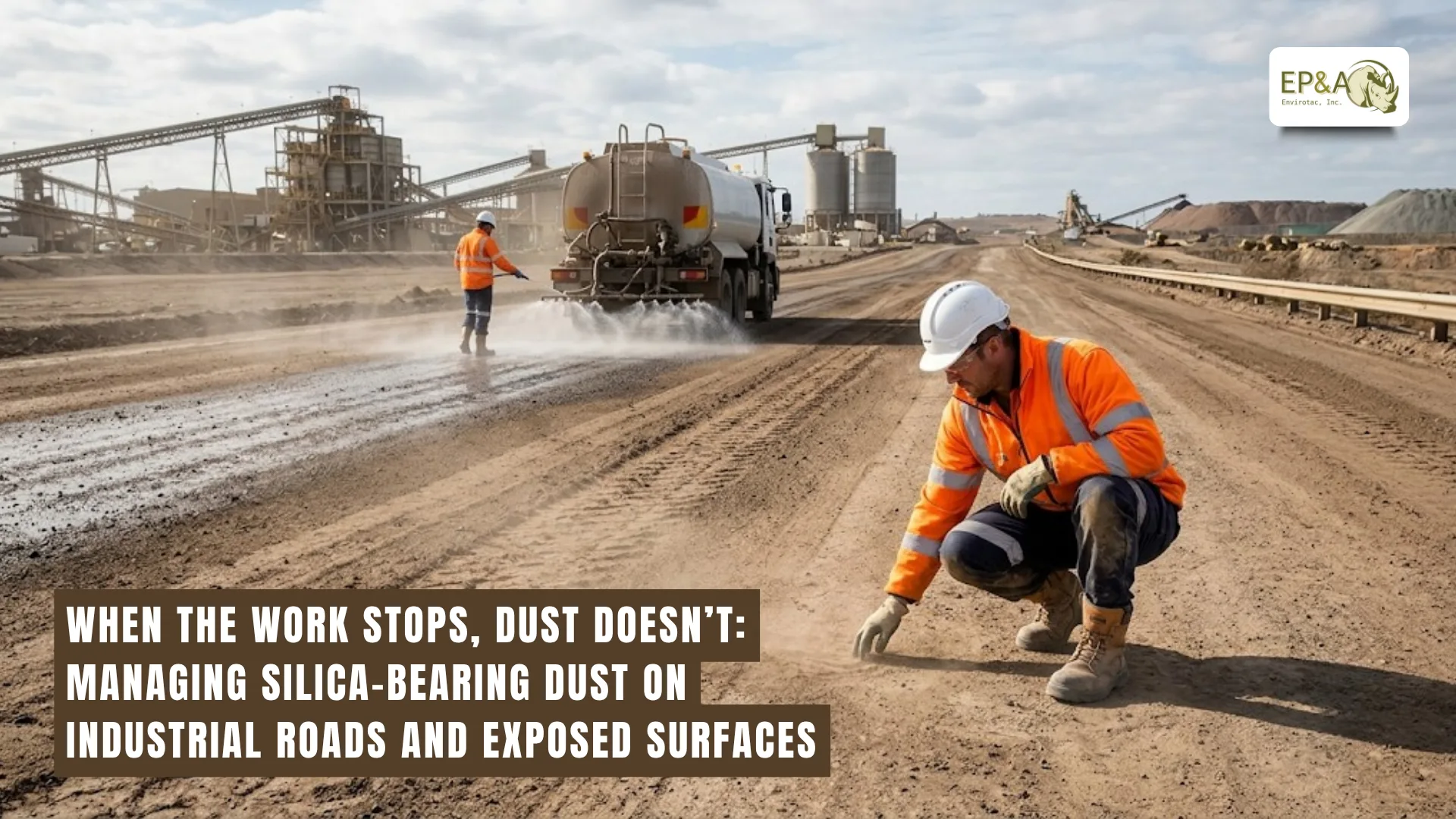
A quarry shuts down for the weekend. The haul trucks are parked, the crusher’s silent, and from the gate the site looks still. But walk out to the access road on a windy afternoon and you’ll see the dust hasn’t gotten the memo. Nobody drove on it. Nobody touched it.
That’s the thing people miss about dust: it’s not just something trucks kick up while they work. It’s baked into the surface itself, and silica-bearing dust will keep coming off an exposed surface long after the equipment shuts down. This piece walks through why that happens, how to tell a visible nuisance from an actual exposure problem, and how you’d actually know if a control method is working, as opposed to just looking like it is.
Why Dust Keeps Moving After the Trucks Stop
Wind alone can do it. Once loose fines on an unpaved surface dry out, it doesn’t take much of a gust to lift them, no vehicle required. The EPA lists unpaved roads, open storage piles, quarries, and construction sites among the common sources of fugitive dust, and names wind erosion as a mechanism in its own right, separate from the mechanical forces of vehicle traffic (EPA, Fugitive Dust Control Measures and Best Practices).
Shutdowns are also never quite as quiet as they look on paper. Maintenance trucks, security patrols, and the occasional delivery run, they’re all still crossing roads everyone assumes are idle, and that trickle of traffic is often enough to break up a crust that was just starting to form. Then weather gets involved. A surface that was damp and compacted while the site was running can dry out and crack within days of going quiet, so whatever worked in July might fall apart by October without a single haul truck on it.
Before jumping to a fix, it’s worth double-checking which surface is actually the problem. A road, a stockpile nearby, and freshly disturbed soil from recent earthworks don’t behave the same way, and treating the wrong one wastes money without solving anything.
Visible Dust Is Not the Same as Silica Exposure
This is where a lot of haul-road dust control advice gets it wrong. Plenty of ordinary materials, sand, gravel, and certain soils contain crystalline silica, and NIOSH’s research on unpaved mine haul roads found that while most of the airborne dust these roads throw off is too coarse to inhale deeply, up to 20 percent falls into the respirable range, small enough to settle deep in the lungs (NIOSH, Controlling Haulage Road Dust, citing Organiscak & Reed, 2004). But that number is only talking about particle size. It doesn’t say whether any of it is silica, and a road that looks noticeably less dusty after treatment tells you nothing about whether actual silica exposure dropped.
That gap matters more than it might seem, because it’s tied directly to compliance. OSHA’s silica standard kicks in once exposure may reach the action level of 25 micrograms per cubic meter and requires control once it crosses the permissible limit of 50 micrograms per cubic meter, both measured as eight-hour averages (OSHA, Respirable Crystalline Silica: Construction). By OSHA’s own estimate, around two million construction workers are exposed to respirable crystalline silica across more than 600,000 workplaces (OSHA Fact Sheet 3681, Crystalline Silica Rule: Construction). In the rulemaking behind the standard, OSHA estimated that roughly 840,000 of those workers are exposed above the permissible limit. The health risks tied to long-term exposure, silicosis, lung cancer, COPD, and kidney disease are serious enough that a cleaner-looking road shouldn’t be mistaken for proof of anything.
Knowing for sure means sampling and lab testing, usually X-ray diffraction done to NIOSH Method 7500 (NIOSH, Method 7500: Silica, Crystalline by XRD). Even that has its limits. The method lists a long run of minerals that can interfere where a sample happens to contain them, from micas and feldspars to zircon and graphite, and tridymite in any quantity overlaps the main quartz and cristobalite peaks. The method you choose shapes what the result actually tells you. Which is exactly why this isn’t a job for a visual inspection. It’s a job for an occupational hygienist.
Why Standard Dust Control Falls Short During a Shutdown
Watering is the go-to fix, and it does work, just not for long. Once the surface dries, which can happen in a matter of hours if it’s hot or windy, the dust comes right back. Sites that treat watering as their whole plan during a shutdown often end up paying for labor and water that buys them a few hours of relief at a time, with nobody around to keep topping it up.
There’s a reason for that beyond bad luck. A 2021 peer-reviewed review of unpaved road dust suppression found that how well a product performs comes down to its own physical and chemical characteristics together with application rate and frequency, the soil it’s going onto, wind speed, and atmospheric conditions at the time (Parvej, Naik, Sajid, Kiran, Huang & Thanki, Fugitive Dust Suppression in Unpaved Roads: State of the Art Research Review, Sustainability, 2021). So a treatment can flop for reasons that have nothing to do with the product itself; wrong timing, wrong surface, or wrong conditions on the day.
Matching the Method to the Shutdown
What you pick for dust suppression during shutdowns should come down to how long the surface will actually sit idle, how much traffic it’ll still see, wind exposure, drainage, and what it needs to be ready for once work picks back up. For short, calm shutdowns, water-based control is usually enough. Once the idle period stretches out and reapplying water stops being practical, a suppressant or binding treatment makes more sense. If the surface has a structural problem rather than just a dust problem, stabilization or material correction is the fix, not a coating on top. And for stockpiles or anything you can’t treat directly, covers and wind barriers are often the more reliable call.
A useful way to compare options is against the same checklist every time:
- Surface material and composition
- Expected duration of inactivity
- Residual traffic type and frequency
- Wind exposure and prevailing direction
- Rainfall, runoff, and drainage requirements
- Intended use of the surface once work resumes
- Environmental or permitting constraints
What the Evidence Actually Shows
Company-Reported Case Studies
Vendor case studies are worth a read, but remember they’re describing one site under one set of conditions, not a guarantee. Veolia’s case study on a steel producer’s access and haul roads found that a base and maintenance program with its DusTreat binding and wetting agents, after proper mechanical surface prep, saved around 5,600 US dollars per mile per year compared to the site’s old watering routine (Veolia, Steel Producer Reduces Road Dust with DusTreat). Cypher Environmental reports something similar on the fuel side: stabilizing haul roads at the Shenhua mine with its ROAD//STABILIZER product cut haul truck fuel consumption by 17.4 percent against the previous year’s untreated roads, which it valued at roughly 3.6 million US dollars in fuel savings over a one-year study (Cypher Environmental, Dust Control and Road Stabilization for Mining). Both numbers are real. Neither one tells you what’ll happen on your road, in your weather, with your trucks.
A Model for Rigorous Evaluation
If you want to see what a properly measured result looks like, a 2018 USGS study is worth borrowing from. Researchers tracked two chemical treatments on unpaved roads for 19 months straight, using a vehicle-mounted particulate meter alongside objective road-condition evaluations. At peak, both treatments cut dust by as much as 99 percent against an untreated control section, and average dust was still 93 percent lower at the 19-month mark; treatment type plus humidity together explained 69 percent of how dust levels varied over that time, with the rest coming down to things like traffic and rainfall (Kunz, Green, Albers, Wildhaber & Little, Use of Real-Time Dust Monitoring and Surface Condition to Evaluate Success of Unpaved Road Treatments, USGS/TRB, 2018). That’s the model: a baseline, an untreated section to compare against, measurements taken repeatedly over time, and an honest account of what the numbers can’t explain.
A simple scorecard following that same logic should cover baseline conditions, application date and method, weather and traffic during the observation window, the measurement method used, follow-up checks, maintenance done, total cost over the control period, and whatever limitations the data has.
A Shutdown Checklist Worth Keeping
- Before shutdown: identify exposed surfaces, confirm material type, and select a method suited to the expected idle period
- During inactivity: watch for wind events and residual traffic, and inspect treated areas on a schedule matched to actual site risk
- After weather or traffic changes: reassess surface condition and reapply where needed
- Before resuming operations: confirm the surface is stable and ready for the traffic about to return
Inspection frequency should come from the site’s own risk profile, not a borrowed schedule.
The Bottom Line
Managing dust control on exposed surfaces well isn’t about finding one magic product. It’s more like a diagnosis: figure out where the dust is actually coming from, pick a method that fits how long the surface will sit idle and what it needs to handle next, and check your results against a real baseline rather than a gut feeling. Sites that approach it this way tend to walk into the next shutdown with a plan already sitting on the shelf, instead of starting from scratch every time the trucks go quiet.
Author
Clay Anderson covers industrial dust management and surface stabilization, examining how mining, quarrying, and heavy industrial sites can manage exposed surfaces and persistent airborne dust. His writing explores dust suppression strategies, silica-related considerations, treatment performance, and practical approaches to maintaining road conditions during active operations and shutdown periods.