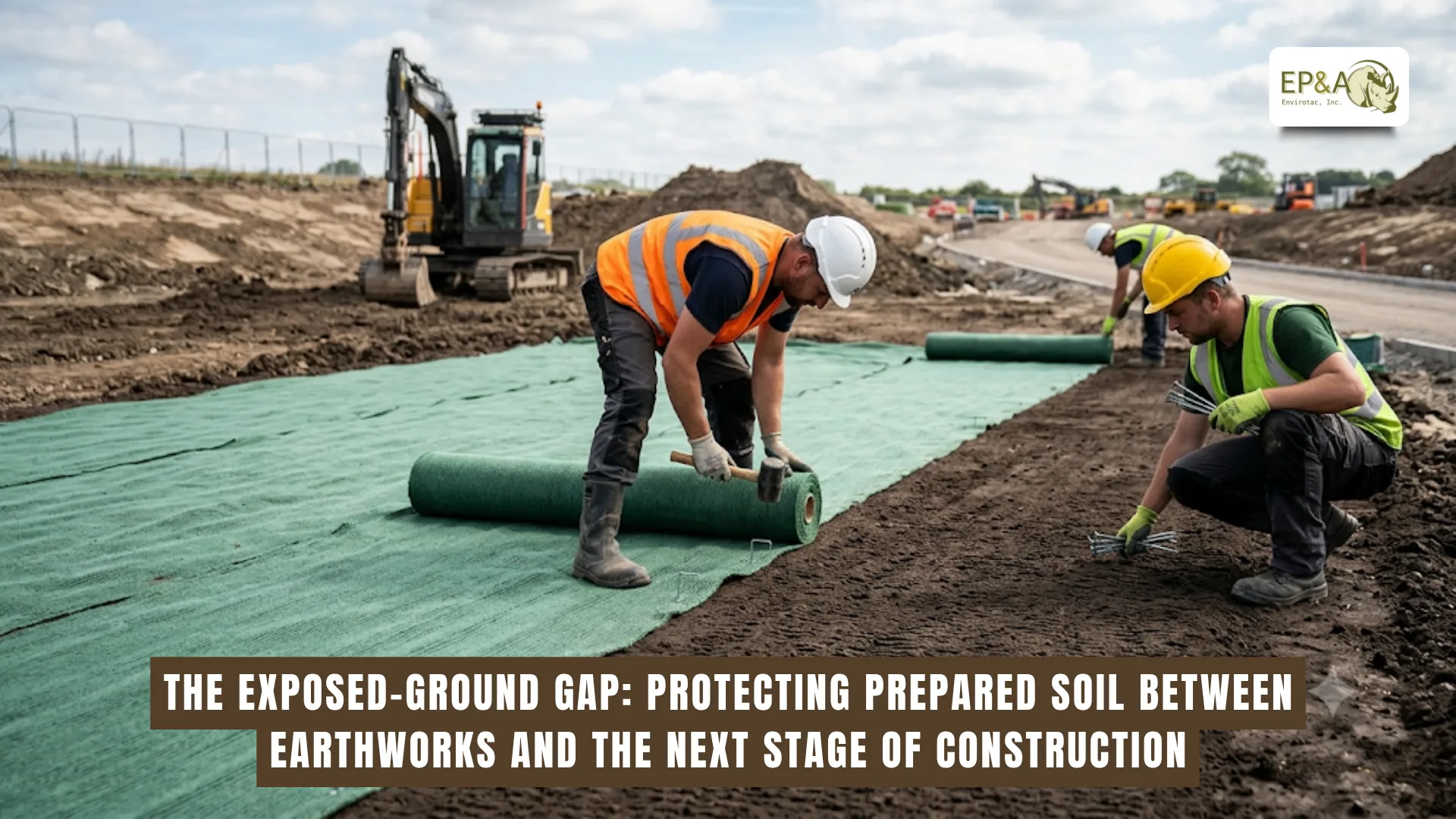
Picture this: the grading crew wraps up on a Friday, the pad is smooth, compacted, and right on grade, and then the paving sub’s start date slips by two weeks. Nobody built that gap into the schedule. But the federal construction stormwater permit doesn’t care whether it was planned: once work won’t resume for more than 14 calendar days, stabilization is supposed to start right away.
That gap almost never shows up on a project schedule, yet it’s often what decides how much corrective work you end up doing later. Here’s a look at the risks that gap creates, how to pick the right control, and what to check before the next crew shows up.
What Happens When Earthworks Are Complete but Construction Has Not Resumed?
Why the Exposure Period Matters
Delayed materials, inspections stuck in queue, bad weather, and phasing conflicts—any of these can quietly stretch a few days into several weeks. A short gap is nothing more than a scheduling note. Let it run open-ended, though, and it becomes its own site condition, one you have to actively manage.
Whether that 14-day clock even applies to your site depends entirely on the permit you’re under. Take Minnesota: its permit excludes applying pavement to roads and parking lots from what counts as construction activity, and states plainly that vehicle traffic on site isn’t construction activity either. It still expects the surrounding soils that aren’t being actively worked to be stabilized within the permit timelines, so read the exclusion narrowly. And the rules themselves move—EPA’s draft 2027 permit was published in August 2026 and would replace the 2022 permit once finalized. Its comment window closed September 17, 2026, and no final permit has issued yet, so check the operative permit rather than the proposal, and watch for the final language.
What Condition Must the Ground Retain?
Before you pick a treatment, figure out what the ground actually needs to be able to do once work picks back up. Dust-free? Grades still intact? Drainage still working? A specific moisture or density target? Whatever comes next on site sets that bar, so define it first, and let the treatment follow from there.
Which Risks Can Develop While Prepared Ground Remains Exposed?
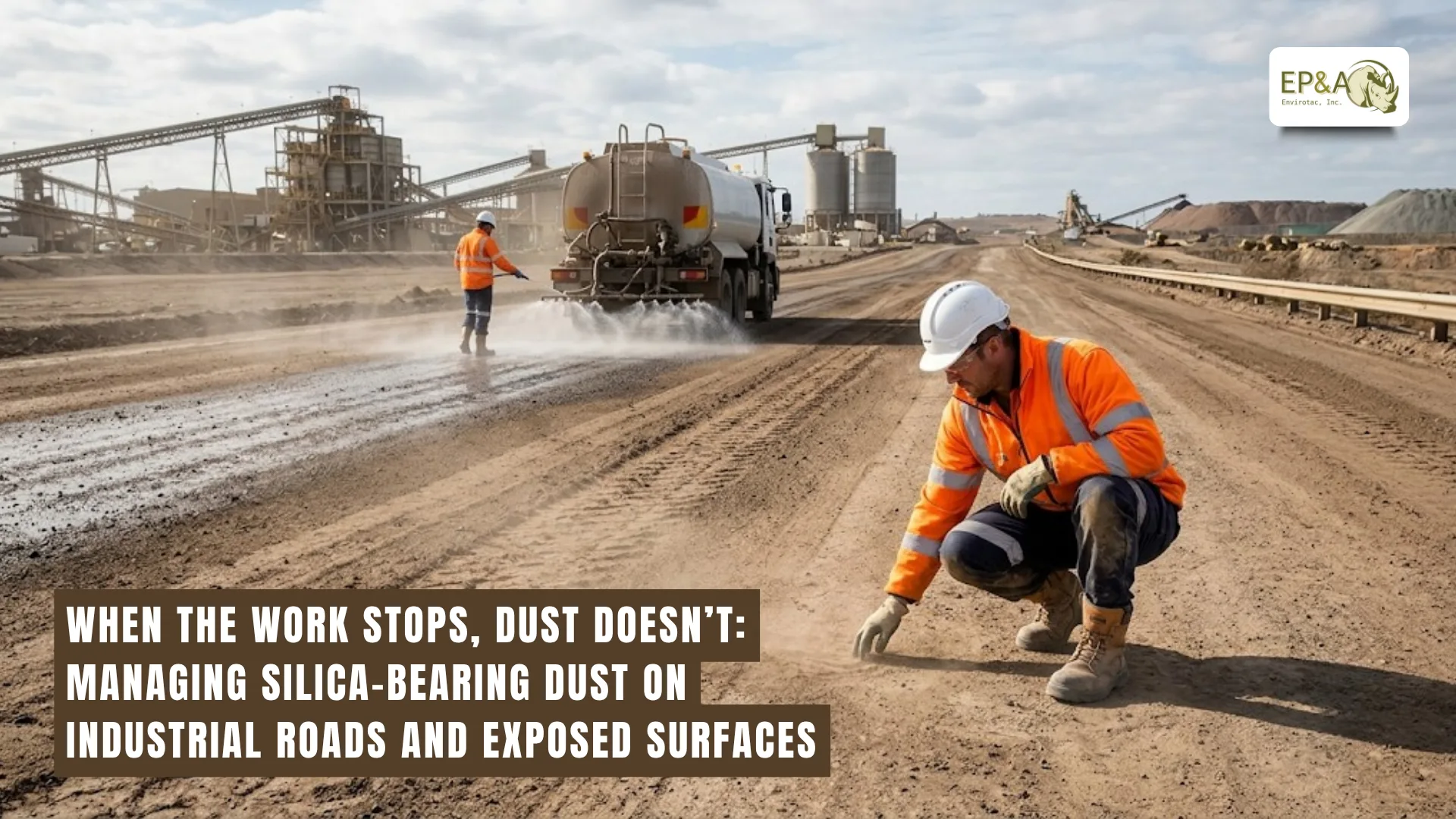
Windblown Dust and Repeated Watering
Watering is the default move, and it’s a demanding one. A 2012 Alaska DOT&PF study found that in hot, dry weather at 70°F, with 40 percent humidity, keeping a gravel road’s visibility acceptable meant watering it every 20 to 25 minutes. The same researchers tried three suppressant products, Freedom Binder 400, Durasoil, and Soiltac, applied at rates built for one week, two weeks, and a month. None of them actually hit their targeted window of 7, 14, or 28 days, and having 200 to 250 extra trucks a day on the road didn’t help. For that particular short job, plain watering still came out cheapest.
Other research tells a different story. EPA points out that water itself is cheap, but because it needs reapplying so often, the total cost can end up higher than a chemical treatment that only needs seasonal or annual attention. A 2009 MnDOT study looked at gravel roads carrying anywhere from 25 to 700 vehicles a day and found all three of calcium chloride, magnesium chloride, and an organic polymer-plus-binder reduced dust, with the two chlorides performing about equally and outperforming the polymer blend.
Put those studies side by side, and a pattern emerges: the real variable is traffic and duration, not simply water versus polymer. Albuquerque’s 2005 air quality guidance backs that up; it says stabilizers are most effective on areas where active operations have ceased, cautions that they aren’t recommended for high-volume or heavy-equipment traffic when used on unpaved roads and shoulders, and recommends stabilizers or ground cover specifically on graded areas sitting more than 60 days out from construction.
And watering isn’t a free pass, either. AP-42 notes that most soils have an ideal moisture range for compaction, and EPA warns that too much water can cause discharge or leave the site tracking mud.
Rainfall, Runoff, and Erosion
Rain does its own damage. It loosens soil, collects in low spots, and carries sediment right off the site. The Minnesota Stormwater Manual credits soil stabilizers with a primary benefit for erosion control, but it’s honest that they offer little to no help with runoff volume or sediment control and flatly says they’re not built for concentrated flow.
Traffic, Surface Disturbance, and Changing Conditions
Even a site that looks dormant is still changing day to day. Survey crews, delivery trucks, and equipment moving through all chip away at the surface crust and rut any treated areas. Speed matters more than you’d think, too: the Alaska team found a large truck moving at 45 mph kicked up significantly more dust than a car doing 30, which is part of why they recommended lower speed limits as a simple way to cut back on watering frequency.
How Should Contractors Choose Protection for the Exposure Period?
Assess Soil, Slope, Moisture, and Drainage
Dust tracks closely with fines and moisture: AP-42 expects emissions to climb as silt content rises and drop as soil moisture rises, and MnDOT’s research found treatments simply didn’t perform as well on sandier gravels. Slope and drainage, meanwhile, are what determine where all that water actually ends up going.
Consider Traffic, Weather, and Expected Duration
Duration is the piece people underestimate most. A water truck that’s perfectly fine for a one-week gap turns into a real, ongoing line item once that gap stretches to two months and wind or rain can shift how often the surface needs attention in either direction.
Match the Control to the Dominant Risk
Once you name the dominant risk, the decision gets a lot simpler. If it’s dust, you’re weighing watering, a suitable suppressant, speed limits, or access control. EPA’s numbers show mulch cutting wind erosion by 75 to 95 percent and gravel cutting soil loss by 95 percent, both compared to bare soil. If it’s rain, start with drainage, diversion, covers, and sediment controls instead. And if it’s traffic, the fix is usually managing access.
Recognize When Dust Suppression Is Not Enough
Here’s the thing worth remembering: a dust treatment was never meant to be a drainage plan. If the real threat is runoff, concentrated flow, or a subgrade that’s softening underneath you, the answer is drainage work, sediment control, or getting an engineer to look at it, possibly alongside dust control, not instead of it.
Where Can Polymer-Based Dust Suppression Fit?
How Suitable Treatments Help Control Surface Dust
Stabilizers work by binding surface particles together, so wind and light traffic have a harder time lifting them loose. Worth knowing: EPA’s list of product families spans everything from polymer emulsions to organic and petroleum-based products, so “polymer-based” really isn’t one single thing; it covers a lot of ground. Always check the manufacturer’s current documentation for whatever specific product you’re considering.
What Affects Application and Performance?
Prep work, application rate, dilution, coverage, curing time, weather conditions, and traffic all play a role in how well a treatment holds up. Caltrans expects the contractor’s treatment plan to cover application methods and rates, the weather conditions required, and drying or curing time, plus continuous inspection during that first application and a cure check before traffic’s allowed back on. The idea is to shift the effort away from repeated passes and toward getting that one application right the first time.
Environmental Suitability and Product Limitations
A few cautions are worth flagging here. EPA warns that cationic polymers can be highly toxic to aquatic life and typically require case-by-case approval and that chlorides can limit plant growth nearby. Before treating ground near water, check the safety data and local restrictions, and be skeptical of label claims about harmlessness to wildlife unless there’s real documentation to back them up.
When Another Control May Be Necessary
If water’s already moving through concentrated channels, or the ground itself is starting to give way, a surface treatment isn’t going to fix what’s actually wrong. That calls for structural stabilization instead, which is a different job altogether. As one example, Midwest Industrial Supply reports raising sandy A-3 soil from a CBR of 2 to over 35 on a New Mexico solar project by treating just the top 6 inches. Worth noting is that’s a single company-reported result for one specific soil, not something to treat as a general dust control benchmark.
How Can Contractors Maintain and Evaluate Protection During Delays?
Establish Inspection and Maintenance Triggers
Protection isn’t something you set and forget; it’s a condition you actively manage. EPA’s permit sets inspections at least once every 7 days, or every 14 days plus within 24 hours of any storm producing 0.25 inches or more of rain. Minnesota’s rule ties inspections to that same 7-day rhythm and to rainfall above 0.5 inch. Caltrans, for its part, suggests daily checks if water is your control method and weekly checks if you’re using a suppressant.
Measure the Outcomes That Matter
It helps to keep dust, erosion, surface condition, maintenance frequency, and engineering acceptance as separate measurements, since each one is really answering a different question. Dust, in particular, is genuinely tough to measure accurately on a live road: the Alaska team found handheld monitors unreliable in practice because drivers would slow down or steer around whenever they saw someone standing nearby with equipment. A visual once-over is never a substitute for an actual specified test.
Record Application and Corrective Work
Keep notes on rates, dates, weather, what you observed, maintenance performed, and any test results. EPA’s permit is specific here: If a control needs the exact same fix three or more times, that’s no longer routine: it needs to go through corrective action or, at minimum, get documented as expected routine upkeep.
Reassess When the Handover Date Changes
If the gap grows, your plan needs to grow with it. A pushed-back handover date can quietly carry you across a 14-day or 60-day threshold without anyone noticing, so it’s worth going back and reassessing the risk, the control, and the budget each time the schedule shifts.
How Can the Team Check Compatibility Before Construction Resumes?
Confirm Compatibility With the Next Construction Layer
Ask the obvious question first: what’s actually going on top of this surface? Aggregate, asphalt, more compaction, concrete, vegetation, each one interacts with a treated surface differently. Independent test data on bonding is genuinely hard to come by, so don’t assume compatibility. Confirm it through the product’s documentation and, ideally, the project engineer.
Follow the Required Acceptance Criteria
A dust-free surface looks good, but it tells you nothing about compaction, moisture, density, or strength, and rain can reset every one of those checks overnight. Iowa’s SUDAS specification, updated in 2025, requires proof of rolling within 7 days of paving, and again if it rains or more than 7 days pass. Any yielding or rutting beyond 2 inches fails the subgrade outright, though the engineer does have the option to waive a repeat test.
Complete the Handover Inspection.
Before the next crew mobilizes, walk the site yourself. Confirm any damage has been assessed and fixed, maintenance is actually finished, compatibility questions are settled, required tests have passed, and the paperwork and approvals are all in order.
How Should Contractors Compare the Total Cost?
Include the Full Cost of the Existing Method
Watering looks cheap on paper, but it rarely stays that way once you add it all up: the water itself, labor, equipment, repeated passes, inspections, and any corrective work that follows. Even the Alaska study that ultimately favored watering pointed to its high cost and the hassle of scheduling equipment as real drawbacks.
Include Application and Maintenance Costs for the Alternative
For comparison, EPA’s 2021 fact sheet offers some dated figures: polyacrylamide runs about $6 a pound at roughly 20 pounds per acre, working out to at least $120 an acre in chemical cost alone, while calcium chloride runs about $0.50 a pound at 1 to 3 tons per acre, or $1,000 to $3,000. Neither number accounts for application, curing time, reapplication, or managing traffic around the work.
Evaluate Performance Using Comparable Evidence
When you’re comparing methods, stick to the same site conditions and the same time period, and lean on your own numbers wherever you can. Alaska’s busy haul road and Minnesota’s lower-traffic gravel roads simply aren’t interchangeable evidence for your particular pad. And only count a schedule or downtime benefit if it’s actually documented somewhere, not assumed.
A Practical Checklist for Protecting Prepared Ground
- Identify the dominant risk: dust, runoff, erosion, traffic, or structural concerns.
- Record soil type, slope, moisture, and drainage.
- Estimate the exposure period and how uncertain it is.
- Confirm what the next operation requires.
- Match the control to the risk and verify product instructions, permits, and environmental limits.
- Set inspection triggers and keep records.
- Compare costs over the same period.
- Complete the handover inspection before work resumes.
Conclusion: Protect the Work Already Completed
There’s no clean winner between water and suppressants here; the evidence just doesn’t support one. What actually decides it is traffic, duration, soil type, and whatever’s going on next, and the paperwork around that gap matters just as much as the product you choose: the 14-day clock, the inspection cycle, and a proof roll you might have to repeat after rain. Start by thinking through expected traffic and how long the gap could realistically run, then check the permit and the next layer’s spec before you commit to anything.
If you’re working through this for a specific site, start with the soil, the traffic, the expected exposure window, and what’s coming next. That conversation alone will usually tell you whether dust control for exposed soil belongs in your plan.
Frequently Asked Questions
How do you protect soil after grading?
Start by naming the dominant risk, then match the control to it: drainage for runoff, covers or mulch for erosion, watering, speed limits, or a suppressant for dust. Check the permit and the next layer’s requirements before deciding.
When is watering sufficient for temporary construction dust control?
When the gap is short, traffic stays light, and your crew can actually keep up with the passes the weather demands. Alaska’s busy gravel road needed watering every 20 to 25 minutes in hot, dry conditions.
What affects dust suppressant application?
Surface prep, application rate, dilution, coverage, curing time, weather, soil type, and traffic are all governed by whatever the manufacturer’s current instructions say.
Can dust suppression replace erosion control?
Not really, no. Minnesota’s manual is clear that stabilizers offer little to no benefit for runoff volume or sediment control, and they’re not designed for concentrated flow.
Can treated soil receive aggregate or pavement?
Possibly, but verify it through the product’s documentation, the project specification, and acceptance tests like proof rolling, rather than assuming.
How should temporary dust control costs be compared?
Over the same time period and conditions, counting water, labor, equipment, application, curing, reapplication, and traffic management together.
About Ray Cooper
Ray Cooper writes about practical dust control solutions for construction sites, unpaved roads, and other environments where airborne dust and surface stability are ongoing challenges. His work focuses on helping contractors weigh dust suppression methods, soil stabilization basics, and product selection against the real conditions of a job site, so decisions about protecting exposed ground hold up once the next crew arrives.