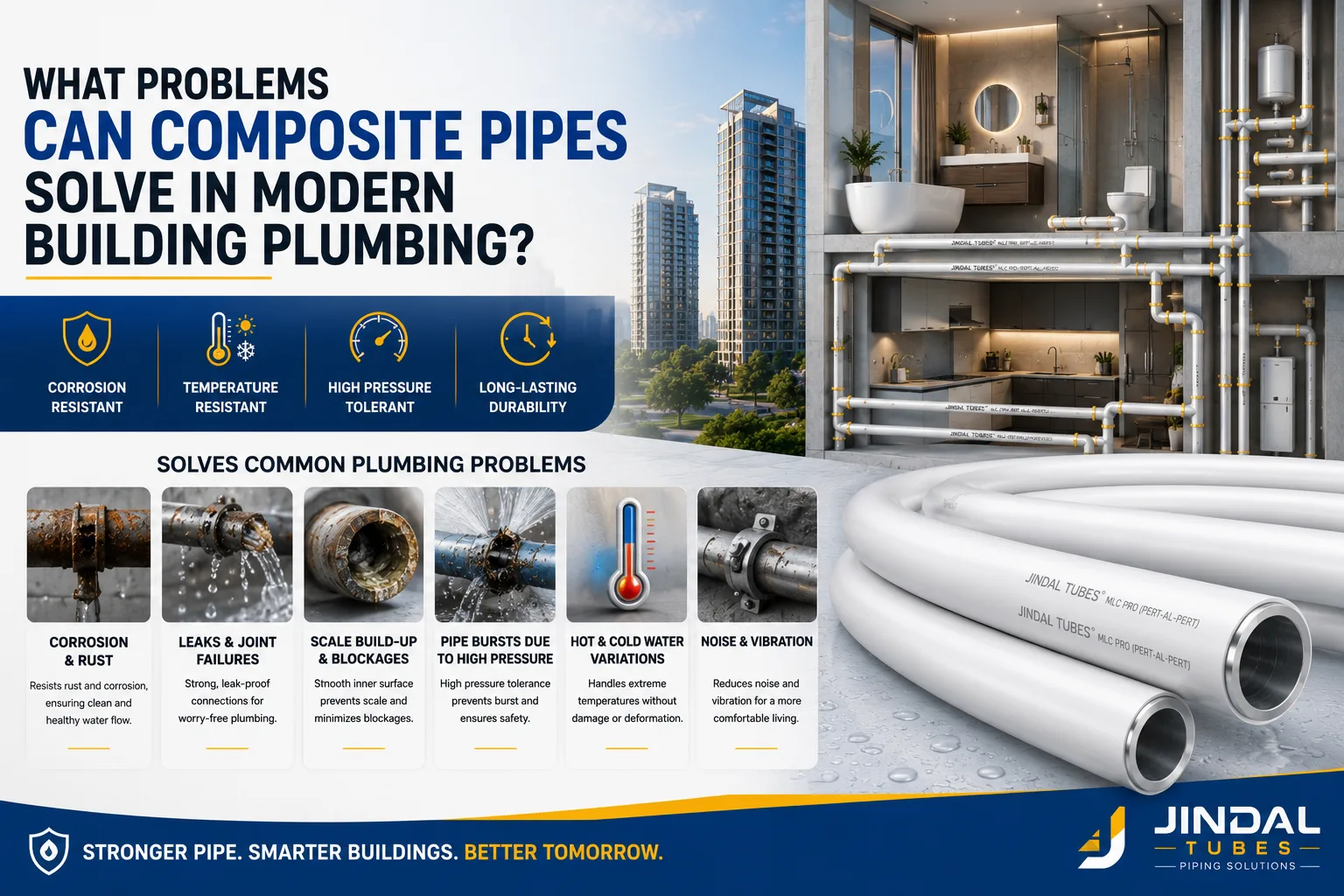
Modern plumbing systems face several challenges, including corrosion, thermal expansion, pressure fluctuations, difficult installation, leakage, and long-term maintenance. Composite pipes address many of these issues by combining multiple materials, typically polyethylene and aluminium, into a single pipe structure. This combination provides a balance of flexibility, strength, dimensional stability, and corrosion resistance.
1. Corrosion and Rust
Corrosion can gradually weaken conventional metal plumbing and affect water quality and flow performance.
Composite pipes use polymer layers that are resistant to conventional corrosion, helping reduce problems such as:
- Internal rust
- Pipe-wall deterioration
- Corrosion-related leaks
- Reduced internal diameter
- Frequent pipe replacement
For drinking-water and building plumbing projects, material selection should also consider applicable standards and certification. The Bureau of Indian Standards (BIS) provides standards and conformity-assessment information relevant to plumbing products used in India.
2. Excessive Thermal Expansion
Hot-water systems experience repeated temperature changes. Some plastic pipes can expand considerably when heated, creating movement and additional stress on supports and connections.
The aluminium layer in PE-AL-PE composite pipe helps control this movement.
This can provide:
- Better dimensional stability
- Reduced pipe movement
- Lower stress on supports
- More stable installations
- Improved performance in hot-water applications
The CIBSE technical guidance on multilayer composite pipe explains how the aluminium layer contributes to dimensional stability in multilayer pipe systems.
3. Leakage at Pipe Connections
Leaks frequently develop around joints rather than along straight sections of pipe.
Composite pipe systems can be paired with compatible press-fit fittings to create secure mechanical connections. Properly designed and installed connections can help reduce leakage risks caused by:
- Poor threading
- Over-tightening
- Seal deterioration
- Thermal movement
- Installation inconsistencies
For multilayer plumbing applications, EZ-PRESS composite fittings provide a press-fit connection option designed for compatible composite pipe systems.
4. Difficult Plumbing Installation
Traditional rigid pipe materials can make installation challenging, particularly around corners, confined spaces, and complex building layouts.
Composite pipes offer a useful balance between flexibility and rigidity.
Their lightweight construction can make them easier to:
- Transport
- Cut
- Bend
- Route through buildings
- Install in confined spaces
This can reduce installation effort while still providing greater dimensional stability than many conventional flexible plastic pipes.
5. Pressure and Temperature Changes
Building plumbing systems rarely operate under completely constant conditions.
Water demand can change throughout the day, while hot-water systems experience repeated temperature cycles.
A properly specified multilayer composite pipe can handle these conditions by combining the properties of its different layers.
The aluminium core contributes mechanical stability, while the polymer layers provide flexibility and corrosion resistance.
However, designers must always verify the specific pressure and temperature ratings of the selected pipe rather than assuming all composite pipes have identical performance.
6. Poor Long-Term Hydraulic Performance
Pipe interiors can affect how efficiently water moves through a plumbing system.
The smooth polymer inner layer of composite pipe provides a low-roughness surface that can support efficient water flow and reduce the potential for corrosion-related buildup.
This can help maintain:
- Consistent flow
- Hydraulic efficiency
- Internal pipe condition
- Long-term system performance
The U.S. Department of Energy also highlights the importance of efficient hot-water distribution and minimizing unnecessary losses in building water systems.
7. Noise and Pipe Movement
Water movement and thermal expansion can cause clicking, knocking, or other unwanted plumbing noises.
Because the aluminium layer restricts thermal movement, multilayer composite pipes can provide greater dimensional stability than many single-layer plastic pipes.
Proper pipe support remains essential, but controlled expansion can help reduce movement-related problems within building plumbing installations.
8. Oxygen Transmission in Heating Systems
Closed-loop heating systems can be sensitive to oxygen entering the system because oxygen can contribute to corrosion of susceptible metallic components.
The aluminium layer in suitable multilayer composite pipes acts as a strong barrier against oxygen diffusion.
This can be particularly useful in:
- Radiant floor heating
- Hydronic heating
- Closed-loop HVAC systems
- Other water-based heating applications
The exact suitability depends on the pipe construction and its certification for the intended heating application.
9. High Maintenance Requirements
A plumbing system that experiences frequent leaks, corrosion, or connection problems can become expensive to maintain.
Composite pipe systems can help reduce some common maintenance issues through:
- Corrosion resistance
- Secure compatible connections
- Controlled thermal expansion
- Lightweight installation
- Long-term dimensional stability
This is why lifecycle performance is becoming increasingly important when selecting plumbing materials for new buildings.
Composite Pipes vs Traditional Plumbing Materials
ProblemComposite Pipe AdvantageCorrosionPolymer layers resist conventional corrosionThermal expansionAluminium layer controls movementInstallation difficultyLightweight and bendableConnection leakageCompatible press-fit systems can improve joint reliabilityPipe movementGreater dimensional stabilityInternal flow resistanceSmooth polymer inner surfaceOxygen diffusionAluminium barrier can reduce oxygen transmissionMaintenancePotentially fewer corrosion and joint-related problemsWhere Can Composite Pipes Be Used?
Composite piping systems can be considered for a variety of modern building applications, depending on the product's specifications.
Common applications include:
- Residential plumbing
- Commercial buildings
- Hot and cold water distribution
- Drinking-water systems
- Underfloor heating
- HVAC systems
- Solar water systems
- Industrial applications
For example, MLC pipe systems use multilayer construction to address several of the performance requirements associated with modern building plumbing.
Why the Complete Pipe-and-Fitting System Matters
Selecting a durable pipe is only part of designing a reliable plumbing network.
The pipe, fittings, joining method, supports, pressure conditions, and installation procedure all influence long-term performance.
For this reason, builders and plumbing professionals should consider:
- Pipe and fitting compatibility
- Operating temperature
- Working pressure
- Installation conditions
- Applicable standards
- Manufacturer specifications
- Intended building application
A well-matched pipe-and-fitting system is generally more reliable than selecting individual components without considering how they work together.
Frequently Asked Questions
What problems do composite pipes solve?
Composite pipes can help address corrosion, excessive thermal expansion, difficult installation, connection stress, oxygen diffusion, and some long-term maintenance challenges.
Are composite pipes suitable for hot water?
Yes, many composite pipe systems are designed for hot-water applications. However, the specific product must be selected according to its temperature and pressure ratings.
Do composite pipes prevent leaks?
No pipe system can guarantee zero leaks. However, composite pipes used with properly designed and installed compatible fittings can reduce common connection and material-related leakage risks.
Are composite pipes better than metal pipes?
They offer different performance characteristics. Composite pipes provide corrosion resistance, low weight, flexibility, and controlled thermal expansion, while metal pipes have their own advantages. The appropriate choice depends on the project.
Can composite pipes be used in high-rise buildings?
Yes, composite pipes can be used in high-rise plumbing systems when the selected system meets the project's pressure, temperature, fire-safety, and building-code requirements.
Final Insight
Composite pipes are not simply an alternative to traditional plumbing materials; their main advantage is the way multiple materials work together to solve different plumbing challenges.
The polymer layers provide corrosion resistance and flexibility, while the aluminium layer contributes strength, dimensional stability, and controlled thermal expansion. When combined with compatible fittings and correct installation practices, this construction can help create plumbing systems that are easier to install, more resistant to common problems, and better suited to long-term building performance.