
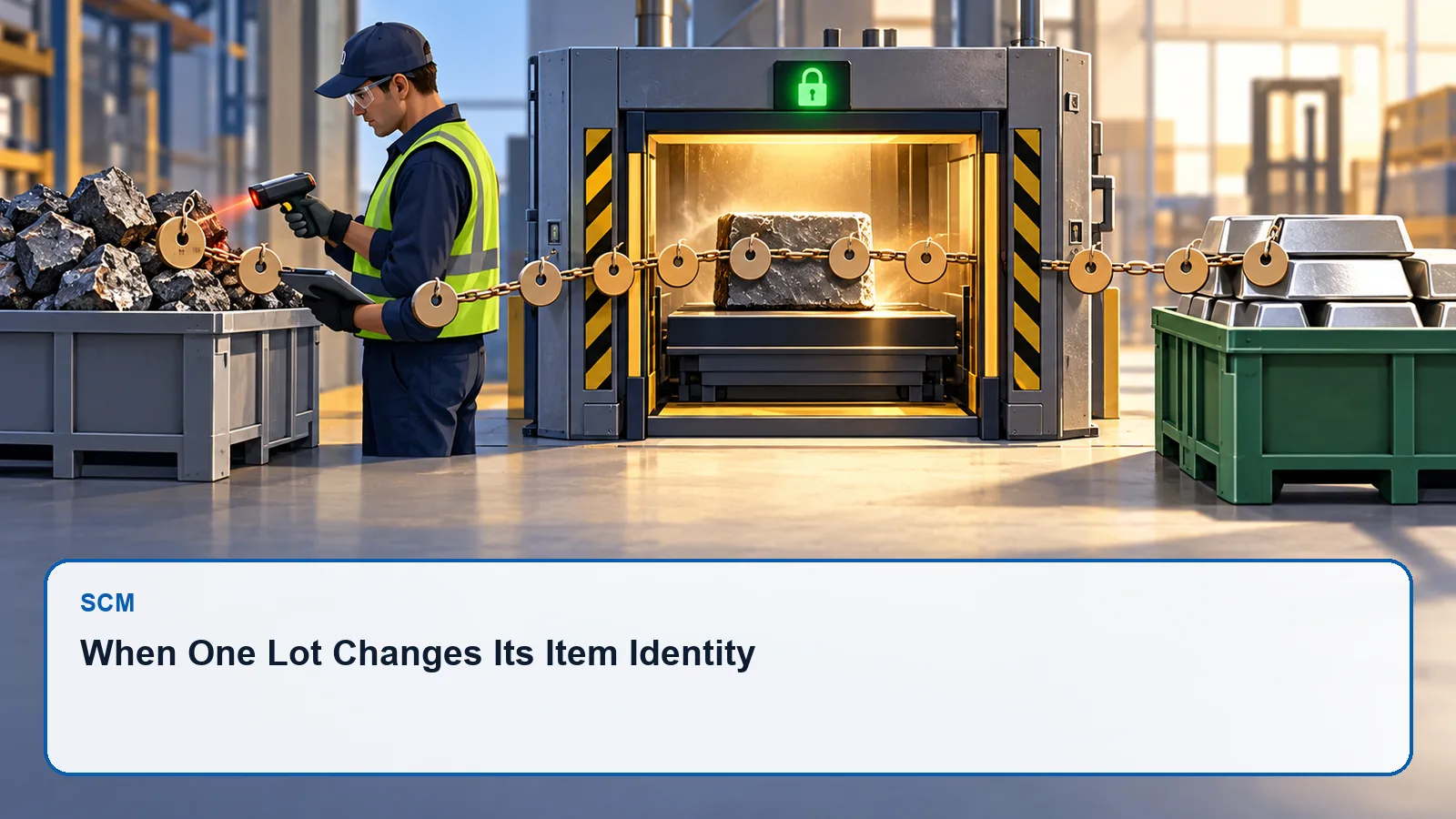
A quality decision can change what inventory is without erasing where it came from. A batch initially classified as premium may be downgraded after testing, aged material may become a different saleable product, or a receipt may have been assigned to the wrong item. Fusion SCM Training should frame this as an identity-change problem, not a routine move. The physical stock may remain in the same building while its item number—and sometimes its lot number—changes. A dedicated item-translation transaction makes that conversion explicit. It issues the source identity, receives the resultant identity, and maintains a traceable relationship instead of asking users to improvise with unrelated miscellaneous transactions. The design challenge is deciding exactly which quantity, controls, and attributes should cross that boundary.
A Downgrade Is Not a Bin Transfer
Picture a food ingredient lot awaiting laboratory results. Most of the batch meets the specification for Item A, but a divisible portion qualifies only for Item B. Moving that portion to another subinventory would change location, not identity. Adjusting Item A down and Item B up through separate entries might produce the desired totals, yet it would obscure their relationship and invite mismatched quantities. Translation expresses the business event directly: selected on-hand from the source lot becomes a target item, with a resultant lot where required. That semantic difference matters to investigations. Months later, a reviewer can follow the conversion rather than infer it from two transactions that happen to share a date, quantity, or comment.
Three Forms of Translation
The action can support a lot-only change, an item-only change, or a combined item-and-lot change when the user holds both item-translate and lot-translate privileges. Lot-only work retains the familiar purpose of correcting or replacing a lot identity. Item-only work changes the item while retaining the applicable lot. The combined form changes both sides in one controlled submission. Users who possess only the lot-translate privilege continue to see the lot translation action; item-translate privilege by itself does not provide a usable translation action. This privilege pairing is not an incidental security detail. It ensures that someone authorized to alter item identity also has authority over the lot continuity needed to execute and record that alteration coherently.
Oracle 26D What's New describes Translate Item on desktop through the Lots tab of Item Quantities and the lot-and-serial view, while mobile users can work through the Lot Transactions task. The source area presents the current item, lot, available quantity, unit, subinventory, and lot details. In the resultant area, the user selects the target item, keeps or supplies a resultant lot as the scenario permits, enters quantity and location, and completes controlled attributes such as parent lot, grade, status, or expiration data. The action replaces the separate Translate Lot choice for a user holding both privilege families. That behavior should be included in training, because two testers with different roles may legitimately see different labels and capabilities on the same record.
Quantity Rules Shape the Decision
Translation begins with eligible on-hand quantity. A lot with no on-hand cannot be translated, and the requested amount must be available. Divisible lot-controlled items may allow a partial or full source quantity; indivisible items require the full source quantity. A partial conversion needs special care because source and resultant stock coexist after the event. The resultant lot must not simply reuse the source lot for that partial translation. For a full lot held in a license plate, the same license plate is retained for the resultant lot. These are not arbitrary form restrictions. They preserve an understandable physical story: which units remained under the old identity, which crossed into the new one, and which container continued to hold the wholly converted material.
Units and control combinations add another layer. The user can work with available primary, transaction, or dual units, with the relevant conversion applied between source and resultant items. For lot-and-serial controlled material, item-only translation is limited to the full source-lot quantity; partial and combined item-and-lot translations are not supported, and serial quantities must be whole numbers. Child-lot items require a parent lot for the resultant child. Grade- or status-controlled targets require those values, while user-defined expiration control requires expiration information. Under shelf-life control, expiration defaults according to the target item's shelf-life rules and origination date. A test script should branch by these item characteristics instead of treating every lot as interchangeable.
Run the Quality-Disposition Scenario
Use a compact scenario matrix for validation. First, translate an entire divisible lot from Item A to Item B while retaining the eligible lot and subinventory. Second, translate only part of another lot and generate a distinct resultant lot. Third, try an indivisible item with less than the full quantity and confirm rejection. Fourth, use a child-lot target and verify the parent requirement. Fifth, test grade, status, and expiration attributes on a controlled target. Add a mobile execution for the warehouse role and a desktop execution for the inventory specialist. After each submission, inspect source reduction, resultant availability, lot lineage, units, location, and any container relationship. A passing page message alone is too narrow to prove a correct conversion.
The human checkpoint belongs before submission. The operator should verify the quality disposition, source lot, convertible quantity, target item, and whether a new resultant lot is required. A second review is sensible for regulated or high-value material because translation changes the identity used by allocation, costing, labeling, and downstream reporting. Teams should also define when not to translate. A mere relocation calls for a transfer; a quantity correction calls for the appropriate adjustment; repackaging may call for a container transaction. Choosing translation only when item or lot identity truly changes keeps lineage meaningful. Otherwise, a powerful transaction becomes a generic shortcut and the transaction history loses its ability to explain the physical event.
Access Must Match the Working Surface
Custom roles need the newly delivered item-translation privilege for the intended interface and the corresponding existing lot-translation privilege. Responsive desktop and mobile surfaces have distinct privilege codes, so granting one route does not automatically prove the other. Build role tests around tasks, not job titles: who may perform a desktop conversion, who may execute it at the point of work, and who may only correct a lot. Then test negative cases. An item-only privilege should not expose a translation action, while a lot-only user should retain lot translation without gaining item conversion. This negative evidence is useful during security review because it confirms the role prevents unauthorized identity changes rather than merely allowing authorized ones.
Conclusion
Item translation gives a quality or classification decision a transaction that matches its meaning. The source lot supplies eligible on-hand, the resultant item receives the converted quantity, and lineage remains available without stitching together unrelated adjustments. Successful adoption depends on respecting divisible and indivisible quantities, serial limitations, target controls, resulting lot choices, and interface-specific privileges. It also depends on teaching operators to distinguish identity change from movement, correction, and repacking. A strong Oracle Fusion SCM Training exercise follows one lot from disposition evidence through submission and then verifies both remaining source stock and resultant stock. That end-to-end view turns a new action into a governed conversion process rather than another menu choice.