
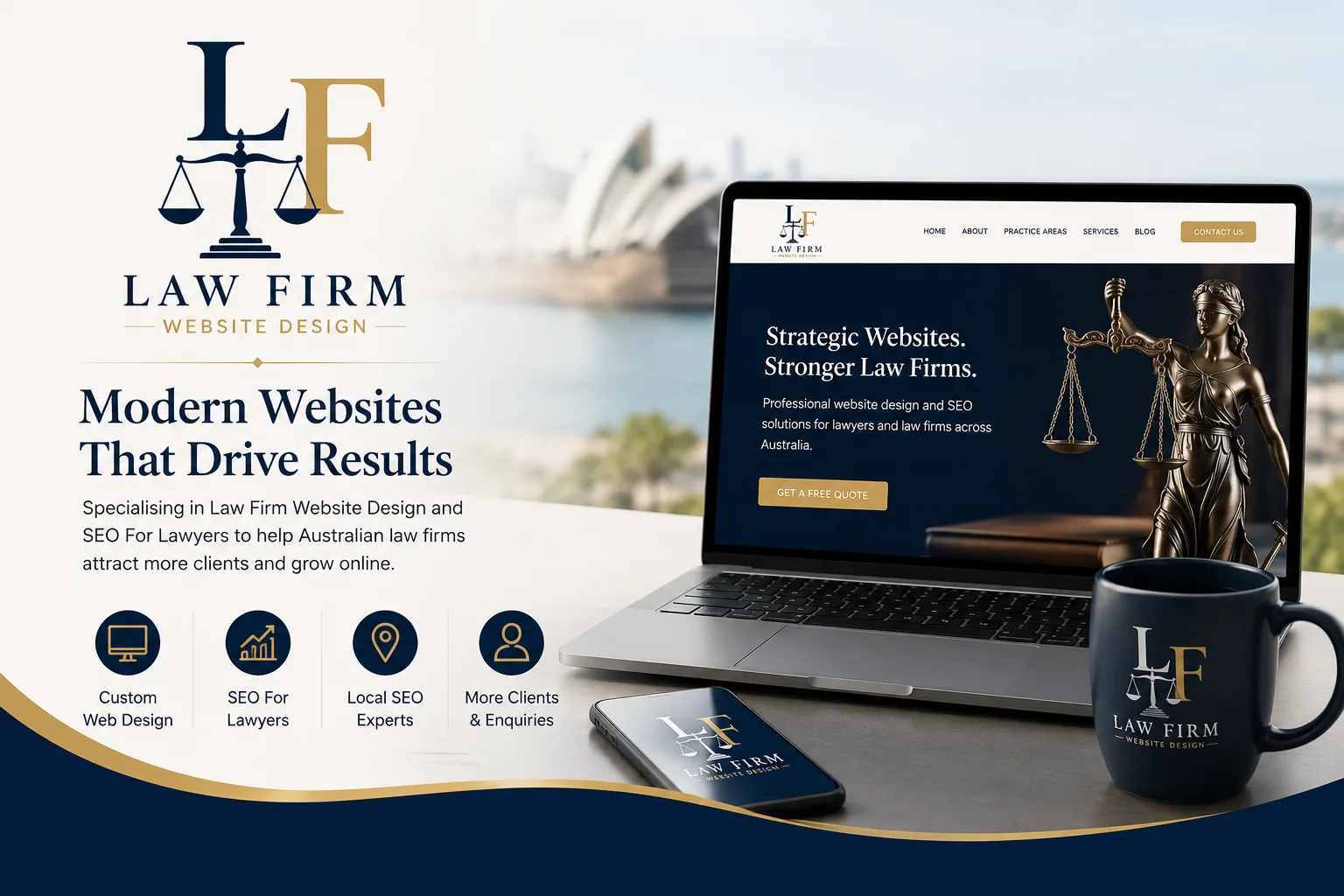
A law firm's website is no longer just an online business card. For many prospective clients, it is the first place they go to understand a firm's services, assess whether the firm appears trustworthy and decide whether to make an enquiry.
That makes law firm website design about much more than colours, images and layouts. A successful website needs to combine clear communication, intuitive navigation, mobile usability, useful content, strong technical foundations and an experience that makes it easy for potential clients to take the next step.
For Australian law firms, there is another important consideration: the website needs to communicate the firm's areas of practice and service locations clearly while avoiding generic content that could apply to almost any legal business.
So, what should a modern law firm website actually include?
1. A Homepage That Makes the Firm's Services Immediately Clear
A visitor should not need to read several paragraphs before understanding what your firm does.
The homepage should quickly communicate:
- The firm's main areas of practice
- The locations it serves
- Who it helps
- What makes the firm different
- How a potential client can get in touch
Instead of filling the first screen with vague statements such as "We provide exceptional legal solutions", use clear language that tells visitors what the firm actually does.
For example, a family law firm could immediately identify its focus on separation, parenting arrangements, property matters and related legal services.
Clarity helps people make decisions faster and also gives search engines useful context about the page.
2. Practice Area Pages Built Around Real Client Questions
One of the most valuable improvements a law firm can make is creating dedicated pages for important legal services.
Rather than placing every service on one large page, consider creating individual pages where there is enough useful information to justify them.
For example:
- Family law
- Criminal law
- Employment law
- Commercial law
- Property law
- Personal injury
- Wills and estates
Each page should explain what the service involves, who may need it, what issues commonly arise and what someone should consider before contacting a lawyer.
This is much more useful than creating a short page containing a service name and a few paragraphs written purely around keywords.
Google specifically recommends creating helpful, reliable content for people rather than content designed primarily to attract search traffic.
3. Design for Mobile Users First
A potential client may discover a law firm while using a smartphone and expect the website to work immediately.
A Responsive Law Firm Website should provide a smooth experience across phones, tablets and desktop computers.
That means:
- Navigation should be easy to use
- Text should be comfortable to read
- Buttons should be easy to tap
- Forms should work properly on smaller screens
- Images should not unnecessarily slow pages down
- Important contact details should remain easy to find
Mobile usability should be treated as part of the overall user experience rather than as a separate SEO exercise.
4. Make Contacting the Firm Simple
A visitor who decides to contact a lawyer shouldn't have to search for a phone number or navigate through multiple pages to find an enquiry form.
Useful calls to action might include:
- Request a Consultation
- Call the Office
- Make an Enquiry
- Speak With Our Team
The right wording depends on the firm's actual intake process.
The important thing is that the CTA should be clear and relevant to where the visitor is in their journey.
For example, a service page could end with a simple invitation to discuss the person's situation rather than using the same generic button everywhere.
5. Show Who Is Behind the Firm
Legal services are built around trust.
Potential clients often want to know who they will be dealing with before making an enquiry. A well-developed team section can therefore be an important part of Website Design for Australian Law Firms.
Individual lawyer profiles can include relevant information such as:
- Qualifications
- Areas of practice
- Professional experience
- Relevant memberships
- Languages spoken
- Professional background
Avoid filling profiles with exaggerated claims. Specific, verifiable information is generally more useful than generic statements about being "the best" or "leading".
For legal websites in particular, demonstrating genuine knowledge and experience is more valuable than simply increasing the amount of content on the page.
6. Build Trust With Evidence, Not Empty Claims
A modern legal website should give visitors reasons to trust the firm.
Depending on what can appropriately be disclosed, useful trust elements may include:
- Lawyer profiles
- Firm history
- Relevant qualifications
- Client testimonials
- Recognised memberships
- Awards where genuinely applicable
- Published insights
- Office information
- Clear contact details
The key is authenticity.
Instead of saying:
"We are Australia's leading legal experts."
Explain what the firm actually does, who it assists and what relevant experience the team has.
This creates stronger content for people and avoids relying on unsupported marketing language.
7. Create Helpful Content Around the Client Journey
A law firm's blog should not exist simply because "every website needs a blog."
It should answer questions potential clients genuinely have.
For example:
Before contacting a lawyer:
- Do I need legal advice?
- What information should I prepare?
- What questions should I ask during an initial consultation?
During a legal matter:
- What documents may I need?
- What are the next steps?
- What factors can affect the process?
After receiving advice:
- What should I consider before making a decision?
- What questions should I ask my lawyer?
This type of content can introduce prospective clients to the firm before they are ready to make an enquiry.
Google's latest guidance for generative AI Search specifically encourages unique, valuable, non-commodity content rather than content that simply repeats information already available everywhere.
8. Use Internal Links to Connect Related Information
Internal linking is often overlooked during a website redesign.
Imagine a firm publishes an article explaining the basics of property settlements. That article could naturally link to the firm's relevant family law service page.
Likewise, a lawyer profile could link to the practice areas that lawyer works in.
This creates a logical pathway:
Helpful article → Practice area → Lawyer profile → Contact page
It also helps search engines discover and understand relationships between pages. Google's Search Essentials specifically recommends making links crawlable so Google can find other pages on a website.
9. Give Every Important Page a Clear Purpose
Not every page needs to rank for a separate keyword.
A better approach is to ask:
What does this page help the visitor accomplish?
For example:
- Homepage → Understand the firm
- Practice area page → Understand a service
- Lawyer profile → Understand who may assist
- Location page → Understand where the firm operates
- Article → Answer a specific question
- Contact page → Make an enquiry
This prevents websites from becoming collections of repetitive pages created mainly for search engines.
It also aligns with Google's current position that there is no ideal page length or requirement to break content into artificial "AI-friendly" chunks. Pages should be structured according to what is useful for the audience.
10. Local Information Should Be Genuine and Useful
For firms serving particular Australian cities or regions, location information can help prospective clients understand where the practice operates.
However, creating dozens of almost identical suburb pages simply by changing the location name is unlikely to provide much value.
A useful location page should contain genuinely relevant information, such as:
- Where the office is located
- Areas served
- Relevant local context
- How clients can reach the office
- Services available from that location
The objective should be to help someone who is actually looking for legal assistance in that area, not to create pages for every possible suburb.
11. Keep the Website Technically Healthy
Good Law Firm Web Design also depends on what happens behind the scenes.
Important technical foundations include:
- HTTPS
- Crawlable links
- Descriptive URLs
- Logical page hierarchy
- XML sitemap
- Proper indexing controls
- Mobile compatibility
- Optimised images
- Good Core Web Vitals
- Appropriate structured data where relevant
Technical SEO doesn't replace useful content, but technical problems can make good content harder for search engines and users to access.
Google's current documentation continues to recommend foundational SEO practices for both traditional Search and AI-powered Search.
12. Don't Ignore Website Speed
A website can look impressive and still provide a poor experience if pages take too long to load.
Law firms should pay attention to:
- Large images
- Unnecessary animations
- Excessive third-party scripts
- Poor hosting performance
- Unoptimised fonts
- Heavy plugins
- Mobile loading times
Core Web Vitals can help identify issues relating to loading performance, responsiveness and visual stability.
The objective isn't to chase a perfect score for its own sake. It is to make the website faster and easier to use.
A Practical Website Checklist for Australian Law Firms
Before launching or redesigning a website, review these areas:
Content
- Are the firm's main services clearly explained?
- Does every important page have a useful purpose?
- Is the content written for real clients?
- Does the website demonstrate genuine knowledge and experience?
User experience
- Is the website easy to navigate?
- Does it work well on mobile?
- Can visitors quickly find contact information?
- Are calls to action clear?
SEO
- Are important pages indexable?
- Are internal links logical?
- Are titles and headings descriptive?
- Are URLs understandable?
- Is the sitemap working correctly?
Trust
- Are lawyer profiles informative?
- Is firm information accurate?
- Are claims supported by evidence?
- Is contact information easy to verify?
Technical performance
- Is HTTPS enabled?
- Are images optimised?
- Are important pages loading efficiently?
- Are there broken links or unnecessary redirects?
What Should a Law Firm Avoid?
A modern website should avoid several common mistakes:
Keyword stuffing: Repeating phrases such as "Law Firm Website Design" unnaturally can make content harder to read.
Thin location pages: Creating dozens of nearly identical pages for suburbs adds little value.
Generic AI content: Publishing large quantities of automatically generated articles without adding original value can create quality and spam-policy risks.
Over-designed interfaces: Animation and visual effects should never make essential information harder to access.
Hidden contact details: Don't make potential clients hunt for your phone number or enquiry form.
Unsubstantiated claims: Avoid statements that cannot be demonstrated or supported.
Ignoring existing URLs: During a redesign, changing URLs without properly mapping and redirecting old pages can cause avoidable SEO problems. Google's current migration guidance recommends preparing a URL map and implementing appropriate redirects when URLs change.
The Bottom Line
The best Law Firm Website Design isn't necessarily the website with the most pages, the most keywords or the most impressive animations.
It is the website that helps the right people find the right information and confidently take the next step.
For Australian law firms, that means combining a clear brand and professional presentation with useful service pages, genuine expertise, mobile-friendly design, strong technical foundations and a straightforward client journey.
Search is becoming more conversational and AI-powered, but that doesn't mean the fundamentals should be abandoned. Google's current guidance is clear: create valuable content for people, make your website technically accessible, and give visitors something genuinely useful.
When those principles are built into the website from the beginning, SEO becomes part of the overall user experience rather than something added after the design is finished.