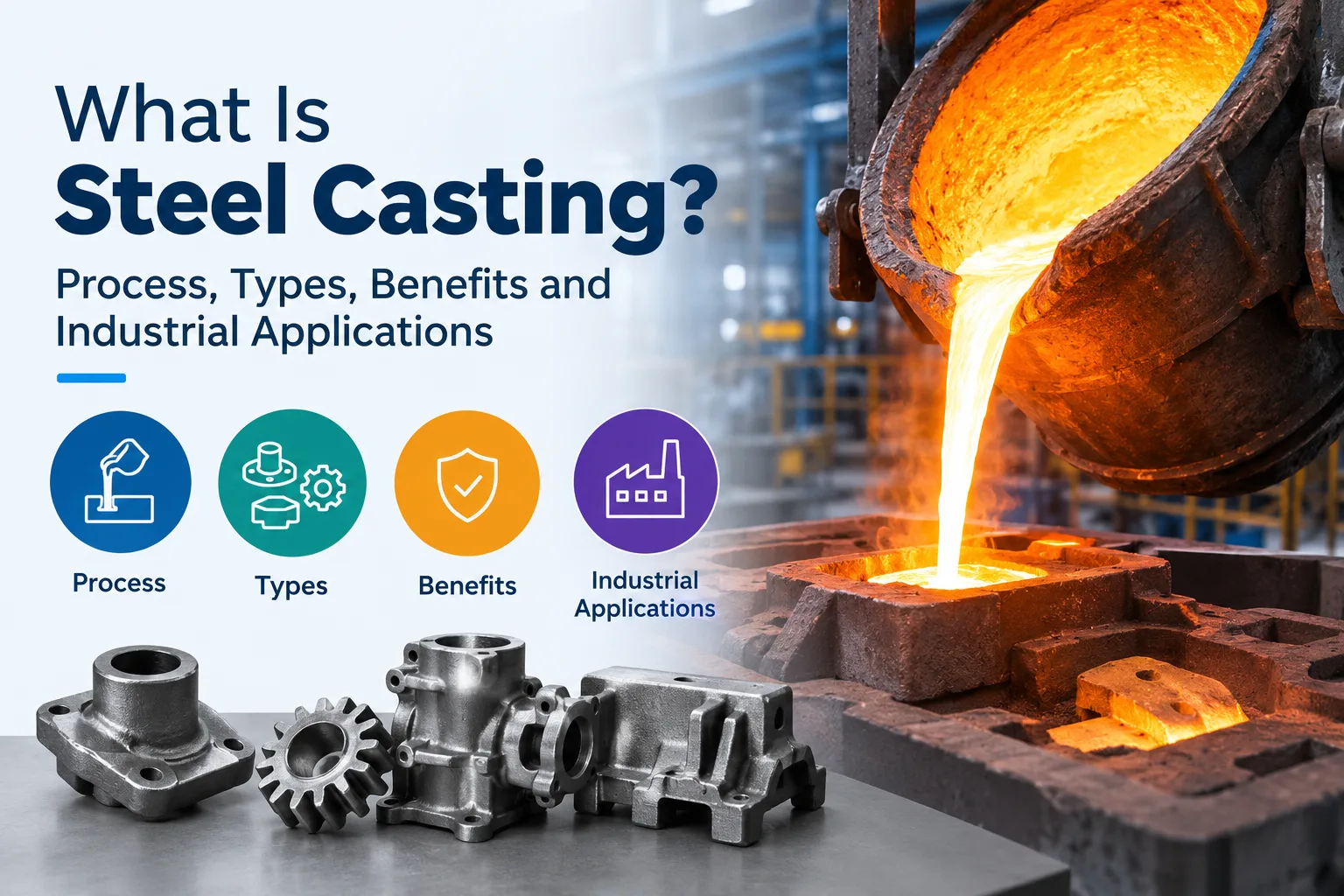
Steel casting is a significant manufacturing process that creates high-quality, durable, and complicated parts for various industries. This method generally consists in casting molten metal in a mould, where it takes the shape of this mould and is then cooled and solidified.
Steel castings are used in many fields such as heavy machinery, transport equipment, pumps, valves, construction machinery, and other industries. The process allows manufacturers to get parts of complex shapes and sizes in due time.
In this article, we will provide you with information on the definition, process, types, benefits, and applications of steel casting.
What Is Steel Casting?
Steel casting may be defined as a manufacturing process in which steel is melted and poured into a mould. Once the metal has solidified, the steel casting is removed from the mould.
The process is particularly advantageous for complex shapes, large parts and those requiring high strength, and varying levels of thickness. A variety of steels can be used depending on the desired properties and performance criteria.
Steel casting is typically applied when an object needs to take a specific shape or form that could not be easily achieved through other manufacturing processes.
How Does the Steel Casting Process Work?
Steel casting involves several important steps to ensure the final component meets the required specifications.
1. Engineering Design and Planning
The process begins with reviewing the component drawing, dimensions, material requirements, and intended application. Engineers determine the appropriate casting method and mould design.
2. Mould Preparation
A mould is made up of the required shape of the component. Sand moulds are normally used for most of the steel casting processes. The mould should have the required elements for the pouring of molten metal and also to allow for the escape of gases.
3. Steel Melting
Steel is heated in a suitable furnace until it reaches the required molten condition. The chemical composition and temperature are controlled according to the selected steel grade and manufacturing requirements.
4. Pouring Molten Steel
The molten steel is carefully poured into the prepared mould. Proper pouring practices help reduce the risk of defects and ensure the mould fills correctly.
5. Cooling and Solidification
The steel cools inside the mould and solidifies into the required shape. Cooling conditions influence the final structure and properties of the casting.
6. Mould Removal and Cleaning
After sufficient cooling, the casting is removed from the mould. Excess material, such as gates and risers, is removed, and the surface is cleaned.
7. Heat Treatment and Machining
Depending on the requirements for parts, heat treatments can be performed to improve the mechanical properties of metals. In addition, machining may be necessary to achieve the desired shape, dimensions, tolerances, and surface finish.
8. Quality Inspection
The finished casting is inspected to verify dimensions, surface condition, and compliance with applicable specifications. Additional testing may be performed depending on the component's intended use.
What Are the Different Types of Steel Casting?
Different casting methods are selected based on component size, shape, production quantity, dimensional requirements, and cost.
1. Sand Casting
Sand casting uses a mould made primarily from prepared sand. It is suitable for producing a wide range of steel components, including large and heavy industrial parts.
Common applications: Heavy machinery, pump housings, industrial equipment, and engineering components.
2. Investment Casting
Investment casting, also known as the lost-wax process, uses a wax pattern to create a ceramic mould. The wax is removed, and molten steel is poured into the resulting cavity.
This method is useful for producing complex shapes with fine details and good surface finish.
Common applications: Precision engineering components, intricate parts, and specialised industrial components.
3. Centrifugal Casting
Centrifugal casting is a process that involves a rotating mould in which the metal is placed and spun at a high speed. This technology is appropriate for specific cylindrical shapes or rotatory parts.
Common applications: Pipes, sleeves, rings, and selected cylindrical industrial parts.
The best casting method depends on the component design, material requirements, production volume, and quality specifications.
Key Benefits of Steel Casting
Steel casting offers several advantages for industrial manufacturing.
1. Design Flexibility
Steel casting can produce complex shapes and various products with different sizes and dimensions. It can be used for special purpose parts and machines with highly complex shapes.
2. Strength and Durability
Steel castings can provide the strength and durability needed for demanding applications when the appropriate grade, design, and processing methods are selected.
3. Wide Material Selection
Manufacturers can use different steel grades, including carbon steel, alloy steel, and stainless steel, depending on the component's operating conditions.
4. Suitable for Large Components
Casting can be used to manufacture large and heavy components that may be difficult to produce using certain alternative manufacturing processes.
5. Reduced Material Waste in Suitable Designs
Casting can produce components close to their required shape. This may reduce machining requirements and material waste, depending on the design and finishing needs.
6. Multiple Industrial Applications
Steel castings can be designed for applications that require specific combinations of strength, wear resistance, toughness, and other mechanical properties.
Industrial Applications of Steel Casting
Steel casting is used across several industries because of its design flexibility and material options.
Automotive and Transportation
Steel castings can be used in selected vehicle and transportation components where strength, durability, and design requirements are important.
Pumps and Valves
Industrial pumps and valves may use steel castings for bodies, housings, and other components exposed to demanding operating conditions.
Construction and Heavy Equipment
Construction and earthmoving machinery may require cast steel components designed to withstand heavy loads and challenging working environments.
Mining and Mineral Processing
Mining equipment can use selected steel castings in applications where wear resistance, strength, and durability are important.
General Engineering
Industrial machinery, processing equipment, and specialised engineering systems may use steel castings to meet particular component design requirements.
Power and Industrial Plants
Certain power generation and industrial processing applications use cast steel components selected to meet the relevant operating temperature, pressure, and material requirements.
How to Choose the Right Steel Casting Manufacturer
Selecting a suitable manufacturer is an important step in achieving consistent component quality.
Before choosing a supplier, consider the following factors:
- Material expertise: Ensure the manufacturer is familiar with the required steel grade.
- Manufacturing capabilities: Check what casting methods and component sizes the manufacturer can apply.
- Quality control: Learn about the manufacturer’s inspection and testing practices for components.
- Machining facilities: Ensure the supplier can perform the required finishing and machining.
- Technical support: Choose a manufacturer that can read your drawings and technical specifications.
- Production requirements: Make sure the supplier can adapt to your demands for components and orders.
Clear communication about drawings, material grades, tolerances, inspection requirements, and intended applications helps manufacturers evaluate the project accurately.
Also Check - Which is the Best Steel Casting Foundry in India?
Conclusion
Steel casting is a multifaceted manufacturing process that involves creating complex, strong, and durable parts through various casting methods. Be it sand casting or investment casting, each method has its own benefits depending on the complexity of the desired shape, size, materials, and quality.
Therefore, it is important to understand casting processes, materials, quality and applications in order to make the right choice for manufacturing purposes.
If you are looking for steel casting solutions for industrial or engineering applications, explore Adithya Tech Force steel casting capabilities to learn more about its services and manufacturing expertise.
Frequently Asked Questions
1. What is steel casting used for?
Steel casting is applied to produce parts for heavy machinery, pumps, valves, construction machinery, mining equipment and engineering machines.
2. What are the main types of steel casting?
Common methods include sand casting, investment casting, and centrifugal casting. The appropriate method depends on the component design and manufacturing requirements.
3. What is the difference between steel casting and forging?
The process of steel casting involves melting the metal and pouring it into a mould. Forging is a process of shaping metal by applying compressive forces. Both methods have their own benefits, and the choice between them depends on the required properties and geometry of the part, as well as the conditions of its operation.
4. Which steel grades are used for casting?
The materials for casting include carbon steel, alloy steel, and stainless steel. The choice of material depends on the strength, impact resistance, temperature resistance and corrosion resistance required for the parts, as well as the technology used.
5. How is steel casting quality checked?
Quality checks may include visual inspection, dimensional measurement, chemical analysis, mechanical testing and non-destructive testing, depending on the applicable specifications and component requirements.