For a long time, picking a softphone came down to comparing much the same product from one vendor to the next. Whose call quality edged ahead, who was cheaper, which devices it supported. Every option did the same core job, connect a call, and the choice was really about who did it a little better.
That's shifting now, and meaningfully. A new kind of softphone has arrived that doesn't simply do the old job better, it does things the old kind couldn't do at all. So instead of another head-to-head on audio quality, here's a look at what genuinely changes when a softphone has AI built in, and why it's an upgrade worth paying attention to.
What is an AI-powered softphone?
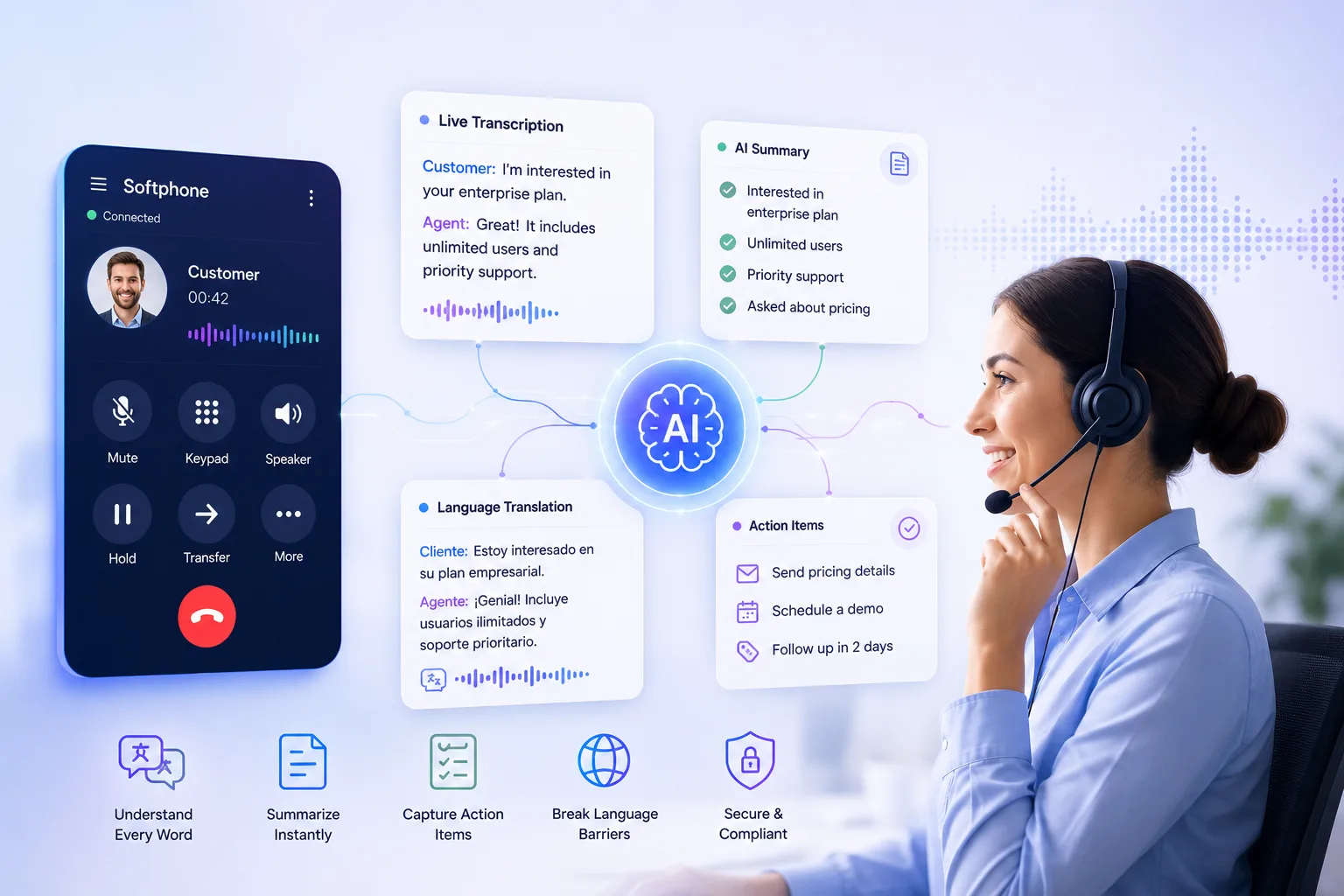
An AI-powered softphone is a calling app that works with what's said on a call, not just carries it. Alongside making and receiving calls, it can translate speech between languages in real time, display a live transcript in the reader's own language, summarize the call once it ends, and turn conversations into searchable records. A traditional softphone connects people. An AI softphone connects them and captures and understands what they said.
The simplest way to put it: a traditional softphone gives you a clean line and gets out of the way, while an AI softphone stays on the line and turns the conversation into something you can use.
You don't give anything up to gain this
Worth saying right at the start, because it's the reassuring part. Moving to an AI softphone doesn't mean trading away what made your current one work.
Reliable calling remains the foundation. Clear audio, calls that connect every time, the workflow your team already knows, all of it stays exactly as it was. The AI is a layer added on top, not a swap of what sits underneath. So this isn't a risk where you gamble the basics to chase clever features. You keep the dependable phone you have and gain a whole new set of capabilities alongside it. That's what makes it an upgrade rather than a leap of faith.
Here's what that added layer actually delivers.
Speaking your customer's language, whatever it is
This is the standout change, and for many businesses it's genuinely transformative.
With a traditional softphone, a customer speaking a language your team doesn't leaves you hiring multilingual staff or paying for interpreters, both slow and expensive. An AI softphone translates the conversation live, in both directions, as people speak. Each person uses their own language and hears the other in theirs. Tragofone's AI softphone, for example, handles real-time translation across 70+ languages, detects the spoken language on its own, and remembers a contact's language for the next call. A staffing headache turns into a feature you simply switch on.
How it works in practice: the translation runs on the side of whoever starts the call, on a desktop or web app where the processing lives. The person on the other end can be on a phone, a laptop, or an ordinary phone line, and it works smoothly, since their device isn't doing the translating.
Reading a call, not just listening to it
A traditional softphone gives you audio and little else. If you want a record, you record the call and replay it later.
An AI softphone turns the conversation into text as it happens, and importantly, in the language you read rather than the one spoken. A transcript in a language you don't understand isn't much help. One in your own language, appearing live, is a different thing entirely. It generally works in three ways: live speech-to-speech translation for the conversation itself, a live on-screen transcript in your language, and the option to translate a saved transcript into any language afterward. None of that exists on a traditional softphone.
A summary instead of a recording to sit through
Anyone who's had to review calls knows the tedium of scrubbing through audio for the one line that mattered.
An AI softphone writes a summary the moment the call ends: what was discussed, what was agreed, what comes next. You read the essentials in seconds instead of replaying the whole thing. And since the transcript is searchable, tracking down "what did we promise that client back in spring" becomes a quick search rather than a hunt through recordings. For any team that follows up on commitments, that's real time saved every week.
Conversations that keep working for you
This is the quieter, longer-term benefit. Ordinarily, everything said on a call vanishes once it ends, unless someone wrote it down. The knowledge stays locked in people's heads and in recordings no one revisits.
An AI softphone treats conversations as data: transcribed, summarized, searchable, translatable. Over months, your calls become a searchable body of knowledge you can learn from, rather than a string of events that happened and then disappeared. That move, from conversations that evaporate to conversations that keep paying off, is the deeper value underneath the headline features.
What you need to doTraditional softphoneAI-powered softphoneTalk to customers in another languageHire multilingual staff or interpretersLive AI translation across 70+ languagesSupport global teamsLanguage gaps slow things downLive voice and transcript translationReview a callListen to the recordingRead a summary in secondsFind what was promisedScrub through the audioSearch the transcriptCapture next stepsTake notes by handAction items captured automaticallyDocument multilingual callsTranscript only in the spoken languageTranscript in each reader's languageComplianceDepends on the vendorBuilt around GDPR, HIPAA, SOC 2
Who gains the most?
Almost any business stands to benefit, and the value tends to show up fast.
Deal with customers across languages and an AI softphone is transformative, turning a staffing challenge into a setting you enable. Have a team that reviews calls or chases follow-ups, and the summaries and searchable transcripts hand back real hours. Work in a regulated industry, and built-in documented, searchable, compliance-ready records are a genuine advantage.
The businesses that gain most are the ones where communication sits at the center: call centers, multilingual customer bases, distributed teams, and regulated industries. For all of them it's an operational edge that compounds over time, gained without giving up the reliable calling they already rely on.
The bottom line
Comparing softphones on call quality and price alone no longer captures the full picture. A traditional softphone and an AI-powered one aren't two versions of the same product anymore. One connects your calls. The other connects them and puts every conversation to work for you.
And the best part is that it costs you nothing you already have. An AI softphone keeps the reliable calling and familiar workflow you depend on, and adds a layer that translates, captures, and organizes your conversations on top. For any business where communication drives the work, that's not a minor upgrade, it's a real and lasting advantage.