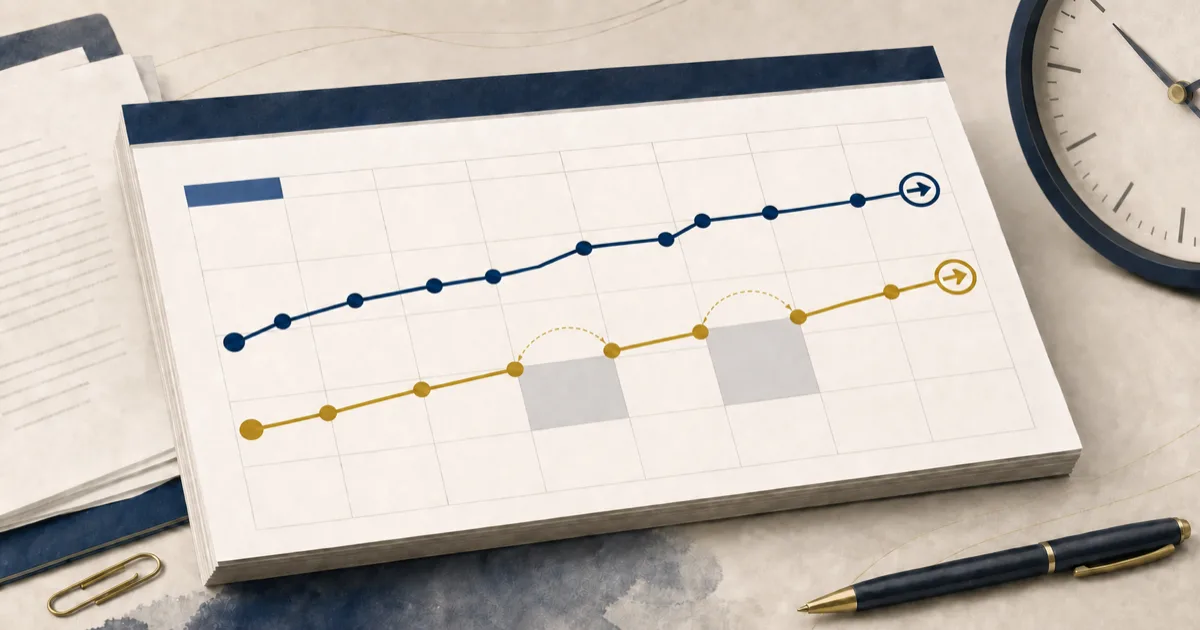
The arithmetic in a court-deadline calculation is usually the easy part. Adding or subtracting a number of days takes seconds. The harder work comes first: identifying the event that starts the clock, the unit to count, the direction to travel, the dates to skip, and any service rule that changes the result.
Building a transparent California court-date calculator required us to model that sequence explicitly. Our rule model keeps the trigger date, court-day or calendar-day unit, forward or backward direction, and service method separate. If any one of those inputs is wrong, perfectly executed arithmetic can still produce the wrong date.
Start with the event the rule names
The most familiar date is not necessarily the legally controlling trigger. A person may remember when a document arrived, while the applicable statute, rule, order, or notice may run time from a hearing, filing, service-completion, or another specified event. The first useful step is therefore to copy the triggering event and date from the controlling source rather than reconstruct it from memory.
California Code of Civil Procedure section 12 supplies the general counting convention: exclude the first day and include the last, unless the last day is a holiday. That is a general rule, not permission to skip the deadline-specific text. A more specific statute may prescribe a different method.
This distinction affected the calculator’s design. A trigger date is preserved as an input, and the counting trace shows that the first day is not counted. The point is not to make a simple subtraction look complicated. It is to make the legal assumption behind day one visible.
Court days and calendar days are different units
A calendar-day period runs through every date in sequence, including weekends and holidays. A court-day count skips weekends and applicable judicial holidays during the count. Consequently, 16 court days will usually cover more calendar time than 16 calendar days.
Holiday treatment also requires a current source. Section 12a addresses a period whose last day is a holiday and, unless another law controls, extends the period through the next day that is not a holiday. The official California Courts 2026 holiday schedule says the courts will be closed on 14 listed dates in 2026. That is the holiday schedule verified for this article; it is not a reverification of holiday data for 2025 or 2027.
Even a current statewide list has limits. A local closure, emergency order, department instruction, or case-specific order may affect the practical filing calendar. The relevant court’s current calendar still needs to be checked.
Direction changes the landing analysis
A forward count and a backward minimum-notice count do not necessarily adjust in the same direction. Suppose a forward calculation produces Saturday, July 11, 2026, as its provisional last day. If section 12a applies, the period can extend forward to Monday, July 13—the next court day in this example.
Now take a neutral backward illustration: counting five calendar days back from Thursday, August 27, 2026, produces Saturday, August 22. Where a governing deadline requires an act no later than a stated number of days before an event, moving forward to Monday would reduce the required interval. The supported calculator behavior moves earlier, to Friday, August 21—the prior court day in this example.
The attribution matters. Section 12c directs backward counting for an act due no later than a specified number of days before a hearing, excludes the hearing day, and directs that service-method days be counted backward from the initially determined day. Read together with deadline-specific “at least” or “no later than” language, that method can require an earlier date. Section 12c, standing alone, should not be described as creating a universal holiday-to-prior-court-day rule.
Service extensions can mix units
Service rules show why one generic “add two days” switch is unsafe. For regular noticed-motion moving papers, CCP § 1005(b) ordinarily requires service and filing at least 16 court days before the hearing. Service by facsimile, express mail, or another overnight-delivery method increases that notice period by two calendar days.
For summary-judgment moving papers, CCP § 437c(a)(2) ordinarily requires at least 81 days’ notice. The same listed overnight methods increase that period by two court days. The number is the same, but the unit is not.
Electronic service adds another bounded rule. Where applicable, section 1010.6(a)(3)(A)–(C) makes service complete on transmission or notification and generally extends a prescribed notice period, right, or duty by two court days. But the extension does not extend the time for filing a notice of intention to move for a new trial, a notice of intention to move to vacate a judgment under section 663a, or a notice of appeal. A more specific statutory or court-rule exception also controls. “Where applicable” is essential; the electronic-service extension is not universal.
Transparency is part of the calculation
That approach shaped DeadCal, a California court-date calculator that exposes each counting step rather than returning only a date.
For supported calculations, the result records skipped dates, shows landing adjustments and service-extension steps, and connects configured rules to primary-source citations. The interface displays verification dates and the holiday file’s coverage period. The engine also warns when a count touches dates outside that coverage instead of silently treating the holiday list as complete.
Those features do not turn a calculator into a court or a legal adviser. They create an audit trail: a reader can see the assumptions, compare them with the governing source, and identify where more verification is needed.
The five questions to ask before relying on a date
- What event legally starts the clock?
- Are the days court days or calendar days?
- Which weekends and judicial holidays are excluded?
- Which direction and landing adjustment apply?
- Does the service method or a local/case-specific rule change the result?
This article is educational information, not legal advice. Before acting on a calculated date, check the current statute, applicable statewide Rules of Court, local rules, the permitted service method, the applicable electronic-filing cutoff, the relevant court calendar, and every case-specific order.