Introduction
If anything, 2026 has made Oracle Fusion Financials a more competitive field to break into, not a less relevant one Cloud ERP migration hasn't slowed down, and neither has the sophistication of the interviews built around it. Soft Online Training has been paying close attention to what's actually being asked in interviews this year, and the pattern is unmistakable: candidates who can only recite textbook definitions are getting left behind by ones who can genuinely reason through a scenario.
Whether you're fresh out of college, transitioning from another finance role, or a few years into an ERP career already, today's interviewers are testing something broader than software familiarity they want real command of the modules, the accounting logic underneath them, complete business workflows, and the judgment to apply all of it when a project hits a snag. This piece walks through the questions coming up most often right now, and how solid Oracle Fusion Financials Online Training actually prepares you to handle them.
Why Preparing Properly Still Matters
Oracle Fusion Financials interviews are designed to probe both technical depth and problem-solving instinct at the same time. Recruiters want evidence that you can interpret business requirements, navigate modules with real confidence, and communicate clearly with clients and project teams not just pass a trivia round. Genuine preparation builds the kind of confidence that carries you through both the straightforward questions and the harder scenario-based ones in the same sitting. A well-built Oracle Fusion Financials Course speeds this up considerably, largely because it forces you to actually apply concepts rather than just read about them.
The Questions That Open Almost Every Interview
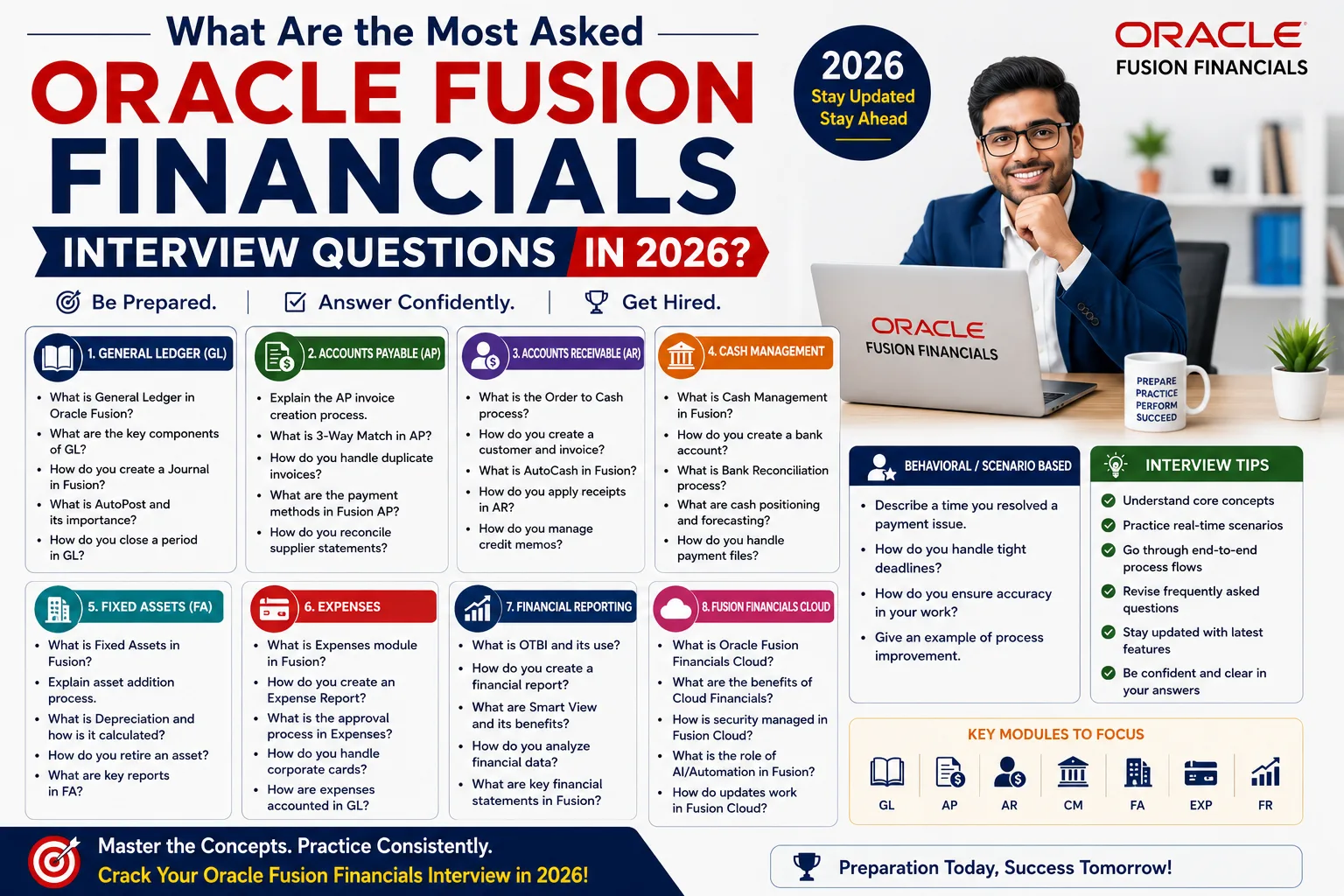
Expect the basics first: What is Oracle Fusion Financials? (Oracle's cloud-based financial management platform for automating accounting, reporting, supplier management, and customer transactions.) Why do companies use it? (Cloud accessibility, automated processes, stronger reporting visibility, scalability, and tighter integration across business functions.) What are the core modules? Be ready to name and briefly describe General Ledger, Accounts Payable, Accounts Receivable, Cash Management, Fixed Assets, Expense Management, Tax Management, and Financial Reporting without needing to think twice.
General Ledger Comes Up Constantly
It's the platform's backbone, so expect: What is a Chart of Accounts? What's a Ledger? How do Journal Entries actually work? What's an Accounting Calendar, and how does posting function? What happens during period close, and how do financial statements get generated afterward? Walking through the full sequence not just naming terms is what actually impresses interviewers here.
Accounts Payable Questions Test the Full Cycle
You'll likely hear: How is a supplier created? Explain invoice processing and validation. What payment methods are available, and how do approval workflows function? What are payment terms? These are all designed to check whether you understand the complete supplier-to-payment journey, not just isolated steps.
Accounts Receivable Focuses on the Revenue Side
Expect: How are customer invoices created? What's a receipt? Explain credit memos. How does the collections process work, and how is revenue tracked over time? A clean answer here shows you understand how money actually comes into the business.
Cash Management Tests Liquidity Understanding
Common questions include: What is Cash Management? Explain bank reconciliation. What's cash positioning? How are bank statements imported, and what does payment matching involve? These check whether you understand how organizations keep real-time visibility into their cash position.
Fixed Assets Covers the Full Lifecycle
Expect questions like: How is an asset created? What is depreciation? Explain asset transfers and what happens at retirement. Interviewers are looking for lifecycle thinking here, not just one stage in isolation.
Accounting Fundamentals Never Go Out of Style
Because the entire system rests on accounting logic, expect questions on debits and credits, journal entries, trial balance, balance sheets, profit and loss statements, and the distinction between assets, liabilities, revenue, and expenses regardless of how many years of experience you have.
Business Process Questions Are Getting More Common
Interviewers increasingly test whether you understand complete workflows: Explain Procure-to-Pay. What is Order-to-Cash? Explain Record-to-Report. How do the different modules actually connect to each other? What role does ERP play in financial management overall? This is exactly where genuinely strong candidates separate from ones who only know disconnected facts.
Scenario-Based Questions Are the Real 2026 Shift
Compared to previous years, interviews now lean noticeably harder into practical scenarios: How would you resolve an invoice processing issue? What would you do if a payment fails? How would you help a user through a transaction error? How do you troubleshoot a reconciliation discrepancy? These test real analytical thinking under pressure, not memorized textbook answers.
What Actually Gets You Ready
Revisit accounting fundamentals on a regular cycle, cover every major module rather than favoring a comfortable few, practice genuine implementation scenarios, learn complete workflows instead of isolated facts, work on communication clarity, and rehearse through mock interviews until answers stop feeling scripted. Practical fluency consistently beats memorized definitions in these conversations.
Why Structured Online Training Genuinely Helps
Solid Oracle Fusion Financials Online Training blends live instruction with real Oracle Cloud practice, genuine implementation scenarios, mock interviews, resume support, and placement guidance exactly the combination that turns theoretical prep into interview-day confidence.
Why Soft Online Training
The program is built around live classes with experienced Oracle professionals, hands-on practice, real implementation projects, flexible scheduling, recorded sessions, resume support, mock interviews, and placement guidance all designed to make learners genuinely interview-ready, not just certificate-holders.
Conclusion
Oracle Fusion Financials interviews in 2026 test far more than basic software familiarity recruiters expect solid accounting principles, real module knowledge, business process understanding, and comfort navigating practical scenarios. Enrolling in Oracle Fusion Financials Online Training builds hands-on experience with exactly the kinds of questions coming up now, while a well-structured Oracle Fusion Financials Course pairs technical depth with genuine interview readiness. With expert mentoring and career-focused support from Soft Online Training, you can walk into your next interview genuinely prepared, not just recently trained.