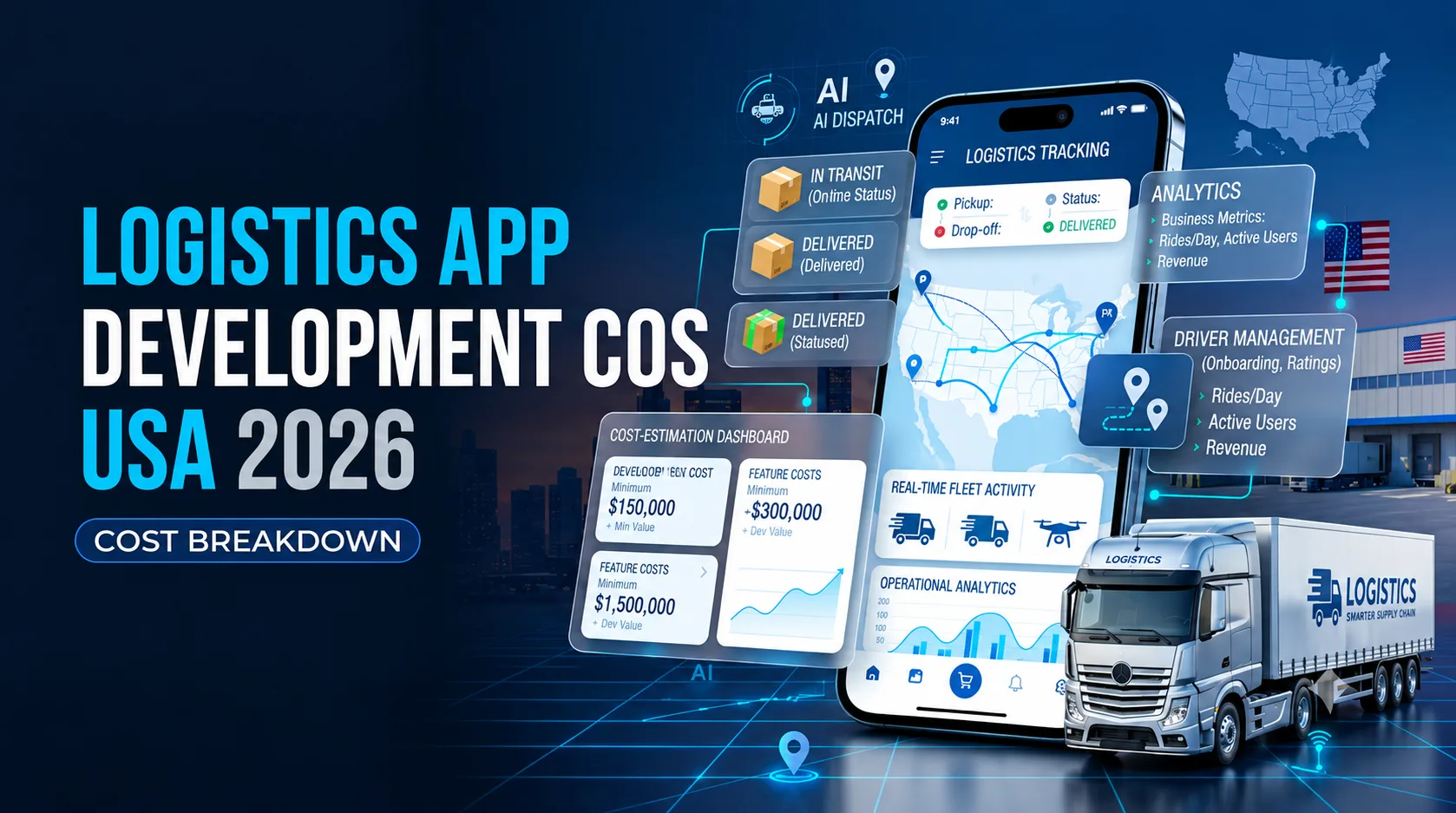
The logistics sector in America is experiencing rapid changes due to digitalization of transportation companies, delivery services, fleets, and supply chains. From organizing everyday deliveries to managing freight transportation across the country, logistics solutions provide businesses with valuable opportunities for increased visibility, automation, and efficient decision-making.
As customer demands for timely delivery and shipment tracking are becoming higher, implementation of a logistics management system becomes a significant step towards modernization. At the same time, the development of a logistics solution should go beyond creation of a user-friendly mobile app. The selection of necessary features, reliable technology, security of sensitive information, and future scalability should be considered during the design and development process.
At the same time, there are several aspects that must be considered while planning and implementing a logistics app development project for businesses working on the American market.
In this article, we will discuss the requirements for logistics app development in the USA.
1. Define Business Requirements and Operational Goals
Before starting development, businesses should identify the operational problems the application needs to solve. A logistics app designed for a local courier service will have different requirements from a freight management platform serving multiple states.
A clear understanding of business processes helps determine the application's features, technology stack, budget, and development timeline.
Start by evaluating the following questions:
- What types of shipments will the application manage?
- How many drivers, vehicles, customers, and dispatchers will use it?
- Does the business require local delivery, long-distance transportation, or both?
- Is real-time tracking essential?
- Which existing systems need to be integrated?
- What operational challenges should the application address?
- How much shipment and user growth is expected over the next few years?
For example, a regional delivery company may prioritize driver assignment, proof of delivery, and customer notifications. A freight operator may require load management, vehicle utilization reports, carrier coordination, and integration with a transportation management system.
Practical tip: Document the existing workflow before choosing features. Identifying bottlenecks in order processing, dispatching, tracking, and delivery confirmation helps ensure that development addresses actual business needs.
2. Real-Time GPS Tracking and Location Services
GPS tracking is one of the most important requirements for logistics applications because it provides visibility into vehicle movements and delivery progress.
With location tracking, dispatchers can monitor drivers, identify delays, and communicate more accurate delivery estimates. Customers can also follow shipment progress without repeatedly contacting support teams.
Essential GPS tracking capabilities include:
- Live or periodic vehicle location updates
- Interactive maps and location history
- Estimated arrival times
- Geofencing for designated locations
- Alerts for unexpected delays or route deviations
- Background location collection where permitted
- Handling of temporary connectivity interruptions
The appropriate tracking frequency depends on the application's purpose. A local delivery app may need frequent updates while a driver is completing a route, whereas a long-distance freight platform may use less frequent updates during certain stages of a journey.
Businesses should also consider battery consumption, mobile network availability, mapping API charges, and location-data privacy.
For US operations, employee monitoring should be designed with appropriate notice, access controls, retention policies, and applicable state privacy and employment requirements.
3. Route Optimization and Navigation
Efficient route planning helps logistics companies reduce unnecessary travel, improve delivery scheduling, and use vehicles more effectively.
A logistics application should determine whether it needs basic navigation or a more sophisticated optimization engine.
Key capabilities may include:
- Multi-stop route planning
- Traffic-aware directions
- Delivery time-window management
- Vehicle capacity considerations
- Driver availability and scheduling
- Route recalculation when conditions change
- Restrictions based on vehicle type or road conditions
For example, a company delivering products to 40 locations in one metropolitan area may benefit from grouping nearby stops and arranging them according to delivery windows and vehicle capacity.
Basic routing can often be implemented through third-party mapping services. Complex operations may require specialized optimization algorithms that consider multiple constraints simultaneously.
Businesses should evaluate route-planning solutions using measurable outcomes, such as travel distance, fuel consumption, missed delivery windows, and dispatcher workload. Sophisticated optimization should be introduced when the expected operational benefit justifies the additional development and operating costs.
4. Real-Time Shipment Tracking and Status Updates
Shipment tracking allows customers and logistics teams to understand where an order is in the delivery process.
A well-designed system should provide consistent updates from order creation through final delivery. It should also handle exceptions, such as unsuccessful delivery attempts, delays, or changes to the shipment schedule.
Important tracking requirements include:
- Shipment creation and identification
- Order processing and dispatch status
- In-transit updates
- Estimated delivery dates and times
- Delivery confirmation
- Exception and delay notifications
- Proof of delivery through photographs, signatures, or other appropriate records
A logistics application may obtain tracking information from driver devices, internal dispatch systems, carrier APIs, or warehouse software.
For instance, a customer ordering equipment from a US distributor might receive notifications when the order is processed, loaded onto a vehicle, and delivered.
The application should clearly distinguish between confirmed events and estimated information. This helps avoid presenting outdated GPS positions or predicted arrival times as guaranteed delivery details.
5. Fleet Management and Vehicle Monitoring
Fleet management functionality helps businesses organize vehicles, manage assignments, monitor utilization, and maintain operational records.
Companies planning to develop a fleet management app should determine whether they need basic vehicle administration or a comprehensive platform connected to telematics and maintenance systems.
Essential fleet management features may include:
- Vehicle profiles and identification records
- Driver-to-vehicle assignments
- Vehicle availability and utilization
- Maintenance schedules and reminders
- Fuel and operating expense records
- Inspection checklists
- Mileage tracking
- Fleet performance reporting
- Telematics integration, where required
For example, a regional trucking company might use the application to identify vehicles due for maintenance and avoid assigning unavailable vehicles to new shipments.
Businesses operating commercial motor vehicles should also determine whether their workflows need to support applicable Federal Motor Carrier Safety Administration (FMCSA) requirements, including relevant driver qualification, inspection, and hours-of-service processes.
Not every logistics app needs every fleet management feature. The right scope depends on the types of vehicles, transportation activities, and responsibilities of the business.
6. Driver Management and Dispatch Automation
Driver management and dispatching are essential for coordinating deliveries and ensuring that available resources are assigned appropriately.
Manual dispatching can become difficult as shipment volumes increase. Automation can help dispatchers allocate orders based on driver availability, vehicle capacity, location, delivery priority, and scheduling constraints.
A logistics app should consider including:
- Driver profiles and role-based access
- Availability and shift scheduling
- Assignment notifications
- Delivery task lists
- Navigation and delivery instructions
- Proof-of-delivery submission
- Delivery exception reporting
- Driver performance dashboards
- Automated dispatch recommendations
For example, when a new delivery request arrives, the system could recommend a driver who is nearby, available, and operating a suitable vehicle.
Automated recommendations should still account for business rules and applicable restrictions. Dispatchers may need the ability to review, override, or reassign tasks when unusual circumstances arise.
The objective is to reduce repetitive work while preserving operational control.
7. Inventory and Warehouse Monitoring
Inventory monitoring becomes important when logistics operations involve storage facilities, distribution centers, fulfillment services, or goods moving between multiple locations.
A logistics application may need to exchange information with an inventory management or warehouse management system rather than maintain a separate inventory database.
Relevant capabilities include:
- Inventory quantity and availability
- Stock movement records
- Warehouse and storage location tracking
- Order picking and packing status
- Barcode or QR-code scanning
- Shipment preparation and dispatch status
- Inventory discrepancy alerts
- Transfer tracking between facilities
Consider a US retailer operating multiple warehouses. When an order is allocated to a fulfillment center, the logistics platform can receive the relevant inventory and dispatch information, helping staff coordinate shipment preparation.
Businesses should define which system owns each type of data. Clear ownership reduces the risk of duplicate records, inconsistent inventory quantities, and conflicting shipment statuses.
For companies that do not operate warehouses, inventory functionality may be unnecessary at launch.
8. Secure Payment Processing and Billing
Some logistics applications need payment functionality for delivery charges, freight invoices, customer accounts, or service fees.
Payment requirements depend on the business model. A business-to-consumer delivery app may collect payment during checkout, while a freight platform may generate invoices for business customers and support account-based billing.
Potential features include:
- Payment gateway integration
- Invoice generation
- Payment status tracking
- Refund and adjustment workflows
- Customer billing records
- Transaction notifications
- Reconciliation and reporting
Businesses should use established payment providers where appropriate instead of storing sensitive payment card information unnecessarily.
If card payments are accepted, the application and its payment architecture should account for applicable Payment Card Industry Data Security Standard (PCI DSS) requirements. Using a hosted or tokenized payment solution may reduce exposure to sensitive card data, although it does not automatically eliminate all compliance responsibilities.
Payment workflows should also include clear transaction records, error handling, and controls against unauthorized access.
9. Data Security, Privacy, and Regulatory Requirements
Logistics applications can process sensitive information, including customer names, delivery addresses, driver records, shipment details, payment data, and business transactions.
Protecting this information is essential for maintaining customer trust and reducing operational risk.
Important security requirements include:
- Encryption of data in transit and at rest
- Secure authentication and authorization
- Role-based access controls
- Multi-factor authentication for appropriate accounts
- Secure API design
- Audit logs for important actions
- Regular security testing and vulnerability management
- Reliable backups and recovery procedures
- Defined data retention and deletion policies
Understanding US Compliance Requirements
There is no single regulation that applies identically to every logistics application. Compliance depends on the business model, data collected, transportation activities, and jurisdictions involved.
Businesses should evaluate potentially relevant requirements, including:
- FMCSA regulations: Applicable to qualifying motor carriers and commercial vehicle operations, including relevant hours-of-service and electronic logging device requirements.
- State privacy laws: Certain states impose obligations concerning personal information, consumer rights, disclosures, and data handling.
- PCI DSS: Relevant when payment card data is processed, stored, or transmitted within the applicable scope.
- Contractual and customer security requirements: Enterprise clients may impose additional security, reporting, and data-handling obligations.
Electronic logging device functionality, for example, should not be treated as a generic GPS feature. Where required, the implementation must meet the applicable technical and regulatory requirements.
Businesses should consult qualified legal, security, or compliance professionals to determine which obligations apply to their specific operations.
10. Cloud Infrastructure and Scalable Architecture
A logistics application must be capable of handling its expected workload reliably, including periods of increased shipment volume or user activity.
Cloud infrastructure can provide computing, storage, databases, monitoring, and recovery capabilities without requiring a business to operate all its own physical servers.
Key infrastructure requirements include:
- Reliable database services
- Secure cloud storage
- Application monitoring and logging
- Automated backups
- Disaster recovery planning
- Traffic management and load balancing, where needed
- Separate development, testing, and production environments
- Capacity planning and cost monitoring
Plan for Growth From the Beginning
A startup may initially support a few dozen drivers and a limited number of daily deliveries. Over time, it may expand to multiple cities, warehouses, and customer groups.
A scalable architecture allows the application to grow without requiring a complete redesign.
For early-stage products, a modular application with a well-designed backend and managed cloud services may be sufficient. Larger systems may eventually benefit from independently scalable services, event-driven processing, or more specialized infrastructure.
Microservices are not automatically the best choice. They can introduce additional deployment, monitoring, and troubleshooting complexity, so architectural decisions should reflect actual business requirements.
Cloud spending should also be monitored. Frequent GPS updates, large volumes of tracking events, extensive logging, and high data transfer can increase operating costs.
11. Third-Party API Integrations
Logistics applications frequently depend on external services to support mapping, communications, payments, shipping, and business operations.
Common integrations include:
- Mapping and navigation providers
- SMS and email notification services
- Payment processors
- Carrier tracking APIs
- ERP systems
- Warehouse management platforms
- Transportation management systems
- Accounting and invoicing software
- Telematics and vehicle monitoring services
Before selecting an integration, businesses should examine API documentation, usage limits, authentication methods, pricing, support availability, and data synchronization requirements.
They should also plan for external service failures. If a carrier API becomes unavailable, for example, the application should handle the interruption gracefully rather than losing shipment records or displaying misleading information.
Where practical, integrations should use clear interfaces, logging, retry policies, and appropriate error handling.
Businesses should avoid integrating every available service at once. Start with the systems that are essential to the core workflow and add other connections as the business grows.
12. Choose the Right Technology Stack
The technology stack affects application performance, development effort, security, and long-term maintenance.
A typical logistics application may include mobile applications for drivers, a customer-facing interface, an administrative dashboard, backend services, and a database.
Potential technologies include:
ComponentCommon optionsCross-platform mobile developmentFlutter, React NativeNative mobile developmentSwift for iOS, Kotlin for AndroidBackend servicesNode.js, Python, JavaDatabasePostgreSQL, MySQLCloud platformAWS, Microsoft Azure, Google CloudMaps and navigationCommercial mapping APIsNotificationsPush notification, SMS, and email servicesThese are examples rather than a universal recommendation.
Cross-platform development can reduce duplicated mobile development effort when both platforms share similar workflows. Native development may be preferable when the product depends on specialized device capabilities or platform-specific behavior.
The selection process should consider the development team's experience, expected application lifespan, integration requirements, performance needs, and available maintenance resources.
13. User-Friendly Design and Application Performance
A logistics application should be easy to use in busy operational environments. Drivers, dispatchers, and customers have different goals, and the interface should reflect those differences.
A driver may need to access a delivery address, confirm arrival, or submit proof of delivery quickly. A dispatcher may need to review dozens of active shipments and identify exceptions without navigating multiple screens.
Important usability requirements include:
- Clear navigation and task-focused screens
- Consistent status indicators
- Readable layouts on different devices
- Accessible interface elements
- Appropriate loading and error messages
- Support for intermittent network connectivity
- Efficient workflows for common actions
Performance is equally important. Slow dashboards, delayed shipment updates, and unreliable synchronization can disrupt operations.
Testing should cover realistic workloads, different mobile devices, poor network conditions, and background location behavior.
The application should also handle temporary offline conditions when feasible, securely queueing appropriate updates and synchronizing them when connectivity returns.
14. Testing, Deployment, and Ongoing Support
A logistics application requires more than a successful initial build. It needs to be tested and maintained throughout its lifecycle.
Before launch, businesses should plan for:
- Functional testing
- API and integration testing
- Security testing
- Performance and load testing
- Mobile device compatibility testing
- GPS and location testing
- User acceptance testing
- Backup and recovery verification
A pilot launch with a limited group of drivers, dispatchers, or customers can help identify workflow problems before a wider rollout.
After deployment, the business should establish a process for bug fixes, security patches, infrastructure monitoring, API updates, and user support.
Ongoing expenses may include cloud hosting, mapping service usage, notification fees, technical support, and future enhancements. These recurring costs should be included in the long-term operating budget rather than treated as one-time development expenses.
How to Prioritize Logistics App Requirements
With so many potential features and technical considerations, businesses should avoid attempting to build a complete enterprise platform before validating their most important requirements.
A phased approach provides a practical way to balance functionality, budget, and time to market.
Phase 1: Core operations
Focus on user access, order management, driver assignment, shipment status updates, and essential administrative tools.
Phase 2: Operational visibility
Introduce GPS tracking, customer notifications, proof of delivery, fleet records, and basic reporting.
Phase 3: Integration and automation
Connect essential external systems and introduce route optimization, automated dispatch recommendations, and more detailed analytics where justified.
Phase 4: Advanced capabilities
Consider predictive analytics, AI-assisted optimization, advanced fleet monitoring, and expanded multi-region support when usage data demonstrates a clear need.
Throughout these phases, security, privacy, performance, and reliable data handling should remain foundational requirements rather than features postponed until the end.
Conclusion
Requirements for Successful Development of a Logistics App in the USA include understanding of business processes, necessary functions, tracking capabilities, routing optimization, vehicle and driver management, security measures, and proper infrastructure. It is also necessary to think about other aspects like usability, performance, maintainability, and legislative requirements.
By focusing on important functions, selecting a proper technology stack, and thinking about future growth, companies can create a logistics application that meets current business requirements but also has potential for future developments.
For more information about logistics apps and technologies used, watch the video below.