
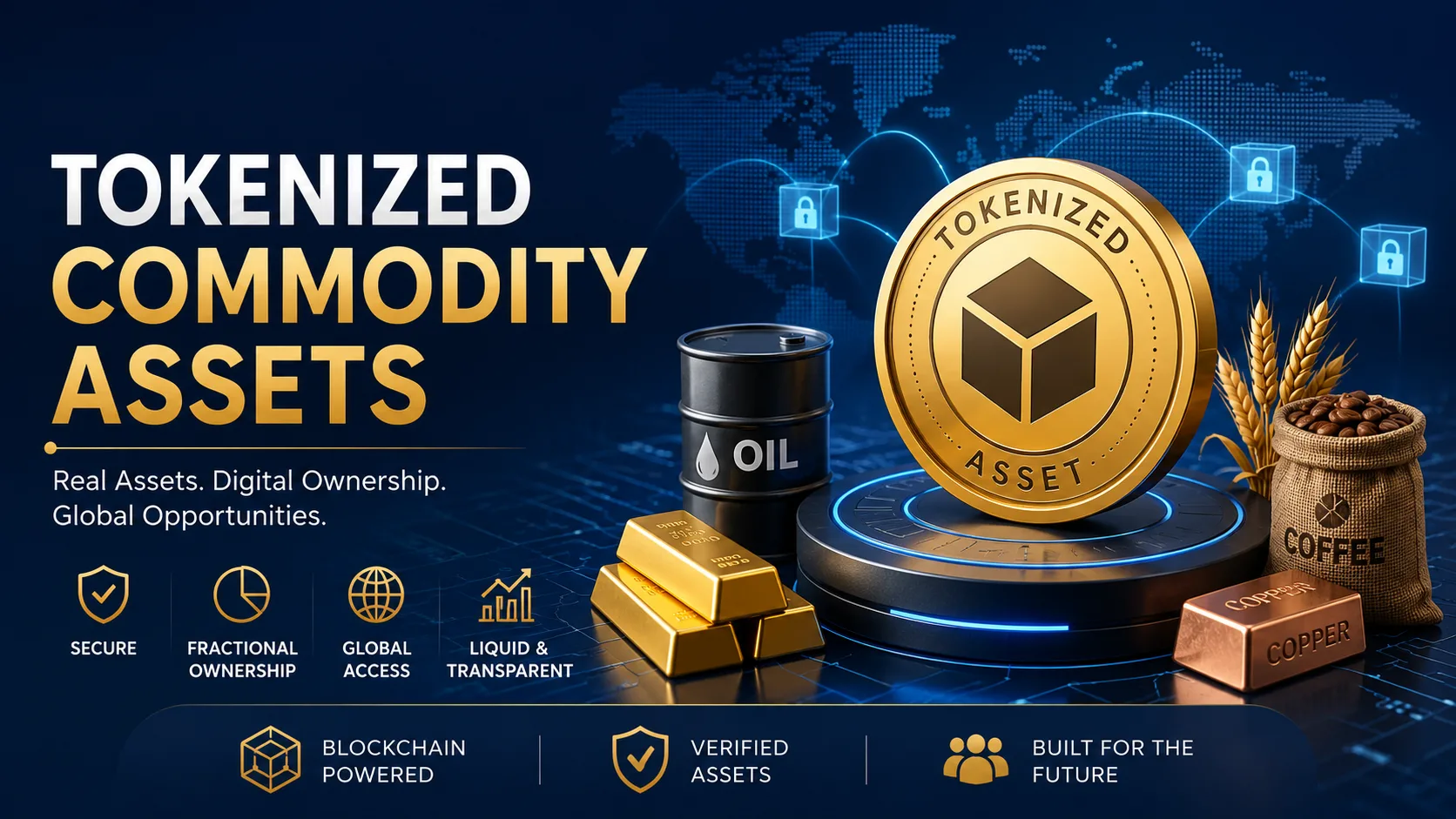
Tokenized commodity assets represent a structural shift in how physical commodities such as gold, oil, agricultural goods, metals, and energy resources are owned, traded, and settled. By converting real-world commodities into blockchain-based digital tokens, ownership can be fractionalized, transferred in near real time, and recorded on transparent, tamper-resistant ledgers.
Despite strong theoretical advantages, adoption remains uneven. The market is shaped by a combination of technological readiness, regulatory clarity, institutional trust, and infrastructure maturity. Understanding both the opportunities and barriers is essential to evaluate how tokenized commodity systems may evolve in global markets.
Understanding Tokenized Commodity Assets
Tokenized commodity assets refer to blockchain-based representations of physical commodities. Each token typically corresponds to a defined quantity of an underlying asset, such as one gram of gold, one barrel of oil, or a fixed amount of wheat.
These tokens are backed by physical reserves or financial instruments that ensure redeemability or price alignment with real-world markets. The primary goal is to combine traditional commodity markets with digital asset efficiency.
Key characteristics include:
- Fractional ownership of high-value commodities
- On-chain transferability and settlement
- Transparent provenance and auditability
- Reduced reliance on intermediaries
- 24/7 global market accessibility
This model attempts to solve inefficiencies in traditional commodity trading systems, which often involve complex clearing processes, high entry barriers, and delayed settlement cycles.
Key Opportunities in Tokenized Commodity Asset Adoption
1. Fractional Access to High-Value Commodity Markets
One of the most significant opportunities lies in democratizing access. Traditionally, commodities such as gold, oil, and industrial metals require substantial capital exposure or institutional access. Tokenization allows investors to purchase small fractions of these assets, enabling broader participation across retail and mid-tier investors. This fractional structure improves liquidity distribution and expands the investor base beyond traditional commodity trading participants.
2. Improved Liquidity in Traditionally Illiquid Markets
Certain commodity markets suffer from low liquidity, particularly in physical settlement systems. Tokenization introduces digital marketplaces where assets can be traded continuously. Because tokens can be exchanged peer-to-peer on blockchain networks, market participation is not restricted by exchange hours or geographic limitations.
Over time, this continuous trading model may reduce bid-ask spreads and improve price discovery mechanisms.
3. Enhanced Transparency and Traceability
Commodity supply chains often face challenges related to provenance verification and ethical sourcing. Blockchain-based token systems introduce traceability at every stage of the asset lifecycle.
For example, tokenized agricultural commodities can embed data on:
- Origin of production
- Storage conditions
- Transportation history
- Certification and compliance records
This level of transparency can improve trust among institutional buyers, regulators, and end users.
4. Operational Efficiency and Reduced Intermediary Costs
Traditional commodity trading relies on multiple intermediaries, including brokers, clearinghouses, custodians, and settlement agents. Each layer introduces cost and operational delay. Tokenized systems streamline these processes by automating settlement through smart contracts. This reduces reconciliation efforts and lowers administrative overhead. As a result, market participants can experience faster settlement cycles and reduced transaction friction.
5. Integration with Decentralized Finance (DeFi) Systems
Tokenized commodities can be integrated into decentralized finance ecosystems, unlocking additional financial utility.
These assets can potentially be used as:
- Collateral for lending protocols
- Margin assets in derivatives trading
- Liquidity pool components
- Hedging instruments in algorithmic strategies
This interoperability introduces new financial layers on top of traditional commodity exposure, increasing capital efficiency.
6. Real-Time Global Market Accessibility
Commodity markets have historically been fragmented across regions, with varying access restrictions. Tokenization enables global participation through internet-based infrastructure. Investors can trade commodity-backed tokens without needing direct access to physical storage facilities or regional exchanges. This global accessibility may contribute to more unified and efficient pricing structures over time.
Key Barriers to Tokenized Commodity Asset Adoption
While the opportunities are significant, adoption faces structural, regulatory, and technical barriers that slow mainstream integration.
1. Regulatory Uncertainty Across Jurisdictions
One of the most critical challenges is the lack of consistent regulatory frameworks. Tokenized commodities sit at the intersection of securities law, commodity trading regulation, and digital asset oversight.
Different jurisdictions treat tokenized assets differently:
- Some classify them as securities
- Others treat them as commodity derivatives
- Several have no clear classification at all
This regulatory fragmentation creates uncertainty for issuers, exchanges, and institutional investors. Without harmonized global standards, scaling cross-border tokenized commodity markets remains difficult.
2. Custody and Physical Asset Backing Risks
Tokenized commodities depend heavily on trust in physical asset custody. Each digital token must be backed by real-world reserves stored in secure vaults or supply systems.
However, risks include:
- Misreporting of reserves
- Inefficient audit mechanisms
- Storage security vulnerabilities
- Counterparty risk in custodial arrangements
If trust in physical backing is compromised, the entire tokenization model can lose credibility.
3. Limited Institutional Adoption
Large institutional players dominate global commodity markets. Their participation is critical for liquidity and stability.
However, institutions often hesitate due to:
- Regulatory ambiguity
- Lack of standardized infrastructure
- Concerns about market manipulation
- Integration complexity with legacy systems
Until institutional adoption increases, tokenized commodity markets may remain fragmented and relatively small in scale.
4. Infrastructure Fragmentation
The infrastructure supporting tokenized commodities is still evolving. There is no universally accepted standard for issuance, settlement, or interoperability across platforms.
This leads to:
- Isolated liquidity pools
- Compatibility issues between platforms
- Difficulty in cross-chain asset movement
- Inefficient market aggregation
Without standardized protocols, scaling global commodity token ecosystems becomes challenging.
5. Price Volatility and Market Perception Challenges
Although commodities are traditionally considered stable assets, tokenized versions may experience additional volatility due to:
- Lower liquidity in early-stage markets
- Speculative trading behavior
- Limited arbitrage efficiency
- External crypto market correlations
This can create perception issues among conservative investors who prefer traditional commodity exposure mechanisms.
6. Technological and Security Risks
Blockchain systems introduce new types of risks, including:
- Smart contract vulnerabilities
- Oracle manipulation (incorrect external price feeds)
- Network congestion and scalability limitations
- Cybersecurity threats targeting token custody systems
If not properly addressed, these risks can undermine confidence in tokenized commodity infrastructure.
The Balance Between Opportunity and Constraint
The adoption of tokenized commodity assets is not limited by a single factor but by the interaction of multiple systems: regulatory environments, financial infrastructure, institutional behavior, and blockchain maturity. On one side, tokenization introduces a more efficient, transparent, and accessible model for commodity ownership and trading. On the other side, the traditional commodity market structure is deeply entrenched, heavily regulated, and institutionally controlled. This creates a transition phase rather than a direct replacement scenario.
Future Outlook for Tokenized Commodity Markets
The long-term evolution of tokenized commodity assets is likely to follow a gradual integration pattern rather than rapid disruption.
Key expected developments include:
- Standardization of token issuance frameworks
- Expansion of regulated tokenized exchanges
- Greater institutional participation through pilot programs
- Improved custody solutions with audited reserve systems
- Interoperability across blockchain networks
As regulatory clarity improves and infrastructure matures, tokenized commodities may become a parallel market layer alongside traditional commodity exchanges rather than a replacement.
Conclusion
Tokenized commodity assets introduce a new financial architecture that blends physical asset markets with digital blockchain infrastructure. The opportunities include increased liquidity, fractional access, operational efficiency, and global market integration. However, meaningful adoption depends on overcoming regulatory fragmentation, custody risks, institutional hesitation, and infrastructure limitations.
The trajectory of this market will be shaped not only by technological progress but also by legal frameworks and trust mechanisms that ensure real-world asset backing remains verifiable and secure. If these challenges are addressed systematically, tokenized commodity assets could become a foundational component of next-generation global commodity markets.