Collagen plays an important role in keeping skin firm and supported. As we age, changes in collagen production and skin structure can contribute to wrinkles, folds, and loss of facial volume.
This has increased interest in aesthetic treatments designed to do more than create immediate fullness. Collagen-stimulating fillers are intended to encourage the body's own collagen response over time, potentially helping improve the appearance of treated areas.
One material used in certain fillers is polycaprolactone, or PCL. Understanding PCL microspheres offers a useful introduction to the material science behind these treatments and the reasons their effects may develop over time.
What Are PCL Microspheres?
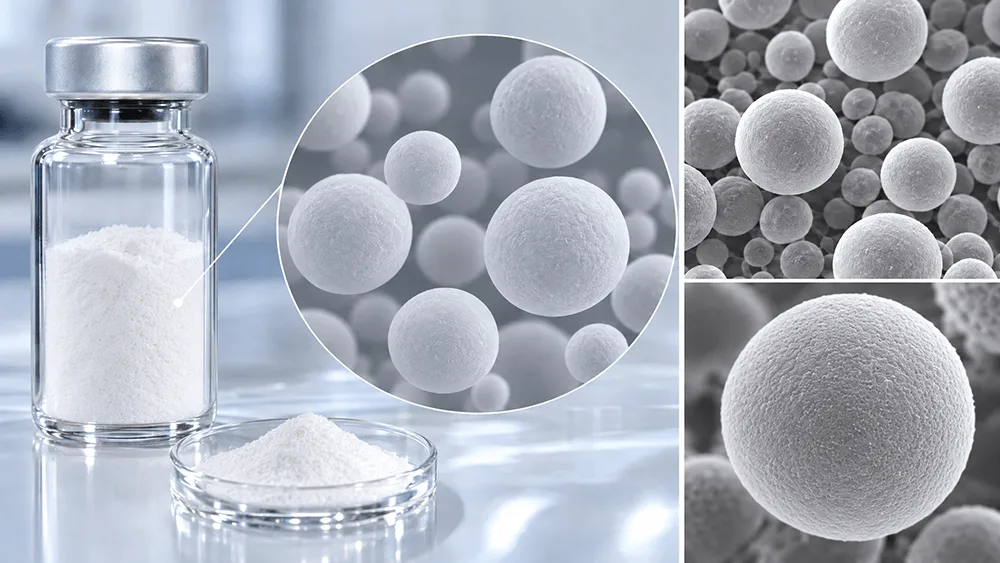
PCL stands for polycaprolactone, a biodegradable polymer that has been explored for various biomedical applications. When manufactured as tiny spherical particles, it is known as PCL microspheres.
In certain injectable filler formulations, these microspheres are suspended in a gel carrier. The carrier helps provide initial volume, while the microspheres are intended to support a longer-term tissue response involving collagen formation.
The distinction is important: PCL microspheres are not the same thing as a finished dermal filler. The finished product also depends on the carrier, formulation, manufacturing process, and intended use.
Different formulations can have different properties, so the behavior of one PCL-based filler should not automatically be assumed to apply to all others.
How Do PCL Microspheres Relate to Collagen Formation?
Collagen is a protein that forms part of the skin's structural framework. It helps give tissue strength and support, working alongside other components of the extracellular matrix.
In a collagen-stimulating filler, the injected material interacts with the surrounding tissue. Cells such as fibroblasts, which help produce collagen, may participate in the body's response to the material.
In formulations containing PCL microspheres, this tissue response is part of the intended mechanism. Over time, collagen formed around the treated area may contribute to its structural support.
However, collagen stimulation does not mean that the body will produce the same amount of collagen in every person. The response can vary with the formulation, treatment area, injection technique, and individual biology.
It is also important to separate a biological process from a cosmetic outcome. The fact that a material is designed to stimulate collagen does not guarantee a particular degree of improvement, a specific treatment duration, or the elimination of wrinkles.
What Does Biodegradable Really Mean?
The term biodegradable is sometimes misunderstood as meaning that a material disappears quickly or completely within a short period.
PCL degrades gradually as its polymer chains break down, primarily through hydrolysis. The pace of degradation depends on material characteristics and the environment in which the polymer is placed.
This gradual process is one reason PCL has attracted interest in biomedical material development. However, biodegradability alone does not establish that a material is appropriate for every medical application.
It is also useful to distinguish PCL degradation from collagen remodeling. Degradation describes changes to the polymer over time, while collagen remodeling describes changes in the surrounding tissue's structural proteins. These processes may occur over overlapping periods, but they are not the same thing.
Understanding both helps explain why the behavior of a collagen-stimulating filler cannot be judged by a single material property.
Why Do Microsphere Characteristics Matter?
Although microspheres may appear similar, they can differ in particle size, shape, surface characteristics, and other material properties.
Particle size is one factor considered during material development. The size of individual particles and the distribution of sizes across a sample can influence how the material is characterized and incorporated into a formulation.
Consistency is also important. If a material is intended for a specific biomedical application, manufacturers need suitable methods to assess whether batches meet their predefined specifications.
Other characteristics, such as intrinsic viscosity, can provide information about aspects of a polymer's molecular characteristics when measured using an appropriate method. These measurements help describe and control a material; they do not independently prove that a finished injectable will be safe or effective.
In short, material characterization is one part of product development. The complete formulation and its intended application must also be evaluated.
From PCL Microspheres to Finished Fillers
A raw material is only the starting point for a finished injectable product. The way microspheres are manufactured, processed, and incorporated into a formulation can affect the characteristics of the final product.
For example, a formulation needs to be assessed as a whole rather than judged solely by the polymer it contains. Manufacturing controls, product consistency, sterility, packaging, and product-specific safety and performance evidence all matter.
Companies working with biomedical polymers, including eSUNMed, are part of the broader materials-development landscape in which polymer properties and material consistency are important considerations.
Still, the quality of a raw material alone cannot establish the suitability of a finished injectable. That determination requires appropriate evaluation of the complete product for its intended use.
What Should Consumers Know About Collagen-Stimulating Fillers?
People considering a collagen-stimulating filler should look beyond general claims about collagen production or long-lasting results.
First, the exact product matters. Products that share a broad material category may differ in formulation, approved uses, clinical evidence, and risk profile.
Second, results vary. The treatment area, individual anatomy, injection technique, and biological response all influence the outcome. No material can guarantee that every person will achieve the same result.
Third, injectable fillers carry risks. These can include swelling, bruising, infection, lumps or nodules, inflammatory reactions, and vascular complications. Some complications can be serious, including tissue injury and, rarely, visual impairment.
PCL-based fillers also cannot be dissolved with hyaluronidase in the same way as hyaluronic acid fillers. Anyone considering treatment should understand this distinction and discuss possible complications and their management with a qualified medical professional.
Before proceeding, ask about the exact product, its authorization for the intended use in your location, the evidence supporting its benefits, possible side effects, and the clinician's plan for follow-up care.
The Takeaway
PCL microspheres are small particles made from a biodegradable polymer called polycaprolactone. In certain collagen-stimulating filler formulations, they are intended to support a tissue response involving collagen formation while the material gradually degrades.
Their role illustrates how material science and aesthetic medicine intersect. But the behavior of a polymer is only one part of the picture. Particle characteristics, formulation design, manufacturing consistency, and the evidence for the finished product all matter.
For anyone interested in regenerative fillers, understanding these basics offers a more balanced starting point than relying on marketing claims alone. The most meaningful questions concern the specific product, its evidence, its limitations, and whether it is appropriate for the individual.