
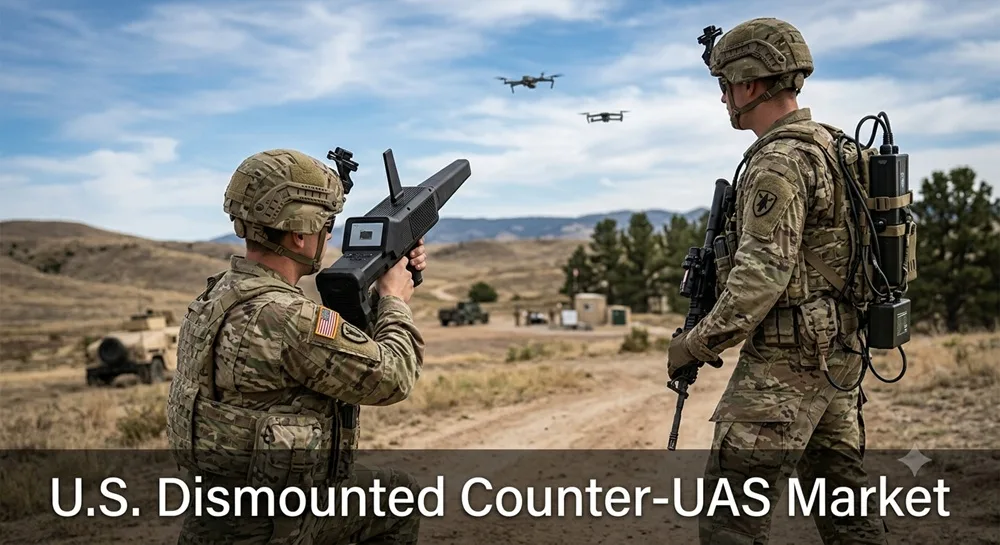
The U.S. Dismounted Counter-UAS Market is expanding as defense agencies prioritize portable counter-drone solutions to address the growing threat posed by small unmanned aerial systems (UAS). Designed for dismounted personnel, these systems combine mobility with rapid detection and neutralization capabilities, enabling soldiers to respond effectively across dynamic operational environments.
According to BIS Research, the market is projected to grow from $650.7 million in 2023 to $2.273.2 million by 2033, registering a CAGR of 13.32% during the forecast period 2023-2033.
What are the Key Drivers of the U.S. Dismounted Counter-UAS Market?
- Growing deployment of commercial and military drones is increasing demand for portable counter-UAS technologies.
- Rising U.S. defense investments in force protection and tactical battlefield mobility are accelerating procurement.
- Greater emphasis on safeguarding military personnel, critical infrastructure, and strategic assets from low-altitude drone threats.
- Continuous advancements in electronic warfare, radar, and detection technologies are improving operational effectiveness.
Request an Updated Sample for U.S. Dismounted Counter-UAS Market - Focus on End User and Type - Analysis and Forecast, 2023-2033
Who are the Primary End Users in the U.S. Dismounted Counter-UAS Market?
Defense organizations represent the largest end-user segment, driven by the need to protect deployed forces against evolving drone threats in combat environments. Homeland security agencies are also expanding investments in portable counter-UAS systems to secure borders, public events, and critical infrastructure. Together, these organizations are strengthening demand for compact, field-ready solutions capable of rapid deployment and reliable performance.
What Key Trends are Shaping the U.S. Dismounted Counter-UAS Market?
- Integration of artificial intelligence (AI) and machine learning (ML) for faster target detection and threat classification.
- Development of next-generation fire control optics to improve targeting precision in field operations.
- Increasing adoption of directed energy weapon (DEW) technologies for efficient drone neutralization.
- Growing focus on lightweight, portable, and rapidly deployable systems that support dismounted troops across diverse missions.
What Challenges and Opportunities Exist in the U.S. Dismounted Counter-UAS Market?
Challenges
- Rapid evolution of drone technologies requires continuous upgrades to countermeasure capabilities.
- Regulatory and operational constraints can complicate the deployment of electronic counter-UAS systems.
- Balancing portability, power consumption, and detection range remains a technical challenge.
- Increasing use of autonomous and swarm drones demands more advanced interception capabilities.
Opportunities
- Expanding U.S. defense modernization programs will create sustained procurement opportunities.
- AI-enabled threat detection and sensor fusion will improve battlefield awareness and response speed.
- Growing homeland security requirements will broaden adoption beyond traditional military applications.
- Advances in directed energy, electronic warfare, and integrated counter-drone architectures will support next-generation solutions.
Who are the Key Players in the U.S. Dismounted Counter-UAS Market?
Leading companies operating in the market include:
- Black River Systems Company
- BlueHalo
- Leonardo DRS
- CACI International Inc.
- Fortem Technologies
- Flex Force Enterprises
- WhiteFox Defense Technologies, Inc.
- Dedrone Holdings Inc.
- Northrop Grumman
- DroneShield Ltd.
Get More Insights for Defense Industry
Conclusion
The U.S. Dismounted Counter-UAS Market is positioned for sustained growth as defense and homeland security agencies strengthen protection against increasingly sophisticated drone threats. Ongoing investments in AI-enabled detection, electronic warfare, advanced optics, and portable counter-drone systems will continue to enhance operational readiness. As modern military operations demand greater mobility and rapid response, dismounted counter-UAS technologies are expected to remain a critical component of the U.S. defense ecosystem.