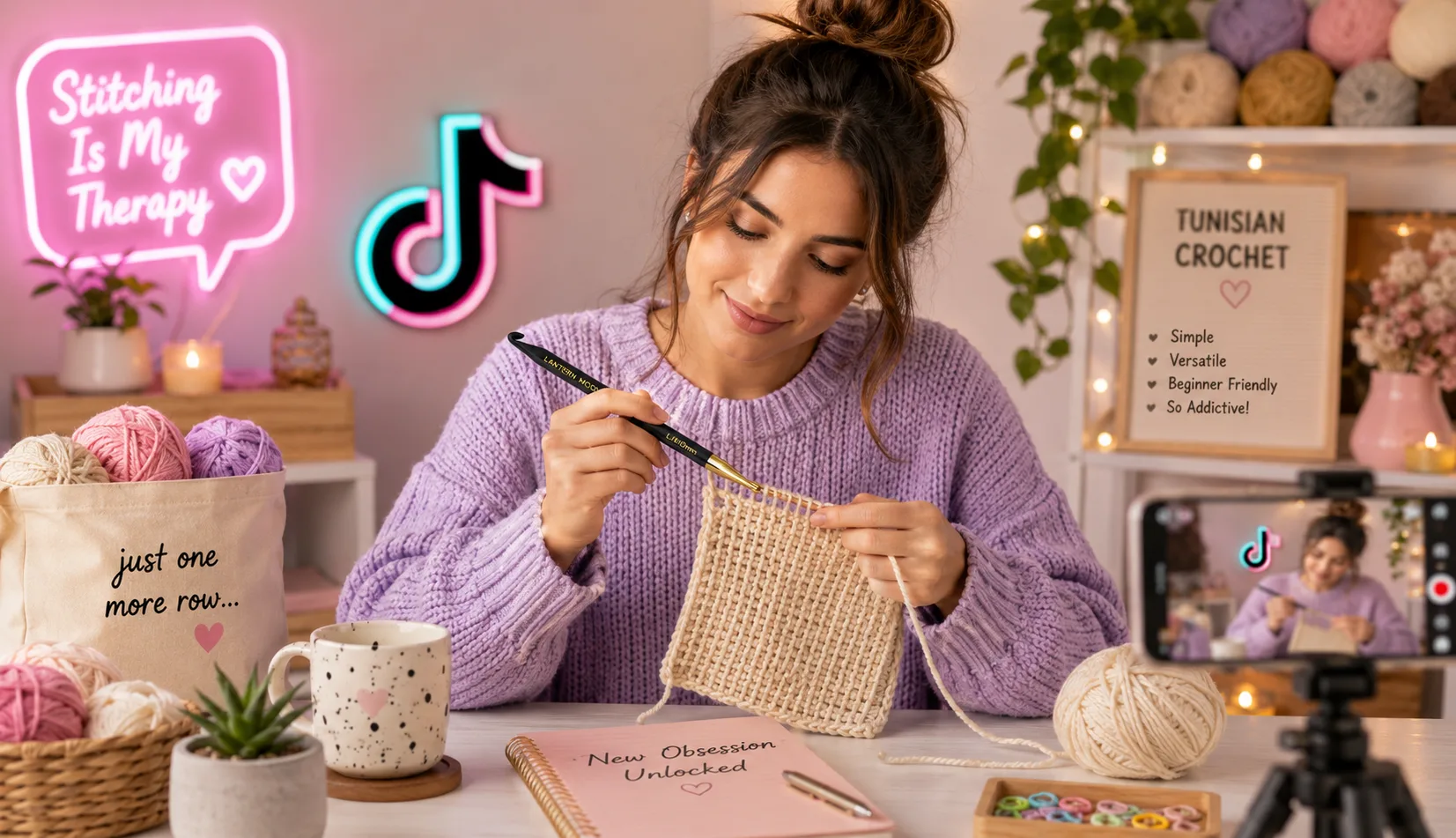
Long hook, two passes per row, fabric that looks like it was woven rather than crocheted — if your TikTok feed has been full of this lately, you're not imagining it. It's called Tunisian crochet, and it's having a real moment. The hashtag #TunisianCrochet has millions of followers and views, making this technique popular on social media.
Tunisian Crochet: What It Actually Is
Tunisian crochet is also referred to as Afghan crochet. It is a hybrid technique that borrows tools and tricks from both knitting and crochet. Instead of a standard crochet hook, you work with a long Tunisian hook, which is often attached with a cable and stopper on the end, similar to what you'd see on a knitting needle.
Here's the part that trips people up: regular crochet finishes one stitch, then moves to the next. Tunisian crochet works in two passes — you load a whole row of loops onto your hook first (the 'forward pass'), then work back across and drop them off one at a time (the 'return pass'). Two passes per row instead of one stitch at a time — that's the whole reason the fabric looks so different.
The fabric that comes out of it is dense and woven-looking, with a texture all its own — more on how it compares to standard crochet and knitting below. It doesn't behave like crochet or knitting — no curling, no drape, just a dense woven surface neither technique produces on its own. That's the appeal for crafters who feel like they've ‘seen it all.’
Why TikTok Crafters Can't Stop Talking About It
A few reasons this technique is spreading fast on TikTok specifically:
- Visually Satisfying to Watch: The forward-and-return pass rhythm is oddly hypnotic on camera — there's a reason ASMR crochet content routinely pulls millions of views, and Tunisian crochet's back-and-forth motion is basically built for it.
- Photographs and Films Beautifully: The basic Tunisian simple stitch (TSS) creates a woven, almost tapestry-like surface that looks incredible in close-up shots, especially with variegated or hand-dyed yarn. It's a texture that stands out in a feed full of standard single crochet swatches.
- A "New Trick" for Experienced Crafters: A lot of the creators driving this trend aren't beginners chasing a first project — they're crafters who've made a hundred granny squares and want something that still surprises their hands. Tunisian crochet's loop-loading rhythm does that.
- Beginner-Friendly Pattern: It looks intricate, but the basic Tunisian simple stitch (TSS) is easy to pick up if you already know how to make a chain and single crochet. A stitch you can learn in one row, paired with a texture that looks impressive on camera — that's exactly the ratio a 60-second tutorial needs.
Why It's Different From Regular Crochet
As a crocheter, if you think it's worth adding this skill set, here's why it's different from the standard one:
- The Hook: You need a longer hook — either a straight Tunisian hook with a stopper, or a cable hook (similar to an interchangeable knitting needle) for larger projects like blankets or garments.
- The resultant fabric is different from regular crochet. Tunisian crochet fabric tends to curl less than regular single crochet but has less stretch than knitting. It's dense, warm, and holds its shape well, which is why it's so popular for blankets, bags, and structured garments.
- It works differently than regular crochet, as you're loading and unloading loops across the row rather than finishing each stitch immediately; your gauge and tension will feel different at first, even if you're an experienced crocheter.
- Beyond the basic Tunisian simple stitch, there's Tunisian knit stitch (which mimics true knit fabric closely enough to fool a glance), Tunisian purl stitch, and — most recently — Tunisian lace and colorwork, both showing up in shawl and cardigan patterns from designers who'd normally work in straight knitting or crochet.
What You Need to Get Started
A few essentials to start. You don't need to make a big investment to try it. If you're picturing a steep learning curve, here's the relief: if you can chain and single crochet, you already have what you need for the basic Tunisian simple stitch. The learning curve is in the rhythm, not in a whole new skill set:
- A Tunisian Crochet Hook: Look for a comfortable-grip hook if you're planning longer sessions — hand fatigue is real when you're holding a full row of loops on your hook.
- A Cable Hook for Bigger Projects. If you want to make a bigger project like a blanket or garment rather than a small swatch or coaster, a cable hook lets you hold way more stitches without your project feeling unwieldy.
- Use Worsted or DK Weight Yarn to Start: Thicker yarn makes it easier to see your stitches clearly while you're still learning the forward and return pass rhythm.
- A Little Patience for the First Few Rows. Almost every crafter says the same thing: the first swatch feels awkward, and by the third or fourth row, it clicks.
Summary
Tunisian crochet isn't just a TikTok fad riding on aesthetic appeal. It's a distinct technique with its own tools, its own fabric behavior, and its own stitch vocabulary — TSS, knit, purl, lace, colorwork — that's still expanding.
If you've been sitting on the fence, this is a good time to try it. Grab a Tunisian hook, some worsted-weight yarn you don't care about, and give yourself one swatch — not a project, just a swatch. Row three is usually where it clicks. Row four is usually where you start planning your next one.