Choosing a forex broker is one of the most important decisions a trader makes before entering the financial markets. A professional-looking website, attractive trading conditions, or a wide selection of instruments may look appealing, but these features alone do not establish whether a broker is suitable for real-money trading. Regulation, company transparency, trading costs, platform reliability, customer support, and withdrawal procedures all need to be considered.
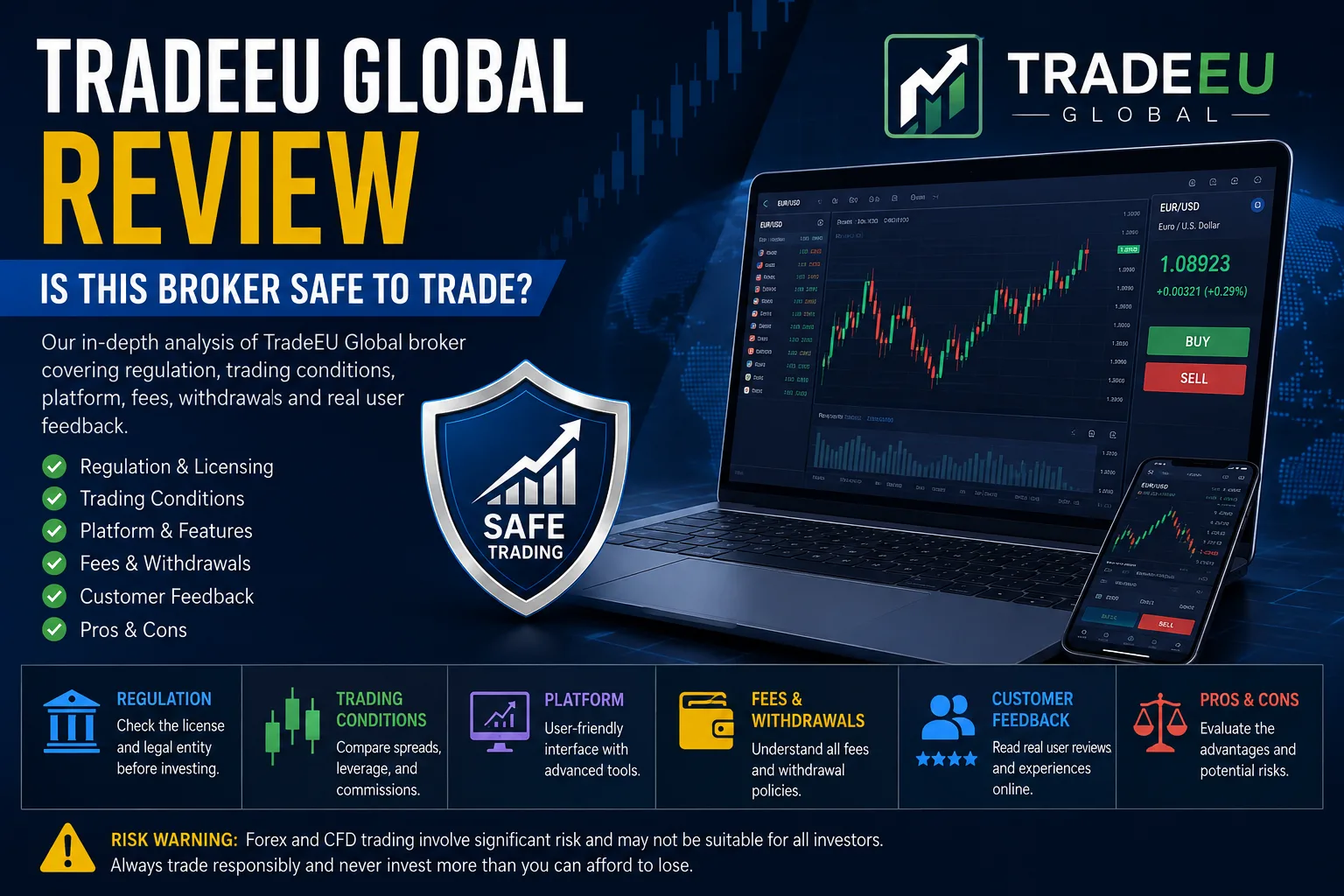
This TradeEU Global Review examines the broker from several important angles to help traders understand what they should check before opening an account. TradeEU Global is associated with online trading services and has attracted attention from traders interested in forex and CFD markets. However, as with any broker, prospective clients should conduct independent due diligence and verify the latest information before depositing funds.
The purpose of this review is not to encourage or discourage trading with the platform without evidence. Instead, it provides a structured overview of the factors that matter when evaluating a forex broker.
What Is TradeEU Global?
TradeEU Global is an online trading brand that provides access to financial markets through leveraged trading products. The platform is aimed at traders who want exposure to markets such as forex and CFDs.
For many new traders, the first step when evaluating a broker is to look at its trading platform or advertised spreads. Experienced traders usually take a broader approach. They examine the legal entity operating the service, regulatory status, client agreements, trading costs, withdrawal policies, and overall reputation.
This distinction is important because a broker can offer an attractive trading environment while still presenting questions that potential clients need to answer.
A detailed TradeEU Global Review should therefore focus on both the potential benefits and the possible risks.
TradeEU Global Review: Regulation and Licensing
Why Regulation Matters
Regulation is one of the most important factors when selecting a forex broker.
A financial regulator can impose requirements relating to capital, reporting, client-money protection, business conduct, and dispute resolution. However, regulatory protections differ from one jurisdiction to another.
Before registering with TradeEU Global, traders should verify:
- The exact legal entity behind the account
- The regulator responsible for that entity
- The current licence status
- The activities covered by the licence
- The jurisdiction governing the trading agreement
- The broker's official complaints procedure
- Whether the information matches current regulatory records
Traders should always use official regulatory information when checking a broker's licence rather than relying exclusively on advertisements, review websites, or promotional material.
Understanding Regulatory Jurisdiction
Not all financial licences provide the same level of investor protection.
A broker regulated by a well-established financial authority may be subject to strict rules concerning leverage, client funds, reporting, and marketing. Other jurisdictions may have different requirements.
For this reason, traders should not simply ask whether a broker is "regulated." They should ask which entity is regulated, by whom, where, and under what permissions.
That approach provides a much clearer picture of the potential protections available to a retail trader.
Trading Platform and Technology
The trading platform is another major part of a broker evaluation.
A good trading environment should provide reliable order execution, understandable charts, account information, risk-management tools, and stable access during normal market conditions.
When assessing TradeEU Global, traders should consider whether the available platform meets their individual trading requirements.
What Traders Should Look For
Important platform features include:
- Stable execution
- Real-time market pricing
- Technical charting
- Multiple order types
- Risk-management functionality
- Mobile accessibility
- Account and transaction history
- Reliable access during volatile markets
A platform can be visually impressive while still requiring careful testing.
Traders should therefore avoid judging a broker solely on website design or promotional screenshots. Where possible, they should familiarize themselves with the platform using a demo environment before committing significant capital.
TradeEU Global Review: Trading Conditions
Trading conditions have a direct effect on the cost and risk of forex trading.
Spreads
The spread is the difference between the bid and ask prices. It is one of the most common costs traders encounter.
A broker may advertise competitive spreads, but traders should examine actual spreads across several currency pairs and different market conditions.
Spreads can widen during periods of high volatility, major economic announcements, reduced liquidity, or market openings and closings.
Therefore, traders should evaluate both advertised and practical trading costs.
Commissions
Some accounts charge commissions in addition to spreads, while others incorporate the cost into the spread.
Before opening an account, traders should understand:
- Whether commissions apply
- Which instruments have commissions
- Whether fees vary by account type
- How commissions are calculated
- Whether additional transaction charges exist
Understanding the complete cost structure is essential for calculating potential profitability.
Leverage
Leverage allows traders to control larger positions with less initial capital.
Although leverage can increase potential returns, it also increases potential losses. A highly leveraged position can move against a trader quickly, resulting in substantial account losses.
New traders should be especially careful with high leverage and should never select a broker simply because it provides a large leverage ratio.
Account Types and Minimum Deposit
Account structures can vary significantly between brokers.
Potential clients should examine the requirements associated with each available account type, including minimum deposits, spreads, commissions, leverage, available instruments, and other conditions.
A lower minimum deposit may make a broker appear more accessible, but traders should not assume that a smaller starting amount means lower overall risk.
The more important questions are:
- What are the complete trading costs?
- What leverage is available?
- What withdrawal rules apply?
- What protections are available?
- What legal entity holds the trading account?
These questions provide greater insight than minimum-deposit figures alone.
TradeEU Global Review: Deposits and Withdrawals
Withdrawal procedures deserve particular attention in any broker review.
Depositing funds is generally straightforward with most online trading platforms. However, traders should understand the withdrawal process before committing money.
A responsible evaluation should examine:
- Available payment methods
- Withdrawal processing times
- Minimum withdrawal requirements
- Applicable fees
- Identity-verification procedures
- Bank or payment-provider restrictions
- Conditions that may affect withdrawal requests
Why Withdrawal Policies Matter
A trader may successfully open an account and deposit funds but later encounter unexpected requirements when attempting to withdraw.
This is why traders should read the broker's current terms and conditions before funding an account.
It is also sensible to retain records of deposits, withdrawals, account statements, and communications with customer support.
If a broker requests additional documentation for identity verification, traders should determine whether the request is consistent with the published terms and applicable regulatory requirements.
Customer Support and Communication
Customer support can become particularly important when traders experience technical issues, account restrictions, payment problems, or questions about trading conditions.
A professional broker should provide clear channels for contacting support and should communicate account-related information in a transparent manner.
Before depositing funds, traders can test customer service by asking specific questions about:
- Account verification
- Withdrawal procedures
- Trading costs
- Platform functionality
- Leverage
- Available instruments
- Complaint procedures
The quality and consistency of the answers can provide useful information about the broker's communication standards.
TradeEU Global Review: Reputation and Customer Feedback
Online reviews can be useful, but they should never be considered conclusive evidence on their own.
Customer-review platforms can contain valuable experiences from real users, but they can also include disputed, incomplete, or unverified claims.
When researching TradeEU Global, traders should look for recurring themes rather than focusing on one isolated comment.
Useful areas to investigate include:
- Withdrawal experiences
- Customer service
- Platform performance
- Account verification
- Trading execution
- Unexpected fees
- Communication quality
If several independent sources report similar issues, those claims deserve additional investigation.
On the other hand, a few positive or negative reviews should not automatically determine a broker's overall reputation.
Is TradeEU Global Legit or a Scam?
This is one of the most common questions traders ask when researching an unfamiliar broker.
A responsible TradeEU Global Review should avoid making an unsupported accusation. Calling a broker a scam requires strong evidence, while a broker's claimed regulatory status does not automatically guarantee that every customer will have a positive experience.
Instead, traders should examine verifiable facts.
The most important checks include:
Verify the Legal Entity
Identify the company named in the client agreement and determine where it is registered.
Verify the Licence
Check the regulator's official database and confirm that the licence is current and covers the services offered to retail clients.
Review the Terms
Read the client agreement, especially sections dealing with withdrawals, account closure, fees, margin, and dispute resolution.
Investigate Customer Feedback
Compare reviews from multiple independent sources and identify repeated complaints or recurring positive experiences.
Evaluate the Risk
Consider whether the broker's regulatory environment and trading conditions match your personal risk tolerance.
Following these steps is more reliable than relying on a simple "legit" or "scam" label.
Key Risk Factors Traders Should Consider
Every broker has potential risks, and TradeEU Global should be evaluated using the same standards as any other trading platform.
Regulatory Risk
The regulatory jurisdiction and legal entity determine the protections available to clients.
Market Risk
Forex and CFDs are leveraged products and can result in significant losses.
Liquidity Risk
Market conditions can change rapidly, potentially causing wider spreads and greater slippage.
Withdrawal Risk
Traders should understand the broker's withdrawal terms and verification requirements before depositing funds.
Operational Risk
Technology failures, account restrictions, communication problems, or platform interruptions can affect trading activity.
Leverage Risk
High leverage can magnify both profits and losses and should be used carefully.
How to Conduct Your Own TradeEU Global Review
Rather than relying entirely on an online article, traders can perform their own broker assessment.
Step 1: Check Regulatory Information
Confirm the current licence and legal entity through the relevant regulator.
Step 2: Read the Client Agreement
Look for withdrawal conditions, fees, account restrictions, and dispute-resolution procedures.
Step 3: Compare Trading Costs
Compare spreads, commissions, swaps, and other charges with several established brokers.
Step 4: Test the Platform
If a demo account is available, use it to understand the platform before risking real funds.
Step 5: Examine Customer Support
Ask detailed questions and evaluate whether responses are timely and consistent.
Step 6: Start Conservatively
If you ultimately decide to trade, avoid committing more money than you can afford to lose.
This process allows traders to make decisions based on evidence rather than marketing claims.
TradeEU Global for Beginner Traders
Beginners should be especially careful when choosing a forex broker.
A new trader may focus on leverage, bonuses, instruments, or attractive account features without fully understanding the risks associated with leveraged products.
Instead, beginners should prioritize:
- Clear regulatory information
- Transparent fees
- Simple account conditions
- Reliable educational resources
- Strong risk-management tools
- Responsive customer support
- Clear withdrawal procedures
The best broker for a beginner is not necessarily the one offering the highest leverage or the largest number of trading instruments.
TradeEU Global for Experienced Traders
Experienced traders may evaluate a broker differently.
They may focus more heavily on execution speed, spreads, liquidity, available instruments, order types, platform functionality, and trading costs.
However, experienced traders should still perform regulatory and withdrawal checks.
Trading experience does not eliminate counterparty risk.
Advantages and Disadvantages to Examine
A balanced TradeEU Global Review should consider both potential benefits and limitations.
Potential Advantages
- Access to online forex and CFD trading
- Multiple trading instruments may be available
- Potentially suitable platform features for active traders
- Different account conditions may appeal to different strategies
- Online customer support and account management
Potential Disadvantages
- Traders must independently verify regulatory information
- Trading leveraged products involves substantial risk
- Trading costs can vary according to account and market conditions
- Withdrawal policies require careful examination
- Online customer feedback should be investigated rather than ignored
These points demonstrate why traders should evaluate the complete service instead of focusing on one advertised feature.
Final TradeEU Global Review Verdict
The forex market contains many brokers, and choosing between them requires careful research. A professional TradeEU Global Review should therefore go beyond platform screenshots and promotional claims.
TradeEU Global should be evaluated based on its current legal entity, regulatory status, trading conditions, platform performance, fees, customer support, withdrawal procedures, and independent reputation.
Potential clients should verify regulatory information directly through the relevant authority and read all contractual documents before depositing funds. They should also understand that forex and CFD trading involve substantial market risk, particularly when leverage is used.
There is no single feature that can prove whether a broker is appropriate for every trader. Regulation, transparency, costs, execution, customer service, and withdrawals all contribute to the overall picture.
For readers researching brokers through BankingRating, the most important takeaway is simple: perform independent due diligence before committing real money.
A careful trader compares multiple brokers, checks regulatory information, studies the terms and conditions, understands all potential costs, and develops a realistic risk-management strategy.
Ultimately, this TradeEU Global Review should be treated as an educational guide rather than a personal investment recommendation. Broker conditions and regulatory information can change, so traders should always confirm the latest information before making a financial decision.