
Rice straw has a reputation among pellet producers. It is not the easiest material to work with, and the reasons are not always obvious until the die clogs and the pellets start to crack. What makes rice straw different is not the fiber or the moisture, although both matter. It is the silica. Rice plants absorb silicon from the soil, and it concentrates in the straw. Under pressure, that silica acts like an abrasive, wearing down steel faster than most other crop residues. A machine that performs well on wheat straw or sawdust will struggle from the first bale of rice straw, and the operator will spend more time clearing jams than filling bags.
A rice straw pelletizer built for this material addresses the problem at the metallurgical level. Hardened dies, wear-resistant rollers, and a feeding system designed for long, tough fibers make the difference between a line that runs and one that sits idle. But the machine alone is not enough. Rice straw also arrives with variable moisture, and it must be dried to a narrow range before it reaches the die. If the dryer is undersized, the press waits. If the grinder produces inconsistent particle size, the pellets crack. The line has to work as a system, not as a collection of machines.
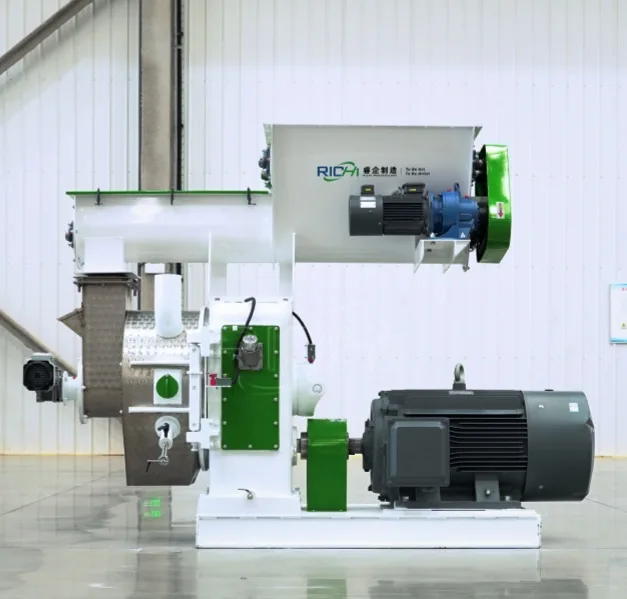
The heart of that system is the pellet press. Its die compression ratio, roller clearance, and conditioning system determine whether the rice straw binds into a durable pellet or crumbles into dust. A well-designed press allows operators to adjust these parameters as the straw changes from one field to the next. That flexibility is what keeps quality consistent when the raw material does not cooperate. A cheap press with fixed settings produces fines and rejects. The difference shows up in energy consumption, die life, and how many hours the line runs before something wears out.
Scale changes the challenge, but not the principle. A farm processing a few hundred kilos per hour can manage with manual adjustments. A commercial operation cannot. At higher volumes, the entire line must be balanced: drying, grinding, conditioning, pressing, cooling, and screening. If one stage lags, the bottleneck moves and downtime becomes the default. That is why experienced producers plan the whole process before they commit to a single component. They test their straw, measure its silica content, and choose a die that can handle the wear. They also keep spare dies and rollers on hand, because rice straw wears them down faster than most feedstocks.
The market for rice straw pellets is real. It can be used for bedding, fuel, or soil amendment, and it turns a field residue into a product with value. But the market rewards consistency, not ambition. Buyers want the same density and the same burn profile in every shipment. A line that varies cannot sign contracts. A line that delivers can. That is why the equipment decision matters more than the recipe. Rice straw is not an impossible feedstock. It is a specific one. Match the machine to the material, balance the stages, and plan for wear. The rest is just running the line.
You may also like:https://pelletizerextruder.com/straw-pellet-machine/