The Marketing Metric Most Growing Businesses Get Wrong (And What to Track Instead)
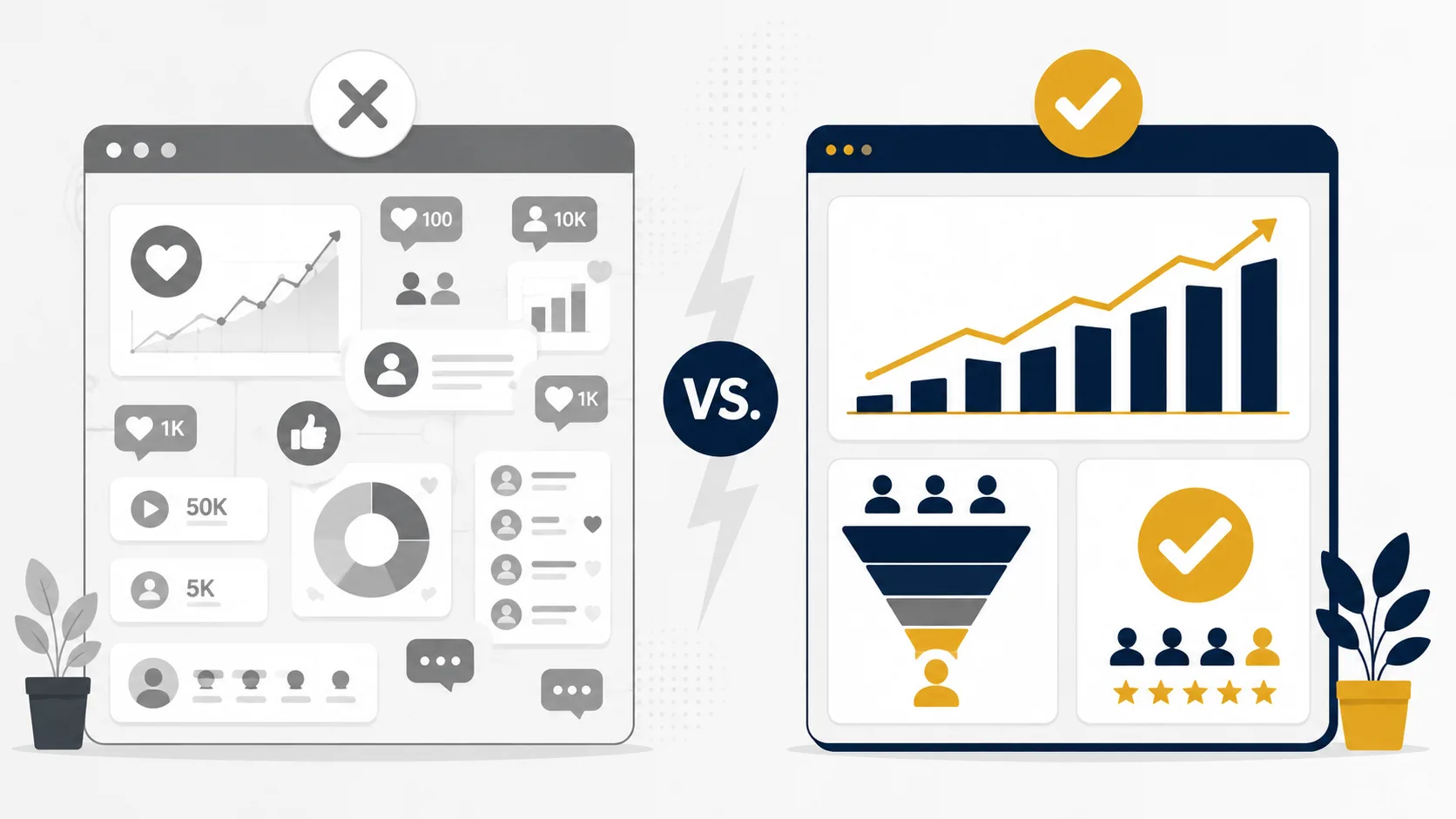
Ask most business owners how their marketing is performing, and you'll get an answer built around vanity metrics: follower growth, impressions, likes, maybe website traffic. These numbers feel like progress because they're easy to see and easy to report. The problem is they rarely answer the question that actually matters — is this marketing making the business money?
That disconnect is one of the most common, and most expensive, mistakes growing businesses make.
Why Vanity Metrics Feel Safe
Vanity metrics are appealing because they almost always go up. Post consistently, and followers grow. Run ads, and impressions climb. There's a steady, comforting sense of motion — something is happening, the numbers on the dashboard keep climbing, and that feels like proof the strategy is working.
But growth in followers or impressions doesn't automatically translate into growth in revenue. A business can have a growing, engaged social following and flat sales at the same time, because nobody ever connected that audience to an actual buying decision. The metric moved. The business didn't.
The Metric That Actually Matters: Cost Per Qualified Lead
The more useful question isn't "how many people saw this?" It's "how many people who saw this became an actual, qualified lead — and what did it cost to get each one?"
Cost per qualified lead ties marketing spend directly to something the business can act on. It's specific enough to compare across channels — is paid search producing cheaper qualified leads than social right now, or the reverse? — and specific enough to catch a problem early, before it shows up as a bigger issue in quarterly revenue.
The key word is qualified. A cheap lead that never had any real intent to buy isn't actually cheap — it's a distraction dressed up as a good number. Tracking cost per qualified lead forces a business to define what "qualified" actually means for them, which is a useful exercise on its own.
Why This Gets Missed So Often
Part of the reason vanity metrics stick around is that they're simpler to report. A follower count is one number. Tracking a lead from first ad click through to an actual qualified conversation requires connecting data across ad platforms, a website or landing page, and often a CRM or intake process — more moving parts, more setup, more discipline to maintain.
That complexity is real, but it's also exactly where the value is. A business that can see, channel by channel, what it actually costs to generate a qualified lead has a genuine advantage over one that's only looking at surface-level engagement numbers. It can shift budget toward what's actually working instead of what merely looks active.
What This Looks Like in Practice
Businesses that make this shift usually start small: pick one or two channels, define clearly what counts as a qualified lead for the business, and track cost per lead consistently for a few months before drawing conclusions. From there, the picture usually gets clearer fast — one channel often turns out to be quietly outperforming another that's been getting more of the budget simply out of habit.
This is also where a business's size stops being a limiting factor. A business with one location and a business with twenty locations can both apply this same principle — the only difference is that a multi-location business needs this tracked at the location level, not just as one blended average, since a strong location can otherwise mask a weak one hiding right behind it.
The Real Shift
None of this requires abandoning social media, brand awareness, or the softer, harder-to-measure parts of marketing that build long-term familiarity. It requires being honest about which numbers are actually evidence of business growth, and which ones just feel like it.
The businesses that consistently turn marketing spend into real, compounding revenue tend to be the ones asking "what did this actually cost us per qualified lead?" — not "how are our numbers this month?" That's a small shift in the question, and a large shift in what it reveals.
If your business is trying to make that shift — from tracking activity to tracking actual results — Automated Marketing LLC works with growing and multi-location businesses to build marketing that's measured by real leads and revenue, not vanity numbers.