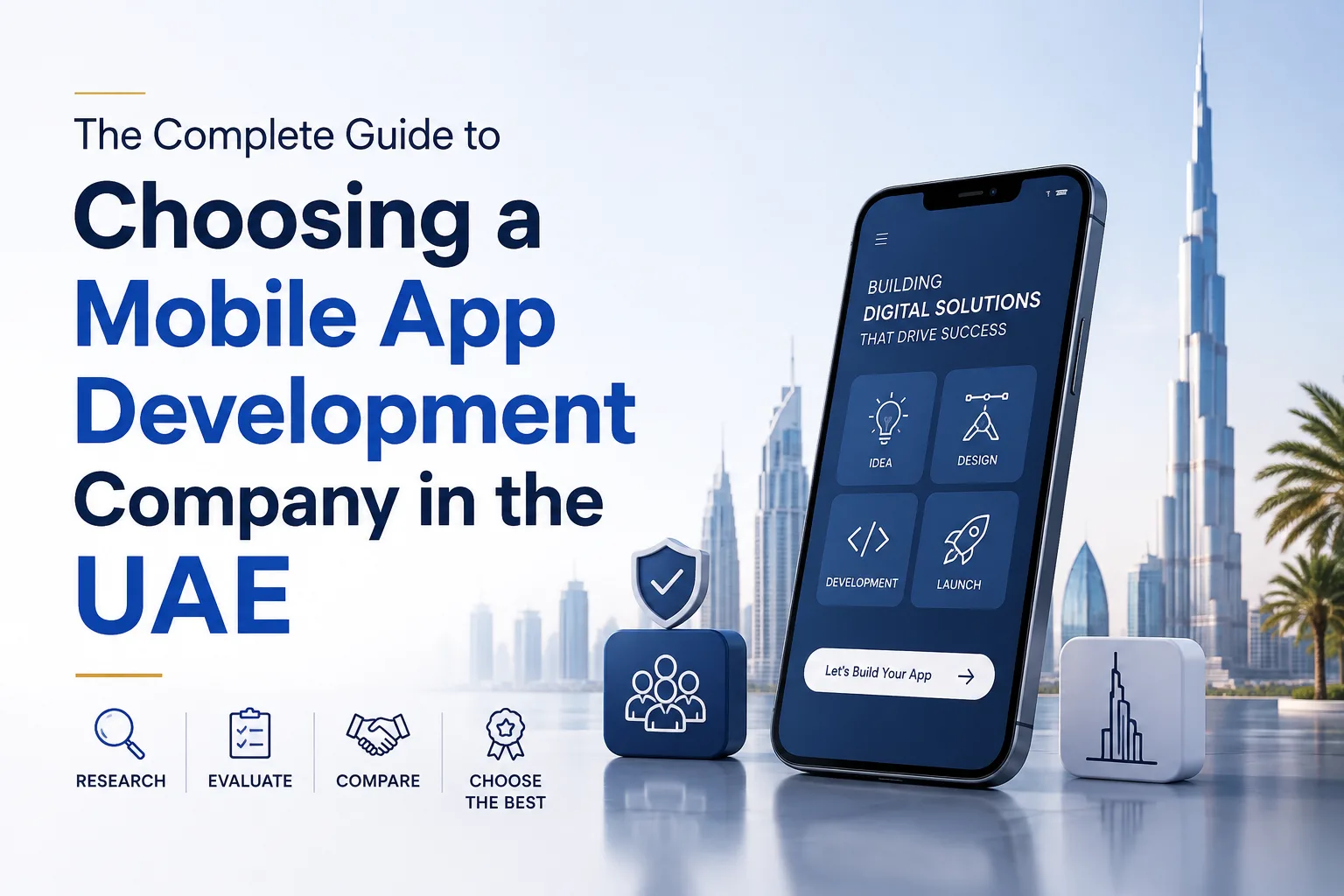
The UAE has become one of the most technology-driven business markets in the Middle East. From Dubai and Abu Dhabi to Sharjah and other growing business hubs, companies are investing heavily in digital products to improve customer engagement, automate operations, and create new revenue opportunities.
A mobile application can help a business reach customers directly, simplify services, improve communication, and build a stronger digital presence. However, the success of an app depends largely on choosing the right mobile app development company in the UAE.
With hundreds of development agencies and technology providers available, selecting the right partner can be challenging. Businesses need to evaluate technical expertise, industry experience, development processes, security standards, pricing, communication, and post-launch support before making a decision.
This complete guide explains the most important factors to consider when choosing an app development company in the UAE and how to find a technology partner that can support your business from idea to long-term growth.
Why Businesses in the UAE Need Mobile Apps
Mobile applications have become an important part of modern business strategies. UAE consumers increasingly expect businesses to provide convenient, fast, and personalized digital experiences.
A well-designed mobile app can help businesses:
- Improve customer engagement
- Increase brand visibility
- Simplify purchasing and booking
- Automate business processes
- Offer personalized experiences
- Collect valuable customer insights
- Increase customer retention
- Generate additional revenue
- Improve operational efficiency
For startups, an app can provide a scalable platform for launching a new business model. For established enterprises, mobile applications can modernize existing processes and create more efficient customer journeys.
This makes choosing an experienced mobile app development company UAE businesses can rely on an important strategic decision rather than simply an outsourcing choice.
Look for Relevant Industry Experience
Technical skills are important, but industry knowledge can make a significant difference. An experienced app development company that UAE businesses choose should understand the specific requirements of their industry.
Relevant experience may include:
Healthcare
Healthcare apps may require:
- Telemedicine
- Appointment scheduling
- Patient management
- Electronic medical records
- Remote monitoring
- Secure communication
FinTech
Fintech applications often require:
- Digital wallets
- Payment gateways
- Banking integrations
- Fraud detection
- Identity verification
- Transaction management
Retail and E-Commerce
Retail apps may include:
- Product catalogs
- Shopping carts
- Payment systems
- Order tracking
- Customer loyalty
- Personalized recommendations
Logistics
Logistics applications commonly require:
- GPS tracking
- Route optimization
- Driver management
- Delivery tracking
- Real-time notifications
Industry experience allows a development team to anticipate challenges and recommend features that support real business requirements.
Evaluate Technical Expertise
Technology evolves rapidly, so businesses should select a development partner with strong technical capabilities.
Depending on the project, your development partner may need expertise in:
- Native iOS development
- Native Android development
- Cross-platform development
- Flutter
- React Native
- Backend development
- Cloud computing
- Artificial intelligence
- Machine learning
- Blockchain
- IoT
- API development
- Data analytics
For businesses looking to build intelligent applications, AI integration can provide additional capabilities such as personalized recommendations, predictive analytics, conversational assistants, automated workflows, and intelligent search.
The right technology should be selected based on business requirements rather than trends.
Check Their Portfolio
A company's portfolio provides valuable insight into its capabilities.
When reviewing an app development company's portfolio, look beyond screenshots. Examine:
- Types of applications developed
- Industries served
- User experience quality
- Technical complexity
- Scalability
- Integrations
- Business outcomes
Ask whether the company has developed applications similar to yours.
For example, if you are planning a marketplace application, experience building simple informational apps may not be enough. You should look for a team that understands user accounts, seller dashboards, product management, payments, search, notifications, and scalable backend architecture.
Read Client Reviews and Testimonials
Client feedback can help you understand how a company works beyond its marketing materials.
Look for reviews that discuss:
- Communication
- Project management
- Development quality
- Meeting deadlines
- Technical expertise
- Responsiveness
- Post-launch support
Don't focus only on the overall rating. Read individual reviews to identify recurring strengths or concerns. You can also ask the development company for relevant case studies or references from previous clients.
Understand the Development Process
understand how the company manages the development lifecycle. A professional development partner should follow a structured, transparent, and business-focused process rather than moving directly into coding. A well-defined development process helps reduce technical risks, control costs, maintain quality, and ensure that the final application meets both business and user expectations.
A typical mobile app development process includes the following stages:
1. Discovery and Requirement Analysis
The development journey begins with understanding your business idea and objectives. During the discovery stage, the development team works closely with stakeholders to identify the application's purpose, target audience, business challenges, and expected outcomes.
The team may analyze:
- Business goals and requirements
- Target users and their expectations
- Competitor applications
- Core features and functionalities
- Revenue and monetization models
- Technical requirements
- Third-party integrations
- Security and compliance needs
This stage creates a clear foundation for the entire project and helps prevent misunderstandings later in development.
2. Product Strategy and Planning
Once the requirements are understood, the development company creates a product strategy and technical roadmap. Developers, business analysts, product managers, and architects determine the most appropriate technologies, platforms, architecture, and development approach.
The strategy may define:
- iOS and Android platforms
- Native or cross-platform development
- Backend architecture
- Database requirements
- Cloud infrastructure
- API integrations
- AI or automation requirements
- Security architecture
- Development milestones
A strong strategy ensures that the application is built for current requirements while remaining flexible enough to support future growth.
3. UI/UX Design
The next stage focuses on creating the application's user experience and visual identity.
UI/UX designers transform business requirements into intuitive user journeys, wireframes, prototypes, and high-fidelity interface designs.
This stage typically includes:
- User journey mapping
- Wireframes
- Interactive prototypes
- Navigation structure
- Visual design
- Design systems
- Responsive layouts
- Usability improvements
The objective is to create an application that looks professional while remaining simple and convenient to use.
4. Mobile App Development
Once the designs are approved, developers begin building the application. The development process usually involves both frontend and backend engineering. The frontend creates the interface users interact with, while the backend manages business logic, databases, authentication, APIs, and server-side functionality.
Depending on the project, developers may work with technologies such as Flutter, React Native, Swift, Kotlin, Node.js, Python, cloud platforms, and various databases.
Third-party services such as payment gateways, maps, analytics platforms, CRM systems, communication tools, and AI services can also be integrated during this stage.
5. Testing and Quality Assurance
Testing is a critical part of professional mobile app development. Before launch, the application should be tested across different devices, operating systems, screen sizes, and network conditions.
A comprehensive QA process may include:
- Functional testing
- UI testing
- Usability testing
- Performance testing
- Security testing
- API testing
- Compatibility testing
- Load testing
- Regression testing
The objective is to identify and resolve bugs, performance issues, security vulnerabilities, and usability problems before users access the application.
6. Deployment and Launch
After testing and final approval, the application is prepared for deployment.
For consumer applications, this may involve publishing the app on the Apple App Store and Google Play Store. Enterprise applications may use private distribution or other deployment methods depending on business requirements.
A professional development partner can also assist with:
- App store submission
- Store listing optimization
- Production configuration
- Server deployment
- Database configuration
- Analytics setup
- Crash monitoring
- Final security checks
Proper deployment ensures that the application is ready for real-world users and business operations.
7. Maintenance and Continuous Improvement
Launching the application is not the end of the development lifecycle. Mobile operating systems, devices, security standards, technologies, and customer expectations continue to change.
Ongoing maintenance can include:
- Bug fixes
- Security updates
- Performance optimization
- OS compatibility updates
- Server monitoring
- Feature enhancements
- Analytics and performance reviews
- Third-party integration updates
A reliable app development company UAE businesses partner with should provide ongoing technical support and help improve the product based on user feedback and business performance.
Prioritize UI/UX Design
A technically advanced application can still fail if users find it difficult to navigate.
The development company should have strong UI/UX capabilities and understand how users interact with mobile products.
Important considerations include:
- Simple navigation
- Fast loading
- Clear call-to-action buttons
- Consistent branding
- Accessible design
- Mobile-first experiences
- Personalized user journeys
The objective should be to create an experience that is intuitive rather than unnecessarily complicated.
Ask About Security
Security should be a priority when selecting a mobile app development company in the UAE. Applications may process sensitive information such as personal details, payment information, business data, and user credentials.
Ask potential development partners about:
- Data encryption
- Secure authentication
- API security
- Role-based access
- Secure cloud infrastructure
- Vulnerability testing
- Secure payment integration
- Data backup
- Privacy practices
If your application operates in a regulated industry, discuss applicable UAE requirements and industry-specific compliance obligations during the discovery stage.
Security should be incorporated into the architecture from the beginning rather than added after development.
Consider Scalability
Your application may start with a small user base, but successful products can grow quickly.
Choosing a scalable architecture can help your application handle increasing:
- Users
- Transactions
- Data
- API requests
- Integrations
- Business operations
Ask the development company how its architecture will support future growth.
A strong technology partner should think beyond the first version of the application and create an infrastructure that can evolve with your business.
Compare Pricing Carefully
Cost is naturally an important factor when choosing an app development company that UAE businesses can work with. However, the cheapest quotation is not always the best option.
App development costs can vary depending on:
- Number of features
- App complexity
- Platform selection
- UI/UX requirements
- Backend architecture
- Third-party integrations
- AI capabilities
- Security requirements
- Development location
- Maintenance requirements
Instead of comparing only total prices, compare what each proposal includes.
Ask whether the quotation covers:
- UI/UX design
- Development
- Testing
- Deployment
- Source code
- Third-party services
- Project management
- Maintenance
- Future updates
A transparent proposal makes it easier to understand the actual value being provided.
Evaluate Communication and Project Management
Communication can determine whether a project remains on track.
Before signing a contract, understand:
- Who will manage the project?
- How frequently will you receive updates?
- Which communication tools will be used?
- How will changes be handled?
- How will milestones be tracked?
- Who will approve deliverables?
A professional development partner should provide regular progress updates and make project status visible.
Good communication also helps prevent misunderstandings about functionality, deadlines, and costs.
Ask About Post-Launch Support
App development does not end when the application is published.
After launch, businesses may need:
- Bug fixes
- Performance optimization
- Security updates
- OS compatibility updates
- New features
- Analytics
- Server monitoring
- Technical support
Ask potential development partners about their maintenance and support plans. A long-term technology partner can continuously improve the application as customer expectations and market conditions change.
Consider AI and Emerging Technologies
Modern applications are increasingly incorporating artificial intelligence and automation.
Depending on your business model, AI can support:
- Personalized recommendations
- Intelligent chatbots
- Predictive analytics
- Automated customer support
- Image recognition
- Voice interfaces
- Fraud detection
- Workflow automation
- Intelligent search
However, AI should solve a genuine business problem rather than being added simply because it is popular. An experienced development company can help determine where AI creates measurable value and where traditional software solutions may be more appropriate.
Choosing Based Only on Price
Selecting the right mobile app development company in the UAE requires careful evaluation. Many businesses focus on the initial quotation or app design while overlooking technical expertise, scalability, security, and long-term support.
Avoiding the following common mistakes can help you choose a reliable development partner and reduce the risk of project delays, unexpected costs, and poor application performance.
Choosing a Development Company Based Only on Price
Cost is an important consideration, but selecting a development company solely because it offers the lowest quotation can create problems later.
A low-cost proposal may exclude important services such as advanced testing, security implementation, UI/UX design, maintenance, or post-launch support. Businesses may eventually need to spend more on fixing technical issues, adding missing features, or rebuilding parts of the application.
Instead of comparing only prices, evaluate the overall value of the proposal, including development expertise, technology stack, project management, testing, security, and long-term support.
Ignoring Scalability
One of the biggest mistakes businesses make is developing an application only for their current requirements. As your business grows, the application may need to support more users, transactions, data, integrations, and features. If the underlying architecture is not designed for growth, performance problems and technical limitations can occur.
A professional app development company UAE businesses choose should consider scalability from the beginning and recommend an architecture capable of supporting future expansion.
Not Checking Previous Work and Case Studies
A company's portfolio can provide valuable insight into its development capabilities.
Before hiring a development partner, review previous applications and case studies. Look for projects that are similar to your business model, industry, technical requirements, or expected user volume.
Pay attention to:
- Application functionality
- UI/UX quality
- Technical complexity
- Industry experience
- Third-party integrations
- Performance and scalability
- Client outcomes
A development company with relevant experience is more likely to understand potential challenges and deliver an application aligned with your requirements.
Focusing Only on Design
An attractive interface can create a strong first impression, but visual design alone does not determine whether an application will succeed.
Businesses should also evaluate the application's:
- Performance
- Security
- Backend architecture
- Scalability
- Functionality
- Database structure
- API integrations
- Reliability
A successful mobile application requires a balance between UI/UX design, technology, performance, security, and business functionality.
Neglecting Post-Launch Maintenance
Some businesses consider app development complete once the application is published. In reality, launch is only the beginning of the product lifecycle. Applications require regular maintenance to remain secure, compatible, and competitive.
Ongoing support may include:
- Bug fixes
- Security updates
- Operating system compatibility
- Performance optimization
- Server monitoring
- Feature enhancements
- Third-party API updates
- Technical support
When choosing a mobile app development company in UAE, ask about its maintenance packages and long-term support options before signing the agreement.
Starting With Unclear Requirements
Unclear requirements are another major source of project delays and unexpected costs.If the business objectives, target users, features, integrations, and technical expectations are not clearly defined, requirements may continue changing during development.
This can result in:
- Scope creep
- Development delays
- Budget increases
- Repeated design changes
- Technical complications
- Conflicts between stakeholders
A professional development company should conduct a discovery and requirement-analysis phase before development begins.
Clearly documenting the project's objectives, essential features, technical requirements, milestones, and expected deliverables gives both parties a common understanding of the project.
Choosing a Partner Without Evaluating Communication
Even a technically capable development team can become difficult to work with if communication is poor. Before selecting an app development company UAE businesses can trust, understand how the company handles project communication.
Ask:
- Who will manage the project?
- How often will progress updates be provided?
- Which communication tools will be used?
- How will feedback be collected?
- How will scope changes be handled?
- Who will approve milestones?
Clear and consistent communication helps keep development aligned with business objectives and reduces misunderstandings.
Ignoring Security Requirements
Security should never be treated as an afterthought, particularly for applications that process personal information, financial transactions, healthcare data, or sensitive business information.
Ask the development company how it approaches:
- Data encryption
- Authentication
- Authorization
- API security
- Secure payment processing
- Data storage
- Vulnerability testing
- Access control
Building security into the application's architecture from the beginning is generally more effective than attempting to fix security weaknesses after launch.
Why Choose Code Brew Labs for Mobile App Development in the UAE?
Code Brew Labs is positioned as a technology and product development partner for businesses looking to build scalable digital products. The company focuses on architecture-driven development, measurable business outcomes, and long-term product growth rather than simply delivering a quick application.
Its capabilities can include mobile application development, AI integration, cloud solutions, backend engineering, UI/UX design, API development, and scalable digital platforms.
Businesses across industries such as healthcare, fintech, retail, logistics, real estate, education, SaaS, and enterprise technology can benefit from solutions designed around specific operational and customer requirements.
For UAE businesses, the key advantage of working with an experienced development partner is the ability to combine local market understanding with modern technology and scalable engineering practices.
Final Thoughts
Choosing the right mobile app development company in the UAE can have a major impact on the success of your digital product.The right partner should offer more than development skills. Look for a company with strong technical expertise, relevant industry experience, transparent communication, scalable architecture, robust security practices, quality UI/UX design, and reliable post-launch support.
Start by defining your business objectives and application requirements. Then evaluate potential partners based on their portfolio, expertise, process, pricing, communication, and long-term capabilities.
Whether you are building a startup MVP, an enterprise application, an e-commerce platform, a fintech solution, or an AI-powered mobile product, selecting the right development partner can turn your idea into a scalable digital business.
In a competitive UAE technology market, the goal should not simply be to launch an app. The goal should be to build a secure, reliable, user-friendly, and scalable product that delivers measurable business value over the long term.