Two days after a biopolymer dust suppressant was sprayed on exposed mine soil at a lignite mine in western Germany, researchers measuring at the same wind speed recorded airborne dust of 0.08 to 0.21 mg/m³ on the treated plots, against a mean of 31.2 mg/m³ on untreated ground nearby (Sieger, Lottermoser & Freer, 2023). Thirteen days later, after roughly four litres of rain per square metre, dust levels on those same treated plots had climbed back towards the untreated control. Same product, same soil, same site. What changed was the weather; the treatment had to survive.
That gap between day two and day fifteen is the whole argument for treating dust suppression as an application process rather than a shopping decision. A product can work exactly as designed and still fail on-site because the surface wasn’t ready, the moisture was wrong, or the forecast caught up with it before the treatment had a chance to set.
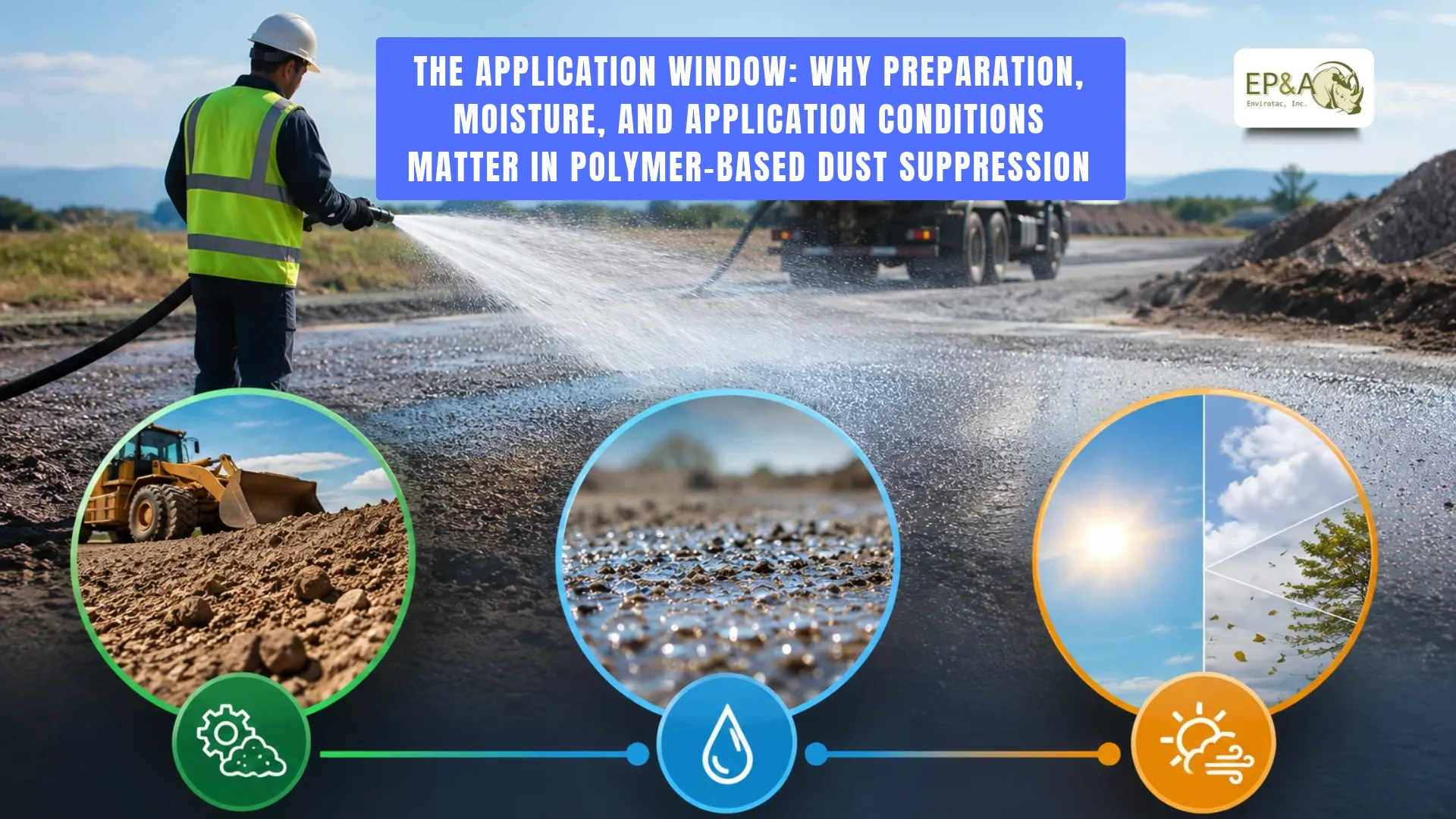
Why the Application Window Matters
“Application window” simply describes the conditions under which a specific product performs according to its own instructions, not a fixed number of hours or a universal temperature range. The spread in how long different formulations actually hold up makes that clear.
A 2022 study at an open construction site in Tianjin found that a waterborne polymer sprayed on backfill soil cut PM10 concentrations by 67.41% after 24 hours, but that figure fell to 60.87% at 48 hours and 46.54% at 72 hours (Yang, Qin & Zhang, 2022). At the other end of the scale, a tall oil pitch treatment tested at a much higher dosage held PM10 reductions for three to six months before its crust began breaking down, while a poloxamer treatment on tailings lost nearly all its effect within two weeks (both cited in Sieger et al., 2023, Table A6).
None of these numbers transfer to a different product. What they show is that durability is a function of chemistry, dosage, and what the site throws at the treatment afterward, not a property of “polymer dust suppressant” as a category.
Start With the Surface, Not the Spray Equipment
Before any of that matters, the site has to be ready to receive treatment. That starts with defining what the job actually needs. Dust suppression, wind erosion control, and formal soil stabilization overlap but aren’t interchangeable, and the answer shapes everything downstream.
Soil and aggregate characteristics affect how a polymer behaves, which is why the substrate needs checking against the specific product in use rather than assumed compatible because something similar worked on a different site. Ruts, potholes, washboarding, and poor drainage all affect how a treatment sits on the surface, and what preparation is required depends on the product and the governing specification.
One point is worth stating plainly: conventional dust palliatives are not necessarily designed to increase bearing strength. The U.S. Navy’s November 1999 user data package on polymer and lignosulfonate suppressants states flatly that the PVA and lignosulfonate products it covers “are not soil stabilizers that increase the bearing strength of the trafficked area.” It also notes that time spent compacting loose material before treatment improves the dust-control system’s effectiveness, not the suppressant itself (NAVFAC, User Data Package UDP-2006-ENV). Some other polymer formulations are designed to consolidate soil, so the distinction depends on the product. If grading or compaction is needed, it has to happen before spraying, not instead of it.
Moisture Is a Process Variable, Not a Universal Target
How wet the substrate is when treatment begins affects penetration and uniformity, but the right starting point depends on the formulation. Some products call for pre-wetting; others don’t, and that’s a label instruction, not a rule of thumb.
Moisture retention is also where polymer treatments do something water alone can’t. In the Tianjin trial, soil treated with the waterborne polymer held an average moisture content of 13.93% during drying at 35°C, compared with 6.38% for soil sprayed with plain water under the same conditions — about 2.18 times the water content, as the authors put it (Yang, Qin & Zhang, 2022). That’s the mechanism behind “longer-lasting” marketing claims made concrete: the polymer isn’t repelling water, it’s slowing how fast the existing water leaves. Dilution water used to prepare the product is a separate variable from that substrate moisture, and confusing the two is a common source of inconsistent application rates.
Weather and Timing: When Should Application Proceed or Pause?
The 1999 NAVFAC guidance states the rain rule in direct, conditional terms: don’t apply during or before rain, and if rain is forecast within 24 hours of the product’s expected drying or curing completion, postpone the work. That’s tied to older PVA and lignosulfonate products, not a universal rain-free window a current formulation should be held to.
The same report notes that, according to the suppressant distributors it cites, some products need temperatures above 63°F to cure. That figure comes from industry sources quoted inside a government report, not from NAVFAC’s own testing, and it shouldn’t be read as a technical standard.
The field evidence backs up why temperature and rain timing matter more than any fixed number: the German biopolymer trial found that treatment effectiveness declined following rainfall. The weather helped set the actual limit.
Check Drainage, Environmental Conditions, and Safe Handling
Storm drains, ditches, and watercourses near the site belong in the application plan, since runoff and suspended material can travel further than expected. And “polymer-based” alone doesn’t establish environmental safety; the evidence that exists is often narrow.
A 2025 USGS-led study in Clark County, Nevada, tracked a butyl acrylate vinyl acetate copolymer used in dust palliatives. Stormwater samples inside and outside the treated areas stayed below the study’s reporting limits, which ranged from 0.02 to 0.20 mg/mL depending on the sample, and the copolymer was no longer detected in treated soil after 90 days (Paul et al., 2025). That’s a specific result for one copolymer in one desert environment. The study also noted that some polymer or degradation product may have travelled with suspended material. It shouldn’t be read as a blanket environmental clearance. Current product SDS and handling instructions, not category-level assumptions, govern that decision on any given job.
Application Rate, Equipment, and Coverage
Application rate and dilution ratio are related but distinct figures, both of which should come from current product documentation rather than an industry range. Spray bar flow, nozzle condition, and travel speed all affect whether coverage lands evenly, and missed overlap is one of the more common, preventable sources of patchy results. Visible runoff should prompt inspection rather than an assumption about cause, and changes to mixing, rate, or weather mid-job are worth writing down, since they often explain the result later.
Drying, Curing, and Return to Service, Then Troubleshooting
Drying and curing aren’t always the same process, and the product’s own terminology should govern what “ready” means, not appearance alone. When results fall short anyway, the pattern worth tracking is symptom to verification, not symptom to assumption.
Uneven suppression usually traces to coverage gaps or surface variation rather than the product. Dust returning after treatment deserves a look at whether the application record shows weather or traffic exposure that outpaced the treatment’s actual durability, the way it did in the Tianjin and German field studies above. Surface changes or poor durability may stem from under-preparation, rainfall, or a mismatch between what the job needed and what was applied. In every case, a basic record covering the product, rate, weather, and any deviations is what turns a guess into a diagnosis.
Pre-Application Readiness Checklist
Surface and objective: Outcome defined, substrate assessed, grading and drainage work completed.
Moisture and weather: Existing moisture and pre-wetting confirmed; forecast checked against the product’s stated limits, not a generic rain-free window.
Application and equipment: Current product instructions on hand; rate and equipment output verified before spraying starts.
Environmental and handling: Drainage and sensitive receptors reviewed; current SDS available; no assumptions made from the word “polymer.”
Curing and verification: Traffic-readiness requirements understood, application record kept, follow-up inspection planned.
Conclusion
The products compared above range from a treatment that lost most of its effect within two weeks to one that held for months, and the difference wasn’t really about which chemistry was “better.” It was about dosage, site exposure, and what the weather did afterward.
That’s the practical takeaway: judge a dust suppressant by how it performed under the conditions it will actually face, not by a reduction percentage measured on a dry day. Verify the product’s current documentation, match it to the site in front of you, and keep a record of what the ground actually went through. That’s what turns a treatment that looks good on day two into one that still works on day fifteen.
Author: Clay Anderson
Clay Anderson writes about industrial dust control, soil stabilization, mining, aggregate operations, road construction, and application methods. His focus is on practical site conditions and the factors that affect treatment performance.
Need help assessing a dust-control application? Visit Envirotac, Inc. to discuss dust-control and soil-stabilization requirements for your site. Product selection and application should always follow the relevant product documentation and site conditions.