
For years, most blockchain conversations revolved around cryptocurrencies.
New tokens, trading markets, and digital assets attracted much of the attention. Today, another part of the industry is gaining serious institutional interest: bringing established financial and physical assets into blockchain-based infrastructure.
That is where real-world asset tokenization comes in.
A government debt instrument can be represented through a digital structure. A private credit position can use programmable infrastructure for specific parts of its lifecycle. A real estate investment can potentially be divided into digital ownership interests, depending on its legal and regulatory structure.
The underlying asset remains the asset.
What changes is the infrastructure used to record, manage, transfer, or settle rights connected to it.
This is why the $10 trillion opportunity has become such a widely discussed figure. Roland Berger estimates that the value of tokenized assets could reach at least $10.9 trillion by 2030 under its conservative forecast, with debt, real estate, and investment funds expected to represent major categories.
That figure is a projection, not the market's current size.
Still, it gives a useful indication of why financial institutions, asset managers, regulators, and technology companies are paying attention.
This is where RWA Tokenization Development becomes more than a technical exercise. Building a token is only one part of the process. The larger challenge is connecting blockchain infrastructure with real assets, legal rights, compliance requirements, and institutional workflows.
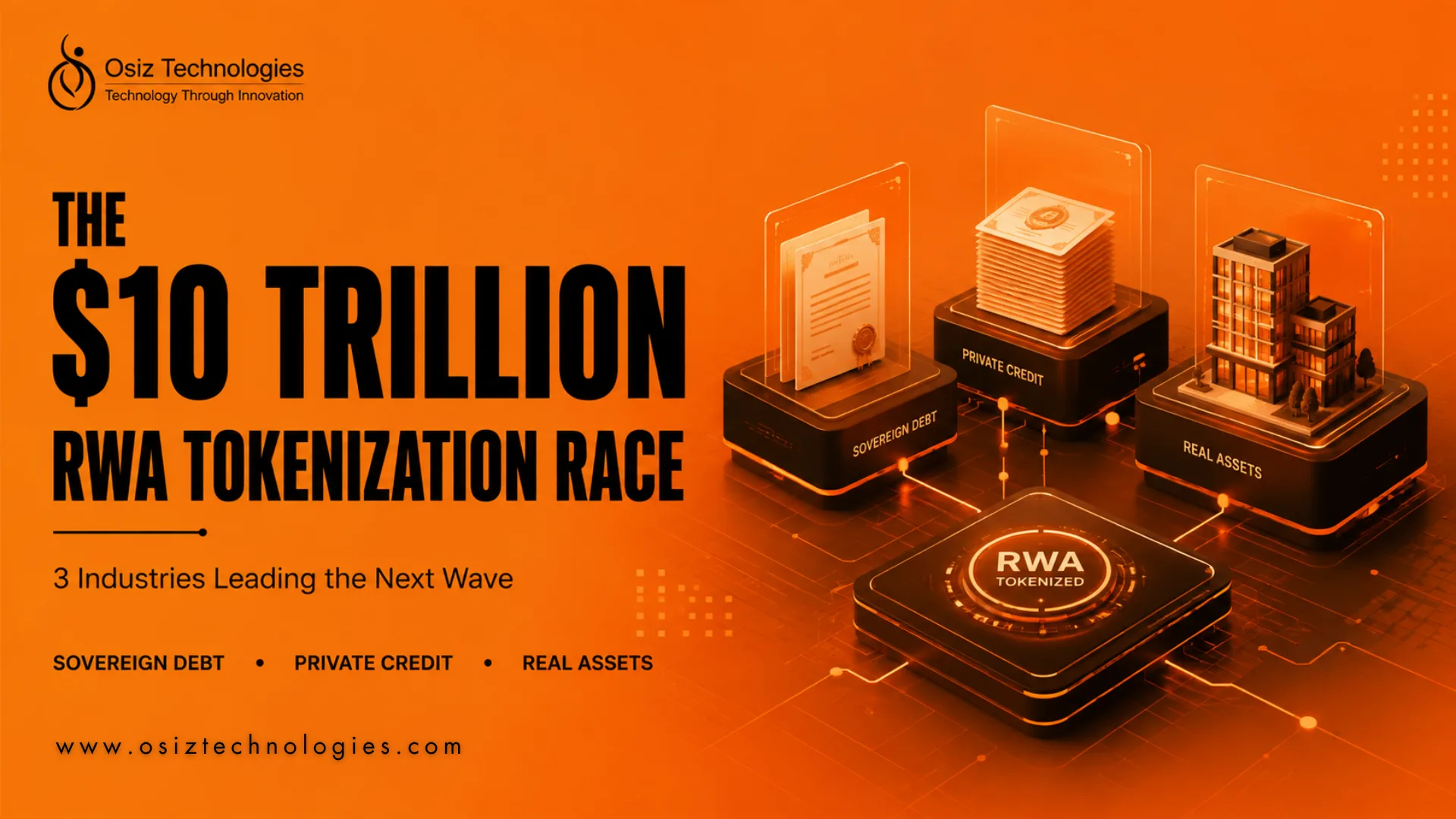
Industry Pillars: The 3 Dominant Assets Leading the On-Chain Land Grab
Pillar 1: Sovereign Debt and Tokenized U.S. Treasuries
If institutional tokenization needs a practical starting point, government debt and money-market products make a strong case.
These are already established asset classes with deep liquidity, familiar legal structures, and significant institutional participation.
Tokenization does not create a new Treasury market. Instead, it creates another way to represent and manage interests connected to existing financial products.
BlackRock's BUIDL has become one of the most visible examples of institutional tokenization. More broadly, the growing interest in tokenized money-market and treasury products shows how established financial instruments can interact with blockchain-based infrastructure.
Franklin Templeton provides another important example. Its Franklin OnChain U.S. Government Money Fund uses blockchain technology for transaction processing and share ownership records, with the BENJI token representing fund shares within its structure.
What makes this category particularly interesting is the combination of familiar assets and new operational possibilities.
Depending on the product structure and regulatory requirements, tokenized financial products can support:
- More flexible digital ownership records
- Programmable transaction workflows
- Integration with other on-chain financial infrastructure
- Wallet-based access for eligible participants
- Potentially more efficient settlement processes
- Improved visibility into certain transaction and ownership data
The important point is that the token itself is not the entire innovation.
Institutional-grade tokenization still requires fund administration, investor verification, custody arrangements, regulatory compliance, and clear ownership records.
That is why tokenized treasuries have become such an important proving ground. They show what happens when blockchain infrastructure is applied to an asset class institutions already understand.
Pillar 2: Private Credit and Institutional Debt Markets
Private credit is another area attracting attention.
The market involves complex financing structures, investor requirements, servicing processes, and transfer restrictions. These characteristics make it an interesting environment for programmable infrastructure.
This is where Blockchain Development can support the broader tokenization architecture.
Tokenization may help create more digital and programmable systems for representing ownership, applying transfer restrictions, managing specific asset events, and connecting participants across the investment lifecycle.
Singapore's Project Guardian offers a useful example of this institutional experimentation. Participants have explored use cases involving private market funds, private credit, fixed income, digital bonds, and other financial products.
Potential applications include:
- Digital representation of private market interests
- Automated transfer restrictions
- Permissioned investor access
- Programmable cash-flow distribution
- More connected reporting workflows
- Improved interoperability between financial infrastructure
For mid-market financing, this could be particularly relevant.
Private market assets can have substantial value while still relying on fragmented administrative processes. The opportunity is not simply to turn every private credit instrument into a freely tradable token.
The more practical opportunity is to improve the infrastructure around how eligible participants access, administer, transfer, and manage these assets.
That distinction matters.
Tokenization does not remove credit risk. It does not automatically create liquidity. And it does not replace the need for due diligence.
What it can provide is a more programmable infrastructure layer around an existing financial product.
Pillar 3: High-Value Real Estate and Commodities
Real estate remains one of the most widely discussed use cases for asset tokenization.
The reason is straightforward: real estate represents a massive pool of global value, while property ownership and investment can involve high entry thresholds and complex transaction processes.
A properly structured tokenization model can potentially divide economic interests into smaller digital units and manage specific ownership or transfer rights through digital infrastructure.
Possible benefits include:
- Smaller investment denominations where legally permitted
- Digital ownership and transaction records
- More efficient administration
- Programmable distributions
- Controlled transfers between eligible participants
- Greater transparency across selected asset workflows
However, tokenizing a property is much more complicated than creating a smart contract.
A serious real estate tokenization model needs clear answers to questions such as:
- Who legally owns the underlying property?
- What rights does the token holder receive?
- How is the asset valued?
- Who manages custody and administration?
- How are rental income or other distributions handled?
- What happens when an investor transfers or redeems their interest?
Commodities present a similar opportunity.
Gold, for example, can connect physical reserves with digital representations. Other commodity markets may also explore tokenized structures, depending on the underlying asset, custody model, and regulatory framework.
This is why RWA Tokenization Development requires expertise beyond blockchain engineering.
Technology matters, but so do asset structuring, compliance, legal rights, custody, and ongoing administration.
Blockchain provides the digital infrastructure.
The real-world asset and its legal structure determine what the digital representation actually means.
The Geopolitical Playbook: Global Regulatory Hubs Driving Adoption
Tokenization may use global technology, but the assets behind those tokens operate within specific legal and regulatory environments.
That makes jurisdiction a major part of the strategy.
🇪🇺 Europe: MiCA and the Wider Regulatory Picture
Europe has established one of the world's most significant regulatory frameworks for crypto-assets through MiCA.
However, for real-world asset tokenization, it is important to understand that MiCA is only part of the regulatory picture.
Under MiCA's scope, crypto-assets that qualify as financial instruments, deposits, certain funds, securitisation positions, and several other regulated financial products fall outside MiCA's scope and may instead be governed by existing EU financial regulations.
This distinction is particularly important for tokenized securities and other investment products.
For businesses building tokenization platforms in Europe, the regulatory analysis should therefore begin with a fundamental question:
What legal rights does the token represent?
The answer may determine which regulatory framework applies.
🇸🇬 Singapore: Institutional Experimentation with Guardrails
Singapore has become an important environment for institutional experimentation around tokenized financial infrastructure.
Through Project Guardian, the Monetary Authority of Singapore has brought together financial institutions and infrastructure providers to explore tokenization use cases across asset management, fixed income, foreign exchange, and private markets.
The focus is not simply on issuing digital tokens.
It is on understanding how regulated financial products can interact with programmable infrastructure while maintaining appropriate controls.
That makes Singapore an important market to watch for the institutional side of asset tokenization.
🇦🇪 Middle East: Abu Dhabi's Digital Asset Framework
Abu Dhabi Global Market has developed regulatory guidance covering digital securities and virtual assets.
Its framework distinguishes between different categories of digital assets and provides regulatory treatment for activities involving digital securities. ADGM's approach highlights an important principle for RWA projects: the legal nature of the underlying rights matters as much as the technology used to represent them.
With its growing financial ecosystem and focus on digital assets, Abu Dhabi remains an important jurisdiction for companies exploring institutional tokenization models.
Technical Infrastructure: Interoperability, Security, and Compliance
The future of tokenized assets is unlikely to exist on a single blockchain.
Different applications may use public networks such as Ethereum or Solana, permissioned networks, or a combination of blockchain and traditional financial infrastructure.
That creates an interoperability challenge.
A tokenized asset may need to interact with:
- Public or permissioned blockchain networks
- Banking and payment infrastructure
- Custody platforms
- KYC and identity systems
- Compliance monitoring tools
- Regulatory reporting systems
Smart contracts can automate specific rules around transfers, distributions, and permissions.
Cross-chain infrastructure can help different blockchain environments communicate, although institutional use cases require careful attention to security, transaction finality, governance, and asset controls.
AI may also support document analysis, compliance monitoring, anomaly detection, and aspects of smart contract review. These systems still require appropriate validation and governance, particularly when they affect regulated financial activity.
For companies planning an RWA platform, the technology decision should begin with the asset and the business model.
Not every project needs the same blockchain.
Not every asset needs the same level of decentralization.
And not every token needs unrestricted transferability.
A capable RWA Tokenization Development Company should design the architecture around the asset, investor requirements, compliance obligations, and operational workflow.
The technology should support the business model - not define it.
Strategic Conclusion and the 2030 Horizon
By 2030, tokenization could become a more familiar part of financial and asset infrastructure.
Government debt, private credit, real estate, investment funds, and commodities may increasingly use digital systems for specific parts of ownership, administration, settlement, and distribution.
Roland Berger's forecast of at least $10.9 trillion in tokenized assets by 2030 illustrates the scale of the potential opportunity, although the actual market outcome will depend on adoption, regulation, infrastructure, and institutional demand.
The bigger opportunity is not simply to place assets on a blockchain.
It is to build better infrastructure around how those assets are managed.
That is where the next phase of RWA Tokenization Development is likely to focus: combining blockchain technology with clear legal structures, reliable asset data, strong compliance controls, and practical institutional requirements.
Which of these three industries do you think will move fastest toward large-scale tokenization: sovereign debt, private credit, or real estate?