A construction bid can be well estimated, competitively priced and still be thrown out in the first round, because a certificate had expired, the EMD was in the wrong form, or a single declaration was left unsigned. In most tenders, the technical envelope is opened first, and a bid that fails there never has its price read.
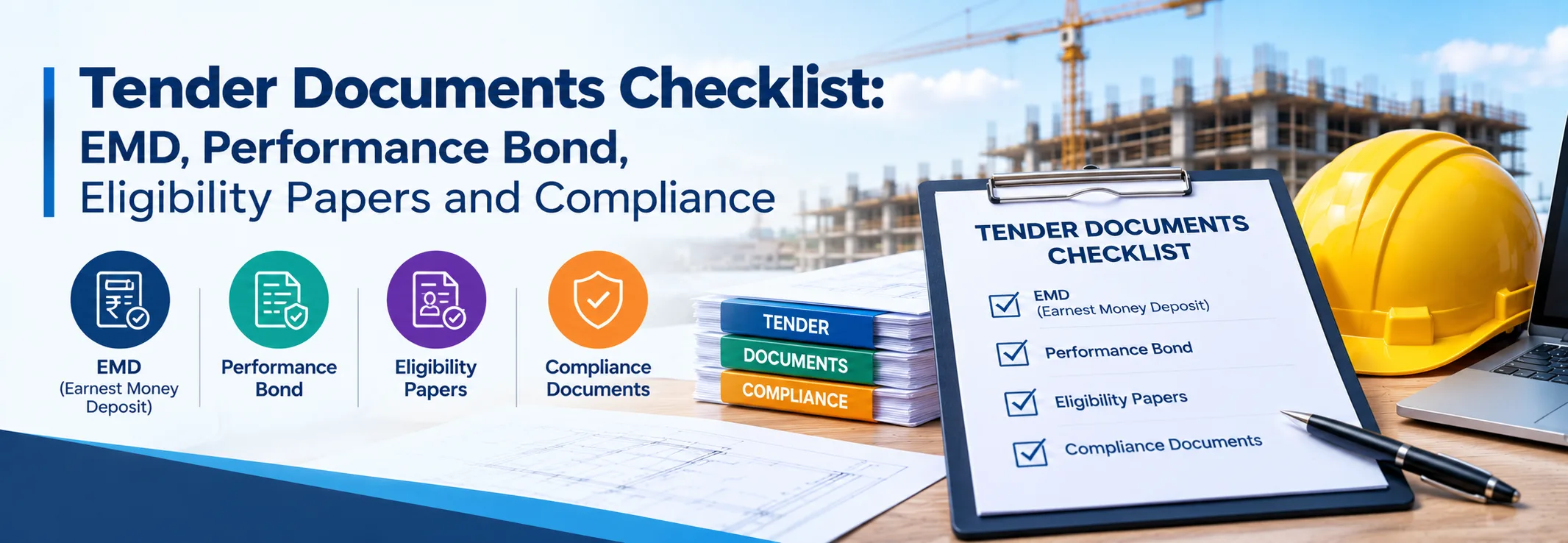
This tender documents checklist covers what contractors typically need to submit: the earnest money deposit (EMD), the performance bond that follows award, eligibility papers that prove you are qualified, and the compliance documents that show you follow the tender rules. Use it alongside the tender's own instructions to bidders, which always take priority.
This article zooms in on the paperwork behind bid submission.
Master Tender Documents Checklist
Exact requirements differ by client, country and contract value. Treat this table as a starting point and compare it with the tender notice and bid data sheet.
CategoryDocumentPurposeWatch out forBid securityEMD or bid security (bank guarantee, demand draft, online payment or other prescribed form)Shows you are serious and covers the client if you withdrawAmount, form, validity period and beneficiary nameBid securityEMD exemption proof, if applicableClaims any exemption the tender allowsValid registration certificate and categoryEligibilityCompany registration, constitution documents, partnership deed or incorporation certificateProves legal identityName must match all other documentsEligibilityPAN, GST registration, tax clearance or returnsProves tax standingRegistration status and stateEligibilityContractor registration or class certificate, where requiredProves category and value limitClass limit versus tender valueFinancialAudited balance sheets and profit and loss statementsShows financial strengthRequired number of years and CA certificationFinancialTurnover and net worth certificatesMeets minimum financial criteriaFormat and period asked forFinancialBank solvency certificate, if askedConfirms credit standingIssue date and validityExperienceCompletion certificates and work orders for similar worksProves comparable experienceValue, scope and date of similar workTechnicalList of key personnel with CVsShows delivery capabilityQualification and experience matchTechnicalList of plant and equipment owned or availableShows resourcesOwnership proof or lease or hire lettersTechnicalMethod statement and construction programmeShows how you will buildConsistency with the BOQ and the completion periodJoint ventureJV agreement and lead partner authorisationDefines roles and liabilityShare, liability and signatoriesCompliancePower of attorney or authorisation letterConfirms who can signNotarisation and signatory nameComplianceSigned tender forms, declarations and undertakingsMeets mandatory conditionsMissed signatures or stampsComplianceAddenda acknowledgementConfirms you priced the latest documentsEvery addendum acknowledgedCommercialPriced BOQ and covering letterThe financial offerNo blank rates, no unauthorised changesPost-awardPerformance security, insurance and agreement documentsSecures contract performanceDeadlines after the letter of awardEMD (Earnest Money Deposit) Explained
The EMD, also called bid security or bid bond, is a deposit submitted with your bid. It protects the client against a bidder who withdraws, changes the offer after opening, or refuses to sign the contract after award. Without a valid EMD in the required form, many tenders treat the bid as non-responsive.
What the tender will specify
- Amount: a fixed sum or a percentage of the estimated project value, stated in the notice or bid data sheet.
- Form: commonly a bank guarantee, demand draft, banker's cheque or online payment. Some clients also accept other instruments, so use only what the tender lists.
- Validity: the guarantee must usually stay valid for the bid validity period plus a margin, so check the exact date.
- Beneficiary and format: the guarantee must name the correct client and often follow a prescribed format.
- Exemptions: some tenders exempt certain categories of bidders, for example registered micro and small enterprises under applicable procurement policies. Claim an exemption only with the proof the tender asks for.
Refund and forfeiture
EMDs of unsuccessful bidders are released after the award or after the bid validity ends, as the conditions state. The successful bidder's EMD is typically adjusted against, or replaced by, the performance security. The client may forfeit an EMD if the bidder withdraws within the validity period, fails to accept the award, or does not provide the performance security on time.
EMD tips
- Ask your bank for the guarantee at least a week before the deadline, since format corrections take time.
- Check amount, validity, beneficiary and wording against the tender, then have a second person verify them.
- Track every EMD in a register with issue date, expiry and release status, so funds are not locked up longer than necessary.
Performance Bond (Performance Security) Explained
A performance bond, also called performance security or performance bank guarantee, is submitted after the letter of award. It assures the client that you will complete the work as per the contract. If you default, the client can claim against it.
Typical features
- Amount: usually a percentage of the contract value, set out in the contract documents.
- Form: bank guarantee, demand draft, fixed deposit receipt or similar, and some clients accept insurance surety bonds. Use what the contract allows.
- Timing: normally due within a fixed number of days from the letter of award or acceptance.
- Validity: generally runs through completion and often through the defect liability period, with a margin for claims.
- Release: returned in full or in stages after completion, handover or the end of the defect liability period, as the contract states.
Related guarantees you may also face
InstrumentPurposeWhen it appliesAdvance payment guaranteeSecures a mobilisation advanceWhen the client pays an advance before work is doneRetention money or retention guaranteeHolds back part of each payment until defects are rectifiedThroughout the contract or until the defect liability period endsInsurance cover (contractor's all risk, workmen's compensation, third-party liability)Covers damage, injury and third-party claimsBefore site start, as the contract requiresPerformance bond tips
- Read the guarantee clause before you bid. It affects your cash flow and bank limits.
- Plan the cost: bank guarantees carry commission and may block credit limits or margin money.
- Calendar the expiry dates and extend guarantees before they lapse, because an expired guarantee can put you in breach.
- Include guarantee cost in your tender estimate so it is not eaten out of your margin.
Eligibility Papers: Proving You Qualify
Eligibility papers answer one question for the client: can this contractor deliver this project? Most tenders test four areas.
1. Legal and registration status
Company or firm registration, partnership deed or incorporation certificate, PAN, GST registration, contractor registration or class certificate where the client requires one, and any trade licences. Names and addresses must be consistent across every document.
2. Financial capacity
Audited financial statements for the required years, turnover certificates, net worth, and sometimes bank solvency or credit limit letters. Tenders usually state minimum annual turnover and liquidity thresholds. If you fall short, check whether the tender allows a joint venture or a combined assessment.
3. Technical and experience capacity
- Completion certificates and work orders for similar works, within the stated value and time window
- Key personnel list with qualifications and experience
- Plant and equipment list, with ownership proof or hire and lease commitments
- Method statement, quality plan and a construction programme where the tender asks for them
Experience certificates should state the client, scope, value, dates and completion status. A certificate that only says "work done" without value or date is often rejected.
4. Integrity and past performance
Undertakings on blacklisting or debarment, litigation history, abandoned or terminated contracts and conflict of interest. Answer them truthfully. A false declaration can lead to disqualification or later termination.
Joint ventures and consortiums
Where you bid as a JV, include the JV agreement, lead partner authorisation, share of work and joint and several liability clauses as required. Confirm in advance how the tender counts each partner's turnover and experience.
Compliance Documents: Showing You Follow the Rules
Compliance covers everything that proves your bid is complete, valid and aligned with the tender conditions, and that your business meets legal obligations.
- Statutory registrations: labour licence, provident fund and ESI registrations, and other registrations that apply to your trade and location.
- Safety, quality and environment: safety policy, quality certifications and environmental compliance, where requested.
- Tender forms and declarations: every prescribed form completed, signed and stamped, including declarations of acceptance of conditions, bid validity and non-collusion.
- Integrity pact or code of conduct: signed where the client requires it.
- Authorisation: power of attorney or board resolution naming the person who signs the bid.
- Digital signature and online submission: a valid digital signature certificate and registration on the e-procurement portal, with file formats and sizes as specified.
- Addenda and clarifications: a signed acknowledgement of every addendum issued, plus evidence your price reflects them.
- Insurance: proof of cover or an undertaking to provide it after award, as the contract states.
Compliance is where careless errors cost the most, because the checks are binary: the document is either there and valid, or the bid fails.
Document Preparation Timeline
Work backwards from the closing date. This schedule suits a typical open tender, so shorten it for limited tenders with tight windows.
- As soon as the notice arrives: read the eligibility clauses and list every document, form and certificate required. Decide bid or no-bid.
- Days 1 to 3: request bank guarantees, audited accounts, CA certificates and experience letters, since these depend on third parties.
- Week 1: collect and verify registrations, tax documents and personnel and equipment lists. Check expiry dates.
- Weeks 1 to 2: prepare method statement, programme and technical forms alongside the estimate.
- Final week: assemble the technical and financial bids, acknowledge all addenda and get authorised signatures.
- Two days before the deadline: independent review by a second person against the master checklist.
- One day before: upload, test file formats and portal limits, and save the submission acknowledgement.
- After submission: diarise EMD expiry, bid validity and likely evaluation dates.
Common Document Mistakes That Disqualify Bids
MistakeResultHow to prevent itEMD in the wrong form, amount or validityBid rejected as non-responsiveCheck against the bid data sheet; verify with a second person before submissionExpired certificates (registration, GST, solvency, DSC)Eligibility not provenKeep a document register with expiry alertsExperience certificates without value, scope or dateExperience not acceptedRequest certificates in the format the tender usesUnsigned or unstamped forms and declarationsTechnical rejectionSign-off checklist with a named reviewerNames and details inconsistent across documentsQueries or rejectionStandard company profile used for every bidAddenda not acknowledged or pricedBid based on outdated scopeLog every addendum and carry changes into the estimateWrong or missing authorisationSignature not validBoard resolution or power of attorney prepared in advanceAltering the BOQ format or leaving rates blankPrice bid invalidFill every line; state assumptions in the covering letterLate or last-minute uploadPortal failure or late rejectionSubmit at least a day early and save the acknowledgementGuarantee expiry missed after awardBreach of contract or claim on the bondCalendar all guarantee expiry and extension datesHow Tender Software Tracks Documents and Compliance
A spreadsheet and a shared folder can hold a document list, but they do not warn you when a certificate is about to expire or a requirement is missing. Construction tender & bid management software builds the checklist into the workflow, so gaps surface before submission, not after rejection.
ZYNO Construction offers tender estimation software that tracks compliance requirements for every tender, including EMD submissions, performance bond requirements, qualification documents, turnover certificates and experience statements. Compliance checklists sit inside the tendering workflow, and missing documents are flagged before submission, so bids are not disqualified on technical grounds after the estimating work is done.
Other features that support your document work:
- Tender registration and pipeline: every opportunity is logged with deadline and status, and deadline alerts work as tender alerts so documents are requested early. This is core tender tracking software functionality.
- Document management and version control: BOQs, drawings, specifications, addenda, queries and bid submissions are stored per tender, and every revision is time-stamped, so you always price and submit from the latest set.
- BOQ upload and scope analysis: the client's BOQ is mapped and checked for gaps before pricing, supporting accurate tender estimation.
- Vendor and subcontractor quotes: quotes are compared in one place, as a tender quoting system and tender evaluation software for supplier bids, so your price and supporting papers stay aligned.
- Guarantee and cash planning: the cost of EMDs and performance bonds can be reflected in your pricing and tracked alongside finance and controls and budgeting.
- After award: the winning estimate converts into the project budget, which is the basis of software linking tender estimate to final account, with procurement and subcontractor management working from the same data.
For head contractor tendering software needs, this means one team can run several live bids, each with its own workspace, checklist and deadlines, without losing track of who owes which document.
Frequently Asked Questions
What documents are required for a construction tender?
Typically bid security (EMD), company registration and tax documents, financial statements and turnover certificates, experience certificates, technical capacity details, signed tender forms and declarations, authorisation documents, addenda acknowledgements and the priced BOQ. The tender notice lists the exact set.
What is EMD in a tender?
EMD stands for earnest money deposit. It is a security submitted with the bid to show commitment and to protect the client if the bidder withdraws or fails to sign the contract after award.
What is the difference between EMD and a performance bond?
The EMD is submitted with the bid and covers the bidding stage. The performance bond is submitted after award and covers delivery of the contract. The EMD of the winning bidder is usually adjusted against or replaced by the performance security.
In what form can EMD be paid?
Common forms include bank guarantee, demand draft, banker's cheque and online payment. Only use the forms the tender document allows, with the specified amount, validity and beneficiary.
How long must a performance bond stay valid?
Usually until completion of the work and often through the defect liability period, with an additional claim period. The contract states the exact validity and the release conditions.
What happens if my EMD expires before the evaluation is complete?
The client may ask you to extend it. If you refuse, your bid can be treated as withdrawn. Track EMD expiry and bid validity from the day you submit.
Which documents prove eligibility?
Registration and tax documents, audited accounts, turnover and net worth certificates, completion certificates for similar works, lists of key personnel and equipment, and declarations on blacklisting and litigation.
Can a bid be rejected for missing documents even if the price is lowest?
Yes. Most tenders evaluate the technical bid first, and a bid that fails the technical stage is rejected before the price bid is opened.
Can tender software manage compliance documents?
Yes. Platforms such as ZYNO Construction include compliance checklists for EMDs, performance bonds, qualification documents and certificates, and flag missing items before submission. You should still verify every requirement against the specific tender.
Conclusion
Tender paperwork is not a formality. EMD, performance bond, eligibility papers and compliance documents decide whether your price is ever considered. Build a master checklist, start third-party documents early, keep a register of expiry dates, review every bid with a second pair of eyes, and submit ahead of the deadline.
The contractors who do this consistently treat tender documents as a managed process, not a last-week scramble. To bring tender tracking, compliance checklists, BOQ analysis, rate analysis and quote comparison into one place, explore ZYNO Construction's tender estimation software, or look at the full ZYNO Construction ERP and book a free demo.