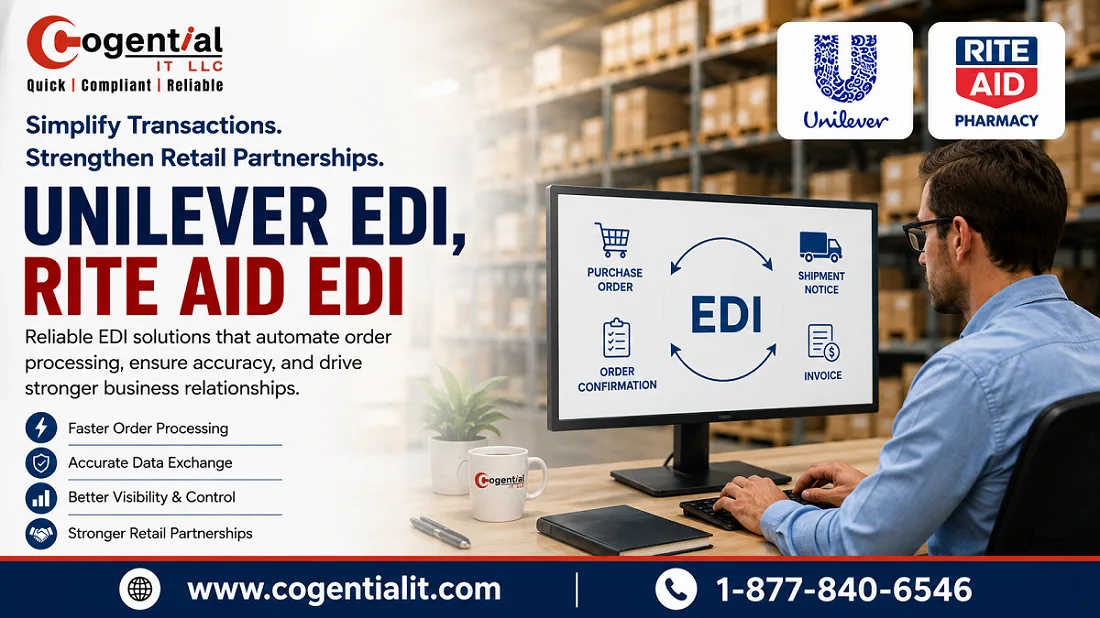
Retail supply chains depend on countless transactions happening correctly and on time. A purchase order needs to reach the right team, shipment details must be communicated clearly, and invoices have to match the original transaction. Unilever EDI helps suppliers create structured electronic communication with Unilever, while Rite Aid EDI supports digital transaction exchange within the healthcare and retail environment. For companies managing high-volume relationships, a well-planned EDI setup can remove unnecessary manual work and create a smoother path from order processing to payment.
Why EDI Has Become Essential for Suppliers
Retail operations generate a constant stream of business documents. Handling those records manually can consume valuable employee time and introduce avoidable errors. EDI provides a standardized digital method for exchanging information between trading partners.
Instead of manually entering order details, teams can connect their internal business applications with an EDI platform. Documents can then be transformed into the required format and transmitted electronically.
This approach can make everyday workflows more consistent while helping employees focus on tasks that require judgment rather than repetitive data entry.
Understanding Unilever EDI
Unilever works with suppliers across a wide range of consumer products and markets. Maintaining accurate transaction communication is important when order volumes and product movement are substantial.
Unilever EDI enables suppliers to exchange standardized business documents electronically according to the applicable trading-partner requirements. Depending on the relationship, these transactions may include purchase orders, acknowledgments, shipment notifications, invoices, and other documents.
A reliable connection can reduce the need for employees to repeatedly copy information between systems. When EDI is connected to an ERP or order-management application, information can move through a defined workflow with fewer manual touchpoints.
The goal is not simply to transmit documents. A useful integration should fit naturally into the supplier’s existing operations.
How Rite Aid EDI Supports Retail Transactions
Healthcare and pharmacy retail environments require dependable coordination between suppliers and retail organizations. Rite Aid EDI provides an electronic channel for exchanging business information in a structured format.
For suppliers, an integrated workflow can support purchase-order communication, shipment-related documents, invoices, and other transaction requirements. Automated exchange can help reduce administrative effort while giving teams better visibility into document activity.
When transaction volumes grow, the value of automation becomes even more apparent. Employees do not have to handle every document as an isolated task. Instead, recurring processes can follow established rules while exceptions receive direct attention.
Benefits of a Reliable EDI Integration
Faster Document Processing
Electronic communication allows transaction information to move between connected systems without relying on manual document handling. This can help shorten processing cycles and improve responsiveness.
Greater Data Accuracy
Manual entry creates opportunities for incorrect quantities, product identifiers, prices, addresses, or other details. Automated data transfer reduces repeated typing and helps maintain consistency.
Reduced Administrative Pressure
EDI can take repetitive tasks out of employees’ daily routines. Instead of constantly downloading files, updating spreadsheets, and entering records, teams can concentrate on operational decisions and customer needs.
Better Transaction Visibility
A properly monitored integration can provide useful insight into document status. Businesses can identify transmission failures or processing problems sooner, allowing issues to be addressed before they affect downstream activities.
Support for Business Growth
Increasing order volume does not always have to mean increasing administrative workload at the same rate. An automated EDI environment can provide a scalable foundation for expanding supplier relationships.
Why Cogential IT for EDI Integration?
Every organization has its own technology stack. One supplier may rely on an ERP platform, while another may use a combination of accounting software, warehouse applications, and custom systems.
Cogential IT helps businesses connect their existing technology with trading-partner requirements. EDI services can include document mapping, data transformation, connectivity, testing, monitoring, and technical support.
The focus is on creating a dependable connection that fits the business instead of adding another disconnected application for employees to manage.
Whether the requirement involves Unilever EDI or Rite Aid EDI, the integration should be designed around transaction requirements, internal workflows, and the systems already supporting the company.
Making the Order-to-Cash Process More Efficient
An EDI connection becomes most valuable when it supports the entire transaction lifecycle. A purchase order enters the supplier’s system, the order is processed, shipment information is communicated, and an invoice follows the appropriate workflow.
Without integration, employees may need to move information manually between multiple applications. That creates additional opportunities for delays and inconsistencies.
With a connected setup, these steps can become part of a repeatable digital process. Employees can monitor activity and step in when something falls outside normal conditions.
This balance between automation and human oversight is what makes EDI practical for modern supply chains.
Common EDI Challenges Businesses Should Consider
Implementing EDI is not simply a matter of connecting two systems. Document structures, business rules, validation requirements, connectivity methods, and internal data formats all need to work together.
Testing is therefore an important stage. Transactions should be validated before production use to confirm that information is mapped correctly and reaches the trading partner in the expected format.
Ongoing monitoring also matters. Even a well-configured connection can encounter issues caused by system changes, missing information, or unexpected transaction conditions. Having appropriate support helps businesses resolve these situations without disrupting routine operations.
Frequently Asked Questions
1. What is Unilever EDI?
Unilever EDI refers to the electronic exchange of standardized business documents between suppliers and Unilever. Depending on the trading relationship, transactions can include orders, acknowledgments, shipment notices, invoices, and related records.
2. What does Rite Aid EDI help suppliers manage?
Rite Aid EDI provides a structured electronic method for exchanging business information with Rite Aid. It can support transaction documents such as purchase orders, shipping information, invoices, and other required communications.
3. Can EDI integrate with an existing ERP?
Yes. EDI can connect with many ERP, accounting, warehouse, and order-management systems. The appropriate method depends on the existing platform and the requirements of the trading partner.
4. Does EDI eliminate the need for employees?
No. EDI reduces repetitive transaction work, but employees remain important for exception handling, operational decisions, customer communication, and business management.
Conclusion
Reliable information exchange is at the heart of a healthy retail supply chain. Unilever EDI and Rite Aid EDI can help suppliers replace repetitive manual processes with structured electronic communication, improving consistency while creating room for teams to focus on more valuable work.
With Cogential IT, businesses can build EDI connections around their existing technology and operational needs. The result is more than automated document exchange—it is a stronger digital foundation that helps suppliers manage transactions confidently, respond to change, and build lasting relationships with major trading partners.