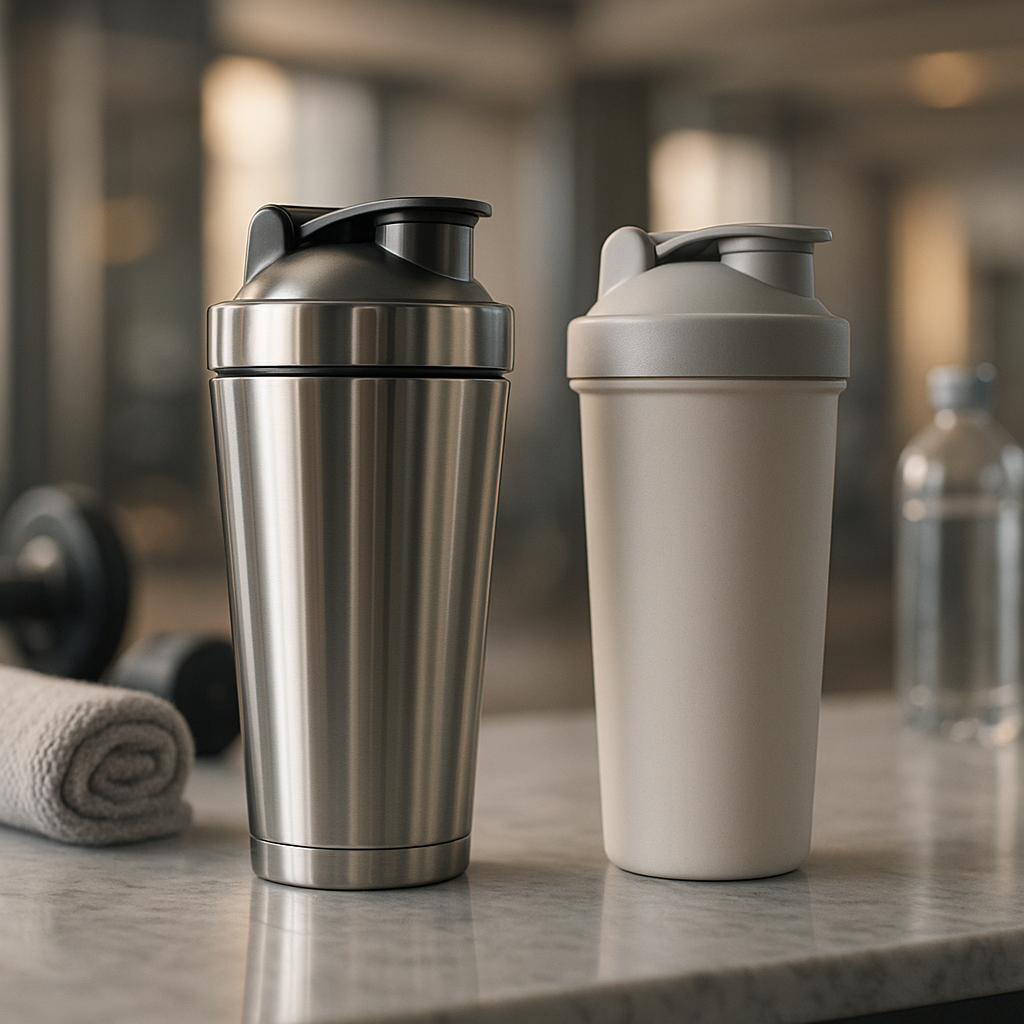
For wholesale and private-label buyers, the right shaker material depends on more than unit price. The decision affects product positioning, tooling, customization, quality checks, and the final cost of bringing a product to market.
Start With the Buyer’s Requirements
A premium fitness brand may want a solid feel, a refined finish, or temperature retention. A promotional program may care more about low weight, affordable pricing, and dependable production at scale. The material should follow the intended use, customer expectations, order volume, and target price—not the other way around.
Three options commonly considered for drinkware programs are stainless steel, polypropylene (PP), and Tritan copolyester. They are not interchangeable. Each has different strengths, limitations, and manufacturing implications, so a clear product brief is the best starting point.
Stainless Steel, PP, and Tritan: The Main Trade-Offs
Stainless steel is often selected for premium positioning and for designs that use double-wall vacuum insulation. It can provide a substantial feel and a durable exterior, but it generally adds weight and cost compared with a simple plastic shaker. Those added costs make sense when the product’s features and intended price point justify them.
Polypropylene is lightweight and commonly considered for cost-sensitive, high-volume programs. It can suit entry-level fitness products, event giveaways, and promotional orders where affordability and everyday practicality matter more than insulation or a metal finish.
Tritan is a transparent copolyester used when visibility of the contents is part of the design. It can offer a clear or translucent look without requiring a stainless-steel body. Buyers should specify the exact resin grade, component, and intended use with the supplier rather than relying on a broad material label.
A Quick Material-Selection Framework
Buyer priorityOption to evaluateMain trade-offPremium feel or insulationStainless steelHigher cost and weightLow weight and cost controlPPUsually not suited to vacuum insulationTransparent plastic appearanceTritanMay cost more than commodity plasticsMultiple price tiersA mix of materialsMore specifications and supplier coordinationWhen Stainless Steel Is Worth Considering
Stainless steel can support a premium product proposition when customers value a sturdy body, a refined finish, or temperature retention. A double-wall vacuum construction may broaden the product’s use case, but it also introduces additional manufacturing steps. Buyers should evaluate the complete product, including wall construction, weld quality, lid design, threads, seals, and surface finish.
The extra investment is not automatically worthwhile. If a shaker is intended mainly as a low-cost giveaway and users do not need temperature control, a vacuum-insulated steel design may add cost and weight without creating enough value. The practical question is whether the added features support the product’s intended audience and price.
When Plastic May Be the Better Business Choice
Plastic can be practical when lightweight handling, transparency, price, and production scale are central to the brief. PP may fit large promotional orders and entry-level products, while Tritan may be worth evaluating when a transparent body is an important design feature.
Performance depends on more than the name of the resin. Wall thickness, mold design, production settings, lid geometry, threads, and sealing components all influence the finished product. A detailed specification and consistent manufacturing controls are more useful than assuming every product in the same material category will perform alike.
How Material Choice Changes Total Cost
Unit price is only one part of the purchasing decision. Total project cost may also include tooling, sampling, decoration, packaging, freight, inspection, and the cost of managing several product variants. A custom plastic shape may require a new injection mold; changes to a steel bottle’s body, lid, or construction can also affect development work and lead time.
Before requesting quotations, prepare a product brief covering the target price, estimated order quantity, user group, capacity, usage scenario, required features, decoration, packaging, and delivery expectations. Suppliers can be compared more fairly when they quote the same specification. If one quotation includes tooling or testing and another does not, comparing unit prices alone can be misleading.
Customization: Decoration or Structural Change?
Customization options may include color matching, logo printing or engraving, surface finishes, custom lids, mixing accessories, and branded packaging. Available methods depend on the material, design, and manufacturing process.
It helps to separate appearance changes from structural changes. Changing artwork or color may be less complex than changing the bottle shape, lid geometry, handle, threads, or internal components. Structural changes can require engineering work, tooling, sample approval, and extra lead time. Decide early which features are essential to differentiation.
What to Check Before Choosing a Manufacturer
Ask the supplier to identify the materials used for the body, lid, gasket, and any other component that contacts the beverage. General phrases such as “food-grade” or “BPA-free” are not a substitute for product-specific documentation. For the U.S. market, the FDA explains that the regulatory status of a food-contact article depends on the substances used and their authorized conditions of use. Buyers can review the FDA’s guidance here:
Request documentation that applies to the actual finished product and its intended use.
The production process should match the design. A vacuum-insulated stainless-steel bottle may involve forming, welding, surface treatment, assembly, and vacuum processing; a custom plastic shaker relies heavily on mold design and control of the molding process. Ask how the supplier manages samples, tooling, production parameters, assembly, and final inspection.
A useful overview of stainless-steel bottle manufacturing processes can help buyers identify questions to raise when evaluating a custom stainless steel bottle manufacturing process.
The body alone does not determine the user experience. Lid fit, thread accuracy, gasket design, locking features, mixing components, and decoration can all affect the finished product. Agree on acceptance criteria before mass production and test representative samples for the intended use. For insulated products, include temperature-retention performance in the quality plan if it is a promised feature.
In an OEM arrangement, the buyer typically provides a more complete specification for the supplier to manufacture. In an ODM arrangement, the supplier may offer an existing or developed design that the buyer adapts to its brand. Definitions and responsibilities vary by contract, so clarify design ownership, tooling ownership, development fees, permitted modifications, lead times, and approval responsibilities before production.
A Practical Checklist for B2B Buyers
- Define the target price, audience, order quantity, and use case.
- Choose the material based on required features—not appearance alone.
- Specify the body, lid, gasket, and mixing components separately.
- Request product-specific material and compliance documentation.
- Clarify whether customization involves decoration, accessories, or new tooling.
- Approve a production-representative sample before placing a bulk order.
- Agree on inspection criteria, packaging, delivery terms, and responsibility for defects.
Conclusion: Match the Material to the Market
There is no single material that is best for every protein-shaker program. Stainless steel may suit premium products where finish and insulation matter; PP may be more practical for lightweight, cost-sensitive, high-volume orders; and Tritan is worth considering when transparency is central to the design.
The strongest purchasing decision balances customer value, target pricing, manufacturing feasibility, customization, documentation, and total landed cost. A clear specification and a disciplined sample-approval process help suppliers quote consistently and give buyers a stronger basis for comparing proposals.
Republication Disclosure
This article was originally published on Waterbottle.tech. The submitting author confirms ownership of the original content and is submitting this version for republication.
Original article: https://www.waterbottle.tech/stainless-steel-vs-plastic-protein-shakers-b2b-sourcing/