
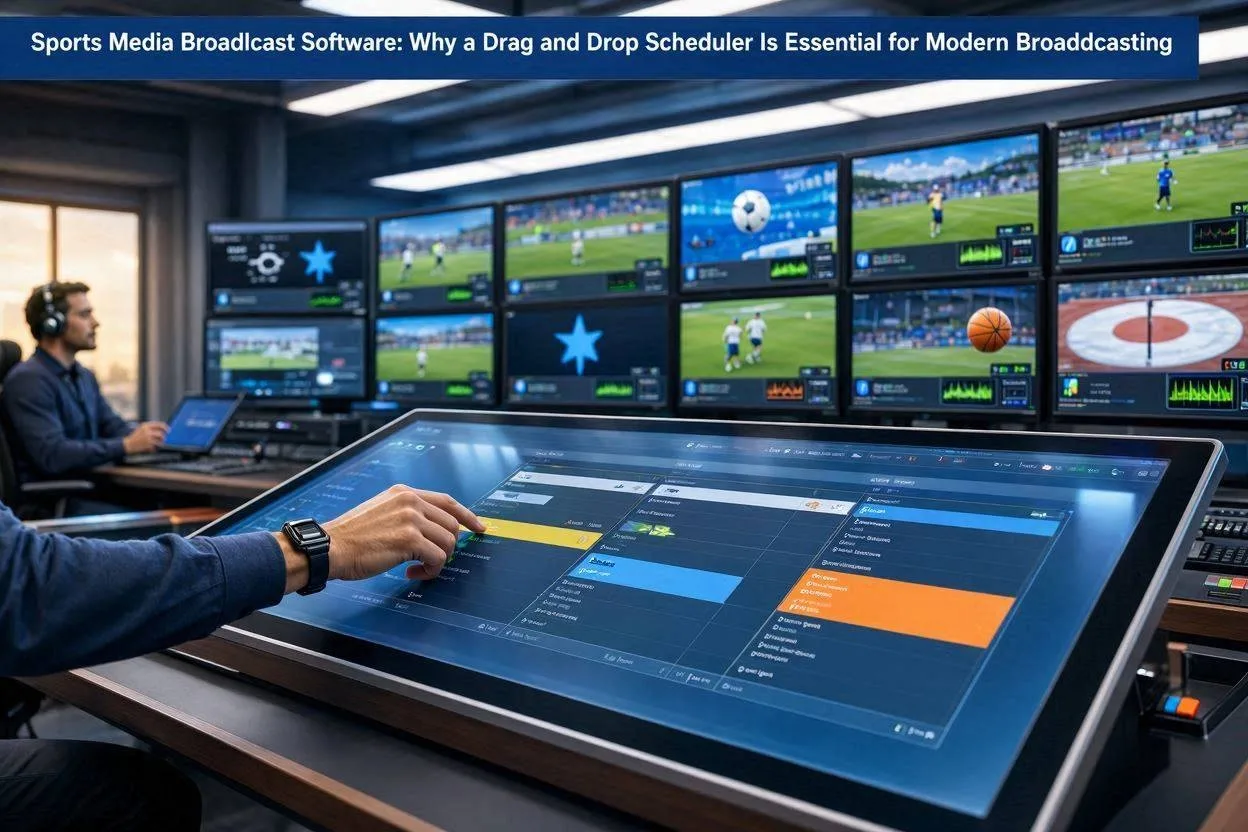
The sports broadcasting landscape has changed dramatically with the rise of OTT platforms, cloud streaming, IPTV services, and FAST channels. Today's audiences expect instant access to live matches, tournament coverage, player interviews, documentaries, and highlight reels across multiple devices. To meet these expectations, broadcasters require advanced sports media broadcast software that simplifies operations while ensuring uninterrupted content delivery. One feature that has become indispensable is the drag and drop scheduler, which enables broadcasters to manage programming quickly, accurately, and efficiently.
Unlike entertainment channels that typically follow fixed schedules, sports broadcasting involves constant changes. Live matches may extend into extra time, tournaments may experience weather delays, and breaking sports news often requires immediate schedule adjustments. Without intelligent scheduling software, managing these changes becomes difficult and increases the risk of broadcasting errors.
This article explores why every sports broadcaster should invest in professional sports media broadcast software with an advanced drag and drop scheduler.
Understanding Sports Media Broadcast Software
Sports media broadcast software is a complete broadcasting solution that helps organizations schedule, automate, manage, and distribute sports content across television channels and online streaming platforms.
Modern broadcast software handles multiple workflows, including:
- Live sports streaming
- Video playlist management
- Channel automation
- Advertisement insertion
- Broadcast scheduling
- Content libraries
- Branding overlays
- Multi-platform distribution
Instead of managing each process separately, broadcasters operate everything from one centralized system.
The Challenges of Sports Broadcasting
Sports programming differs significantly from traditional television scheduling.
Broadcasters regularly deal with:
- Match delays
- Overtime periods
- Tournament schedule changes
- Weather interruptions
- Simultaneous sporting events
- Emergency broadcasts
Because sports programming is unpredictable, broadcasters require flexible scheduling systems capable of responding instantly to changing circumstances.
What Is a Drag and Drop Scheduler?
A drag and drop scheduler is a visual scheduling tool that allows broadcasters to organize television programming simply by moving content blocks across a graphical timeline.
Rather than manually editing broadcast schedules, operators can update programming with a few simple actions.
For example, if a football match extends beyond its scheduled finish time, operators can quickly move the next program without rebuilding the entire day's schedule.
This approach dramatically simplifies broadcast management.
Advantages of a Drag and Drop Scheduler
Modern scheduling systems provide several operational benefits.
Rapid Schedule Updates
Programming changes can be completed within seconds.
This flexibility is especially valuable during live sporting events.
Reduced Human Error
Visual interfaces make programming conflicts much easier to identify before broadcasts begin.
Automation also reduces scheduling mistakes.
Greater Operational Efficiency
Broadcast teams spend less time managing schedules and more time producing quality content.
Improved Collaboration
Multiple departments can coordinate programming using a centralized scheduling interface.
These advantages significantly improve broadcasting reliability.
Managing Live Sports Broadcasting
Live sports remain one of the most demanding forms of television production.
Professional broadcasting software supports:
- Football
- Cricket
- Basketball
- Tennis
- Rugby
- Hockey
- Motorsports
- Esports
Scheduling software ensures that live broadcasts transition smoothly while maintaining continuous programming.
Cloud-Based Broadcasting
Modern sports broadcasters increasingly rely on cloud-native infrastructure.
Cloud broadcasting offers several important benefits.
Automatic Scaling
Major tournaments often attract millions of viewers simultaneously.
Cloud systems automatically allocate additional resources to maintain stable streaming.
Remote Operations
Production teams can manage broadcasts from virtually any location.
Lower Operating Costs
Organizations reduce hardware investments while simplifying maintenance.
Cloud-native broadcasting provides flexibility while supporting future expansion.
Video-on-Demand Libraries
Today's audiences expect more than live broadcasts.
Professional sports platforms organize:
- Match replays
- Tournament archives
- Coaching videos
- Sports documentaries
- Athlete interviews
- Highlight collections
Scheduling software also manages promotional placement for these on-demand assets.
Broadcast Automation
Automation is one of the greatest strengths of modern sports media broadcast software.
Automated systems manage:
- Daily playlists
- Commercial insertion
- Promotional content
- Channel branding
- Live event transitions
- Emergency schedule changes
Automation reduces manual intervention while maintaining consistent broadcasting quality.
Adaptive Streaming Technology
Internet speeds vary between viewers.
Adaptive bitrate streaming automatically adjusts playback quality according to available bandwidth.
Benefits include:
- Faster loading
- Stable playback
- Reduced buffering
- Improved viewing quality
Reliable playback remains essential for live sporting events.
Multi-Platform Distribution
Sports audiences consume content across multiple devices.
Professional broadcasting software supports:
- Smartphones
- Tablets
- Desktop browsers
- Android TV
- Apple TV
- Roku
- Samsung Smart TVs
- LG Smart TVs
Centralized scheduling ensures consistent programming across every platform.
Enterprise Security
Premium sports content requires comprehensive protection.
Professional broadcasting platforms include:
- Secure authentication
- Digital Rights Management (DRM)
- Encrypted streaming
- Geo-restrictions
- Token-based playback
Enterprise-grade security protects valuable broadcasting rights while preventing unauthorized access.
Audience Analytics
Modern broadcasting software generates detailed operational insights.
Analytics commonly monitor:
- Watch time
- Peak concurrent viewers
- Geographic distribution
- Device usage
- Viewer engagement
- Advertisement performance
These reports help broadcasters improve scheduling while maximizing advertising revenue.
Revenue Opportunities
Professional sports broadcasters typically generate income through multiple business models.
Advertising
Commercial advertisements remain one of the largest revenue sources.
Subscription Services
Premium memberships provide recurring monthly income.
Pay-Per-View
Exclusive tournaments generate one-time purchases.
Sponsorship
Brands sponsor sports events, programs, and featured broadcasts.
Diversified monetization strengthens long-term profitability.
Best Practices for Choosing Broadcast Software
Organizations should evaluate several important features before selecting a broadcasting solution.
Choose software that includes an intuitive drag and drop scheduler.
Invest in cloud-native infrastructure for future scalability.
Support every major Smart TV and streaming platform.
Implement adaptive streaming for reliable playback.
Use analytics to optimize programming decisions.
These best practices improve operational efficiency while enhancing viewer satisfaction.
Future of Sports Broadcasting
Sports broadcasting technology continues evolving rapidly.
Future broadcasting platforms will increasingly support:
- AI-assisted scheduling
- Automated highlight creation
- Personalized recommendations
- Cloud-native production
- Interactive sports experiences
- Advanced audience analytics
Organizations investing in scalable broadcasting technologies today will remain competitive in the rapidly expanding streaming industry.
Conclusion
Modern sports media broadcast software has become the backbone of professional sports broadcasting. As live events become increasingly complex, broadcasters require intelligent automation tools that simplify programming while maintaining uninterrupted content delivery. An advanced drag and drop scheduler enables rapid schedule adjustments, reduces operational errors, improves collaboration, and ensures viewers receive a consistent, high-quality broadcasting experience.
By combining cloud-native infrastructure, adaptive streaming, enterprise security, broadcast automation, detailed analytics, multi-platform distribution, and intelligent scheduling, broadcasters can build scalable sports broadcasting operations that maximize audience engagement, strengthen viewer loyalty, and support sustainable long-term growth in today's competitive digital media environment.