
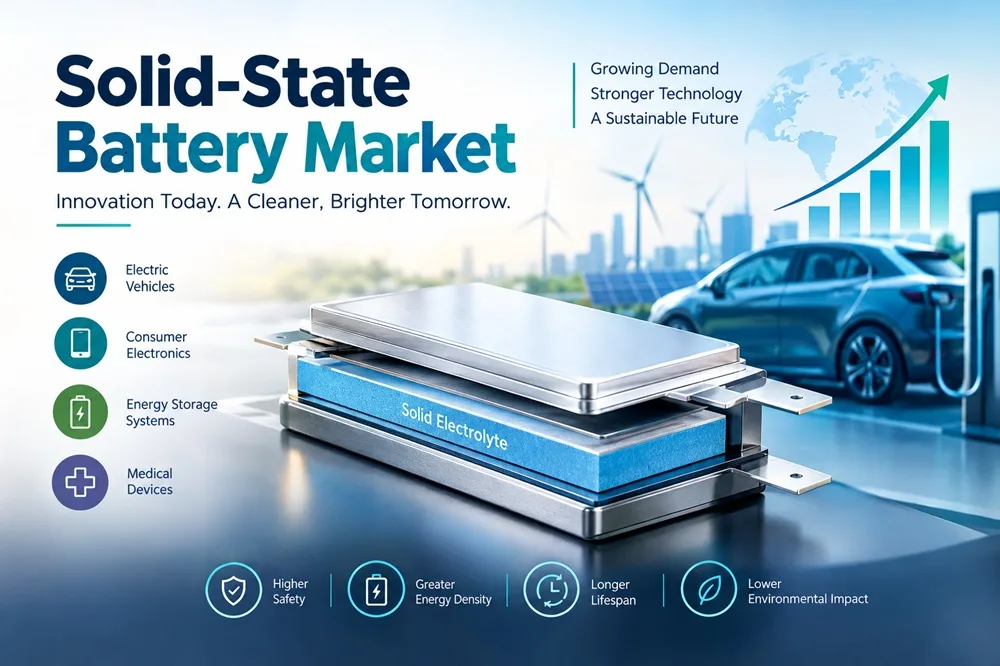
The solid-state battery market is gaining momentum as industries seek safer, higher-energy-density solutions for next-generation energy storage. According to BIS Research, the global market is projected to grow from $149.8 million in 2025 to $2,741.9 million by 2035, registering a CAGR of 33.75% during 2026–2035. Growing electric vehicle adoption, advances in battery materials, and commercialization efforts are supporting market expansion.
What are the Key Drivers of the Solid-State Battery Market?
- Growing electric vehicle demand: Automakers are exploring advanced battery technologies to improve driving range, safety, and charging performance.
- Increasing safety requirements: Solid electrolytes offer the potential to reduce leakage and improve thermal stability compared with conventional liquid-electrolyte batteries.
- Advancements in battery technology: Research into electrolyte materials, lithium-metal anodes, and cell architecture is improving performance potential.
- Rising investment in manufacturing: Pilot production facilities, strategic partnerships, and government-backed initiatives are helping move technologies toward commercial deployment.
Which Applications are Driving Market Growth?
Solid-state batteries are finding opportunities across electric vehicles, consumer electronics, energy storage systems, and medical devices. Consumer electronics represent an important near-term application because compact batteries can support wearables, sensors, and portable devices that require space efficiency and reliable performance. Electric vehicles offer substantial long-term potential as manufacturers evaluate batteries designed to improve energy density and safety. Medical devices and specialized electronics also present opportunities for compact, application-specific energy storage solutions.
Get A Sample for Solid-State Battery Market - Focus on Application, Product, and Regional Analysis and Forecast, 2026-2035
How Does Electrolyte Type Influence the Market?
Electrolyte chemistry is a major factor influencing battery performance, manufacturing complexity, and commercialization potential. The market includes oxide, sulfide, polymer, and other electrolyte systems, including hybrid materials. Oxide electrolytes benefit from thermal and chemical stability, while sulfide electrolytes offer high ionic conductivity and potential advantages for automotive applications. Polymer-based systems provide flexibility in battery design, although conductivity and operating-temperature requirements remain important considerations.
What are the Key Trends Shaping the Market?
- Automotive-led commercialization: Automotive manufacturers and battery developers are advancing validation programs and pre-commercial deployment initiatives.
- Electrolyte innovation: Competition among oxide, sulfide, and polymer chemistries is encouraging improvements in conductivity, stability, and manufacturability.
- Pilot-scale manufacturing expansion: Companies are investing in production processes to improve consistency, manufacturing yields, and scalability.
- Application-specific development: Manufacturers are tailoring battery designs to the requirements of consumer electronics, medical devices, electric vehicles, and stationary energy storage.
Which Regions are Leading the Solid-State Battery Market?
Asia-Pacific is projected to lead the solid-state battery market, supported by established battery manufacturing capabilities, electronics production, and investment in next-generation technologies across China, Japan, and South Korea. North America benefits from automotive partnerships, research initiatives, and pilot manufacturing investments. Europe also represents an important market, driven by automotive innovation and battery technology development. Regional competitiveness will depend on manufacturing scale, supply-chain resilience, and commercialization readiness.
What Challenges and Opportunities Will Shape Market Development?
The market faces challenges related to high production costs, manufacturing scalability, material processing, and the stability of interfaces between battery components. Sulfide electrolytes can be sensitive to moisture, while oxide systems may require demanding processing conditions. These factors can affect production yields and delay commercial deployment.
However, opportunities are emerging in premium electric vehicles, medical devices, wearable electronics, and specialized energy storage applications. Strategic collaborations among battery developers, automotive manufacturers, materials suppliers, and equipment providers can accelerate technology validation. Investment in manufacturing optimization and application-specific product development will be important for improving commercial viability.
Conclusion
The solid-state battery market is poised for significant growth as demand for safer, more efficient, and higher-energy-density battery technologies increases. Advancements in electrolyte materials, manufacturing processes, and battery design are creating new opportunities across electric vehicles, consumer electronics, and medical devices. However, high production costs and scalability challenges remain key barriers. Continued research, strategic partnerships, and manufacturing innovation will be essential to accelerate commercialization and support long-term market expansion.
FAQs for Solid-State Battery Market
What is a solid-state battery?
A solid-state battery uses a solid electrolyte instead of the liquid electrolyte commonly found in conventional lithium-ion batteries. This design has the potential to improve thermal stability, support higher energy density, and reduce certain safety risks, depending on the materials and cell architecture.
What is the projected size of the solid-state battery market by 2035?
The global market is projected to reach $2,741.9 million by 2035, growing at a CAGR of 33.75% during the 2026–2035 forecast period.
Which industries are adopting solid-state battery technology?
Key industries include automotive, consumer electronics, medical devices, and energy storage. Consumer electronics offer near-term opportunities in compact devices, while electric vehicles represent a significant potential market as manufacturers work to improve battery performance and commercial scalability.
Get Insights for Advanced Materials, Chemicals & Fuels Market
Which electrolyte types are used in solid-state batteries?
The main electrolyte categories are oxide, sulfide, and polymer, alongside other emerging and hybrid materials. Each has different characteristics related to ionic conductivity, thermal stability, processing requirements, cost, and suitability for specific applications.