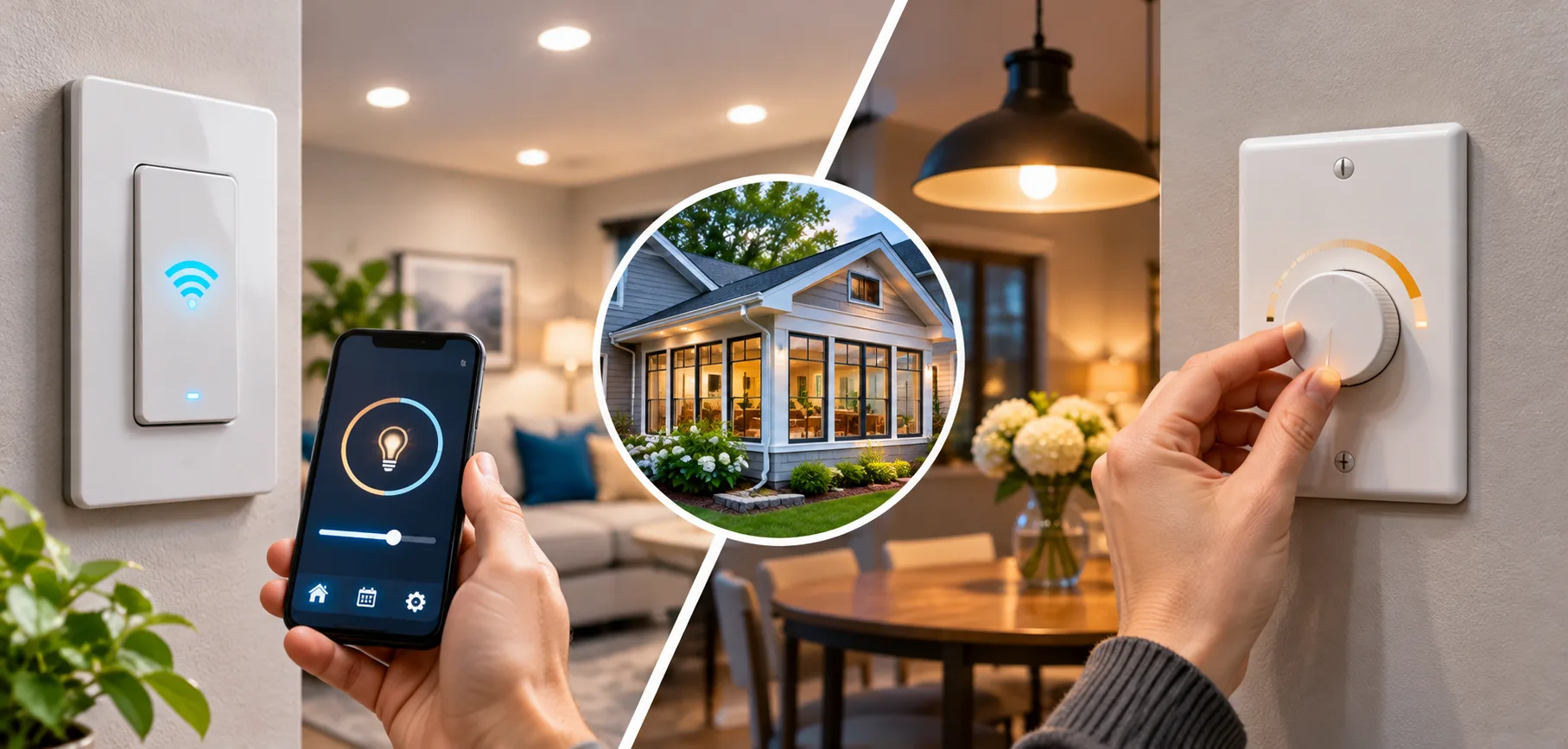
Smart Switches vs Dimmer Switches: Which Should You Install?
A wall switch looks simple until a homeowner wants more from it. Maybe the porch light should turn on before anyone arrives home. Maybe the dining room feels too bright at night. Maybe one switch should still work normally for guests without forcing anyone to open an app.
That is where the choice between Smart Switch Installation and a Dimmer Switch Upgrade becomes important. The two controls solve different problems. A smart switch adds scheduling, remote access, automation, or voice control. A dimmer changes light level. A smart dimmer can combine both, but only when the light source, wiring, and control are compatible.
The useful question is not which device is more advanced. It is which type of control matches the circuit, the room, and the way people actually use the light.
Key Takeaways
- Choose a smart switch when convenient on/off control, schedules, or automation matter most.
- Choose a dimmer when adjustable brightness changes how a room functions or feels.
- Consider a smart dimmer when both connected control and brightness adjustment are useful.
- Check wiring and load compatibility before assuming a new control can replace the existing switch.
Smart Switches and Dimmers Solve Different Problems
A standard wall switch opens or closes a circuit. A smart switch keeps that basic function but adds connected control. Depending on the product, a homeowner may operate it from the wall, an app, a voice assistant, a schedule, or an automation routine.
A dimmer has a different job. It changes the output of compatible lighting instead of limiting control to full-on or off. That makes it useful where the same fixtures need bright task light at one time and softer light later.
The distinction matters because a homeowner can buy the wrong product even when both fit the same wall box. Light Switch Installation should start with the desired behavior, not with whichever device has the longest feature list.
When Does a Smart Switch Make More Sense?
A smart switch earns its place when timing and access matter more than brightness. Exterior lights are a common example. A homeowner may want them on around sunset and off later without remembering the switch every evening.
The same idea can work in hallways, utility spaces, garages, or rooms where lights are frequently left on. Schedules and automation can make the control more predictable without changing the fixture itself.
Smart controls can also be useful when someone wants to operate lights remotely or include them in a broader home routine. The important part is that the wall control should still make sense to anyone standing in the room.
“Design is not just what it looks like and feels like. Design is how it works,” Steve Jobs said. That principle fits smart controls well: useful automation should simplify an action, not make turning on a light feel like operating software.
When Is a Dimmer the Better Choice?
A dimmer makes sense when brightness itself needs to change.
Dining rooms are an obvious example. Full output can be useful while setting the table or cleaning, while lower light may suit dinner. Living rooms often need similar flexibility between reading, conversation, television, and late-evening use.
Bedrooms can benefit from a Dimmer Switch Upgrade when the same ceiling or wall lighting is used for getting dressed in the morning and winding down at night. The value comes from having one fixture serve more than one lighting condition.
The U.S. Department of Energy reports individual task tuning through dimming can save about 7% energy on average in lighting retrofit projects. That figure does not guarantee the same result in every home, but it shows dimming can affect energy use when compatible lighting operates below full output.
Compare the Control Before You Compare the Price
The purchase price does not tell a homeowner which switch is the better fit. Compare what each control is expected to do every day.
Decision PointSmart SwitchDimmer SwitchSmart DimmerBasic on/off controlYesYesYesAdjustable brightnessUsually noYesYesSchedulingOftenNoOftenRemote/app controlOftenNoOftenVoice integrationProduct dependentNoProduct dependentRequires dimmable lightingNoYesYesBest fitAutomationLight-level controlBoth needs togetherThe table also shows why the decision is not always smart versus dimmer. A smart dimmer can be the better answer when a room needs both. Residential Electrical Services can help determine whether the selected control suits the existing wiring, fixture, and load before installation.
Check the Bulb and Fixture Before Choosing the Switch
Installing a dimmer does not automatically make a light dimmable. The lamp, integrated LED, driver, and control need to work together.
An incompatible combination can lead to flicker, buzzing, a narrow dimming range, delayed response, or lights that do not shut off cleanly. That is why the package or manufacturer documentation matters more than assumptions based on bulb shape.
Smart switches have compatibility questions too. Some models require a neutral conductor at the switch box. Others have minimum-load requirements or need a particular wiring arrangement for multi-location control.
A Smart Switch Installation should therefore begin with the circuit that exists, not just the features advertised on the box.
The Three-Part Test Every Switch Upgrade Needs
Before choosing a control, work through three questions:
- Function: Does the light only need on/off control, adjustable brightness, or both?
- Compatibility: Is the lamp, fixture, driver, and wiring suitable for that control?
- Routine: Will scheduling, remote access, scenes, or voice control actually be used?
This simple test keeps technology from driving the decision. A storage room may need nothing more than straightforward switching. A dining room may justify dimming. Exterior lighting may benefit more from scheduling. A main living space might justify a smart dimmer.
The right control is the one whose useful features match a repeated need.
Smarter Controls Should Not Mean More Confusion
A connected home still needs understandable physical controls.
If a visitor, child, or family member has to find a phone to switch on a light, the system has probably become more complicated than necessary. Smart lighting works best when the wall control remains obvious and automation operates quietly in the background.
That is particularly important when one circuit can be controlled from several locations. Replacing conventional multi-location switching with smart controls can require compatible companion devices or a different configuration.
For that reason, Light Switch Installation should consider how everyone enters and uses the space, not only how the primary homeowner prefers to control it.
One Switch Type Does Not Fit Every Load
One switch box can serve different types of equipment, and that matters.
A dimmer designed for lighting should not automatically be used to control a ceiling fan, exhaust fan, motor, or other load. The control has to be rated and designed for what it operates.
That sounds basic, but smart devices can blur the distinction because products may look similar from the front. Read the device rating and the equipment requirements before treating a connected control as interchangeable.
- Do this: choose a control designed for the specific load.
- Not that: assume any smart switch or dimmer can control anything connected to a wall switch.
- Do this: verify LED dimming compatibility.
- Not that: troubleshoot persistent flicker by repeatedly swapping random bulbs.
One Home Can Need Three Different Answers
Consider a household deciding what to do with three frequently used areas.
The front entry has lights that are often forgotten until someone is already outside. There is little need to change brightness, so scheduled smart on/off control fits the problem.
The dining room already has compatible dimmable fixtures. Here, brightness matters more than remote access, making a conventional Dimmer Switch Upgrade a practical choice.
The main living room is different. It is used for reading, entertaining, television, and late evenings. The household wants adjustable brightness plus an evening routine that can lower the lights automatically. A smart dimmer fits both requirements.
The scenario shows why replacing every switch with the same technology can be wasteful. Different rooms ask different questions.
Smart Control Is Useful Only When the Routine Is Real
A switch should earn its complexity. Scheduling a porch light may save effort because the same action happens every evening. Remote control may be useful for someone who arrives after dark or wants to check whether lights were left on. Voice control may help in a kitchen when both hands are occupied.
But connected features are less valuable when they duplicate a wall switch that already works perfectly for the household. Before paying for functions, identify the repeated inconvenience first.
The same logic applies to dimming. If a room is always used at one brightness level, a dimmer may add little. If the space shifts between work, meals, relaxation, and entertaining, adjustable light becomes more useful.
Choosing controls around real routines keeps the system understandable and avoids paying for features that sound impressive but rarely get used.
Wiring Can Decide Before Features Do
The most appealing control still has to work with the electrical system behind the wall.
Some smart controls need a neutral conductor. Wall-box depth can matter because electronic devices may occupy more space than conventional switches. Multi-location circuits can require matched accessories. Dimmers must also be selected for the type and amount of lighting they control.
This is where Residential Electrical Services become more important than product comparison. An electrician can identify the wiring configuration, assess the controlled load, and determine what type of device can be installed correctly.
Electrical conditions vary, especially where switches or lighting have been changed during earlier updates. Guessing from the faceplate does not reveal what is inside the box.
When Should Professional Installation Take Over?
Replacing a control is not only a cosmetic change. The device becomes part of the electrical circuit.
Professional help is appropriate when wiring is uncertain, there is no obvious neutral where the selected product requires one, several switches control the same circuit, a box is crowded, the controlled load is unclear, or flicker and buzzing already exist.
A professional Smart Switch Installation can also help when multiple controls need to work together as one system rather than as isolated gadgets.
The same applies to a Dimmer Switch Upgrade involving integrated LEDs, specialty drivers, or several fixtures. Correct product selection matters before the switch is connected.
Choose the Control That Solves the Repeated Problem
Smart switches and dimmers should not compete for every wall. They are tools for different jobs.
Choose smart switching when automation, schedules, remote control, or integration solves a recurring inconvenience. Choose dimming when changing brightness improves how the room is used. Choose a smart dimmer when both benefits matter and the lighting is compatible.
Then check the electrical side before installation. The best feature list cannot overcome the wrong load, unsuitable wiring, or incompatible lighting.
For homeowners who want the control to match the circuit as well as the routine, ARC Electrical Solutions Inc. can provide Light Switch Installation and related electrical work based on the actual setup behind the wall.
Frequently Asked Questions
What makes a good smart switch installation?
A good installation matches the switch to the wiring, controlled load, desired automation, and locations where people need physical control.
What are the best practices for choosing a dimmer?
Confirm that the lighting is dimmable, check manufacturer compatibility, and choose a control rated for the type and total load being operated.
How do homeowners choose between smart switches and dimmers?
Start with the desired function. Choose smart switching for connected on/off control, dimming for adjustable brightness, or a smart dimmer when both are useful.
When should an electrician handle light switch installation?
Professional installation makes sense when wiring is uncertain, multiple locations control one circuit, electronic controls need neutrals, or existing lights already flicker or buzz.
Can smart switches work without smart bulbs?
Often, yes. Many smart wall switches control ordinary compatible lighting at the circuit, but requirements vary by product and wiring configuration.