
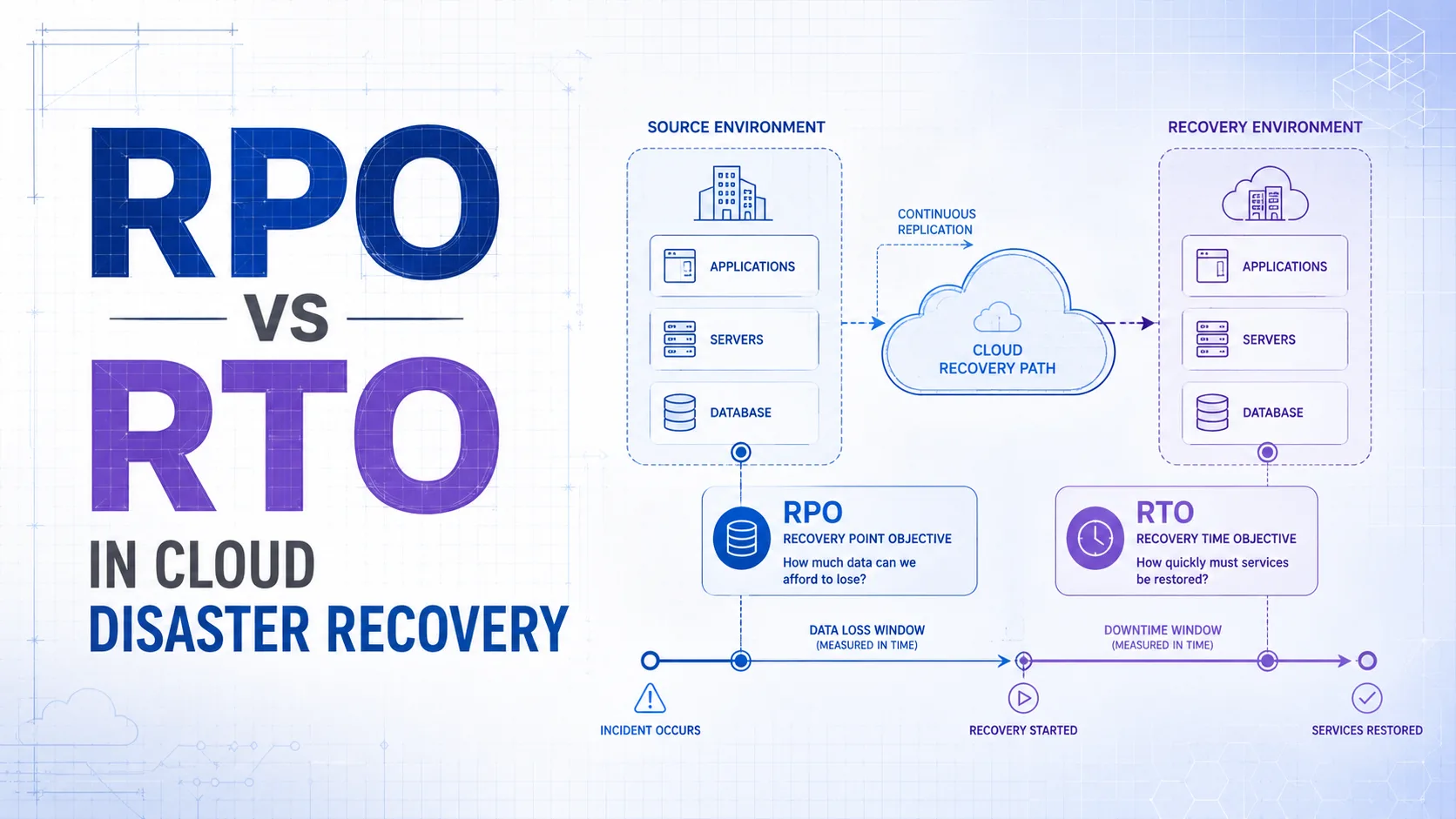
I have spent over a decade writing about cloud infrastructure, and if there is one conversation that repeats itself in every DR discussion I have ever sat in, it is this one. Someone asks how quickly we can recover, someone else answers with how recent the backups are, and neither person realizes they just answered two completely different questions.
So let me save you from that meeting. RTO and RPO are the two numbers that decide whether your disaster recovery plan actually works or just looks good on a slide deck. Here is how I explain them, why I believe most teams set them wrong, and what I would do differently.
RTO is about time. RPO is about data. Stop mixing them up.
RTO, or Recovery Time Objective, is the maximum time your systems can stay down before the damage becomes unacceptable. Your order system crashes at noon with a four-hour RTO, you had better be live by 4 PM. Simple.
RPO, or Recovery Point Objective, is the maximum amount of data you can afford to lose, measured in time. If your RPO is one hour and the system dies at 1:59 PM, you restore to the 1:00 PM state. Those 59 minutes of transactions? Gone. You agreed to that loss the day you set the RPO.
Here is the mental model I give people. Picture the failure as a point on a timeline. RPO is the window stretching backward from that point, and RTO is the window stretching forward. Two directions, two budgets, two very different engineering problems.
FactorRTORPOMeasuresDowntime durationData loss in timeDirectionsForward from the incidentBackward from the incidentDriversFailover and recovery architectureBackup and replication frequencyCost DriversStandby infrastructureStorage and replicationAnd here is the part that trips even experienced engineers. The two are completely independent. You can restore in ten minutes from a backup that is a day old, which means you nailed RTO and blew RPO. You can also restore perfectly fresh data after six painful hours, which is the opposite failure. Meeting one tells you nothing about the other. Set them separately, per workload, every time.
My honest opinion? These are budget decisions about wearing IT costumes.
RTO and RPO are not technical metrics. They are financial decisions, and pretending otherwise is why so many DR plans fail.
Every step down in either number costs real money. ITIC's Hourly Cost of Downtime survey says over 90% of mid-size and large enterprises lose more than $300,000 per hour of downtime, and even SMBs typically bleed $8,000 to $25,000 an hour. Organizations with frequent outages fare even worse, facing losses 16 times higher than those with fewer, per LogicMonitor's outage impact study. So, when your CFO asks why you need a warm standby environment, do not talk about replication lag. Talk about revenue per hour of outage. That conversation funds itself.
The practical move is moving it to the tier, and I would push you to be ruthless about it. Your payment system deserves an RTO in minutes and an RPO in seconds. Your internal wiki genuinely does not. I have watched teams burn money protecting dev environments like they were trading platforms, then discover their actual revenue systems were riding on nightly backups. Run a business impact analysis, put every workload in a tier, and spend accordingly. The savings from Tier 3 pay for Tier 1.
My View on the four cloud DR strategies
The industry standard model comes from the AWS Well-Architected Framework, and it maps neatly onto your targets.
- Backup and restore. RPO in hours, RTO up to a day. Cheap. Perfect for anything non-critical, and honestly where most Tier 3 workloads should live.
- Pilot light. RPO in minutes, RTO in tens of minutes to hours. Data replicates continuously, databases stay warm, compute stays off until you flip the switch.
- Warm standby. RPO in seconds, RTO in minutes. A scaled-down copy of production runs all the time and scales up on failover.
- Multi-site active/active. Near-zero everything. Multiple regions serving live traffic. Magnificent, and magnificently expensive.
Two nuances I rarely see written down. First, pilot light cannot serve a single request until you activate it, while warm standby takes reduced traffic immediately. That difference is your real RTO gap, so do not let anyone sell you pilot light as instant recovery. Second, replication is not a protection. If ransomware encrypts your primary, replication faithfully delivers that encryption to every copy within seconds. You need immutable, point-in-time recovery copies alongside it. Sophos research found that fewer than 7% of ransomware victims recover within a day, largely because finding a verified clean recovery point takes longer than restoring the data itself.
Your RTO is a hypothesis until you test it
This is the advice I want you to actually act on this quarter. Objectives live in documents. Actuals live in reality, and the industry even has names for them, RTA and RPA. The gap between the two only shows up in a real drill, and roughly half of organizations test their DR plans once a year or never, according to ConnectWise research. That statistic should scare you more than any outage story.
So here is my challenge to you. Pick your most critical workload this month. Fail it over, for real, and time it with a stopwatch. If the actual number matches your documented RTO, congratulations, you are in a small and smug minority. If it does not, you just learned something priceless at zero cost, on a day you chose, instead of at 2 AM on a day you did not.