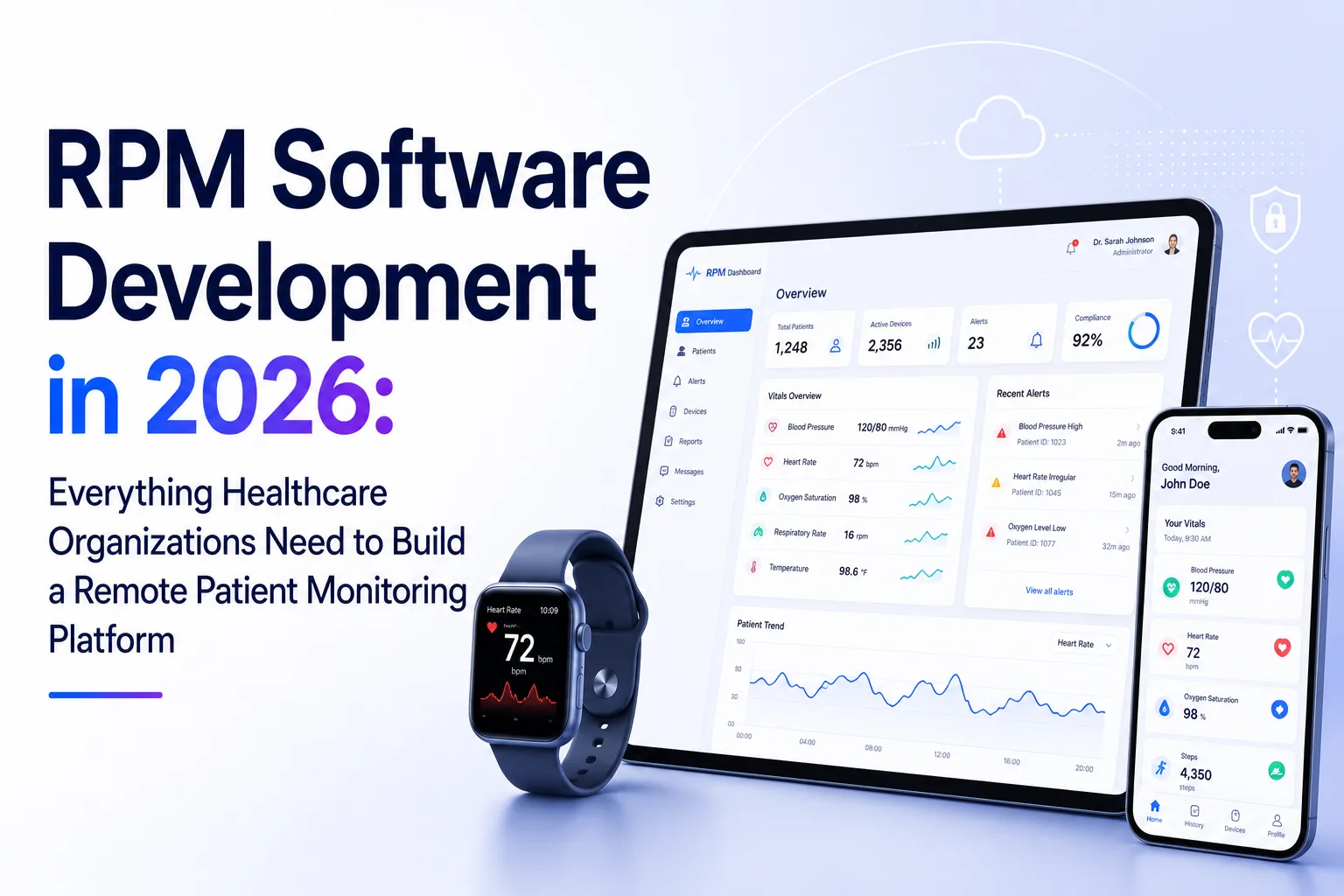
Healthcare is no longer confined to hospitals and clinics. As connected medical devices, wearable technology, and telehealth become part of everyday care, providers are increasingly monitoring patients from their homes rather than waiting for them to return for follow-up visits. This shift is changing how chronic diseases are managed, how post-discharge recovery is monitored, and how clinicians respond to early signs of health deterioration. At the center of this transformation is RPM Software Development, which provides the digital infrastructure needed to collect, analyze, and act on patient health data in real time.
Remote Patient Monitoring (RPM) has evolved far beyond recording blood pressure or glucose readings. Modern platforms connect wearable devices, home medical equipment, mobile applications, clinician dashboards, Electronic Health Records (EHRs), telehealth services, and artificial intelligence into a single ecosystem that enables continuous, data-driven care. Healthcare organizations are increasingly investing in these platforms to improve patient outcomes, reduce avoidable hospitalizations, optimize clinical workflows, and support value-based care initiatives.
The growing adoption of RPM is also being driven by demographic and economic factors. Aging populations, increasing rates of chronic disease, clinician shortages, and rising healthcare costs are encouraging providers to move appropriate care outside traditional healthcare facilities. Instead of relying solely on periodic appointments, clinicians can continuously monitor patient health, identify concerning trends earlier, and intervene before minor issues develop into serious medical complications.
However, building an effective RPM platform is considerably more complex than developing a healthcare mobile application. Successful solutions must securely process large volumes of patient-generated health data while integrating with connected medical devices, hospital systems, telehealth platforms, laboratory software, and healthcare analytics tools. They must also comply with healthcare regulations such as HIPAA, GDPR, and interoperability standards including HL7 and FHIR, all while maintaining high levels of performance, scalability, and cybersecurity.
This article explores the essential aspects of RPM Software Development, including the technologies behind modern remote monitoring platforms, the challenges organizations should prepare for, the role of artificial intelligence in connected healthcare, and the characteristics that distinguish scalable enterprise RPM solutions from basic patient monitoring applications.
Why Remote Patient Monitoring Has Become a Strategic Healthcare Priority
Healthcare providers are increasingly shifting from reactive care models toward continuous patient management. Instead of treating illnesses only after symptoms become severe, providers now aim to identify clinical deterioration earlier through ongoing monitoring and timely intervention. Remote patient monitoring makes this possible by creating a continuous stream of health information between patients and care teams, regardless of location.
This approach is especially valuable for individuals managing chronic conditions such as diabetes, hypertension, heart failure, chronic obstructive pulmonary disease (COPD), and cardiovascular disease. These patients often require frequent monitoring, medication adjustments, and lifestyle guidance that traditional appointment-based care cannot always provide efficiently. RPM platforms allow clinicians to review patient data remotely, prioritize individuals who require immediate attention, and reduce unnecessary in-person visits without compromising care quality.
The benefits extend beyond chronic disease management. Hospitals increasingly use remote monitoring after discharge to reduce readmission rates by tracking patient recovery during the critical weeks following hospitalization. Maternal health programs use connected monitoring devices to supervise high-risk pregnancies, while elderly care providers leverage RPM technology to help older adults maintain independence while remaining under clinical supervision.
As healthcare organizations expand these services, RPM Software Development has become less about building standalone monitoring tools and more about creating connected healthcare ecosystems capable of supporting multiple clinical programs through a unified technology platform.
What Makes Modern RPM Software Different from Traditional Healthcare Applications?
One of the biggest misconceptions surrounding remote patient monitoring is that it simply involves collecting health data from wearable devices and displaying it on a dashboard. In reality, modern RPM platforms function as intelligent healthcare ecosystems that continuously coordinate information between patients, clinicians, connected devices, and existing hospital infrastructure.
Unlike conventional healthcare applications that depend on users manually entering health information, RPM platforms automatically gather physiological data from medical-grade devices and consumer wearables. Blood pressure monitors, pulse oximeters, ECG devices, continuous glucose monitors, smart scales, spirometers, and activity trackers all contribute to a continuous stream of clinical information that can be reviewed without requiring patients to visit a healthcare facility.
This constant flow of information fundamentally changes how healthcare teams operate. Rather than reviewing a patient's condition only during scheduled appointments, clinicians gain ongoing visibility into changes that occur between visits. Small deviations in blood pressure, glucose levels, oxygen saturation, heart rate variability, or medication adherence can trigger early intervention before conditions become severe enough to require emergency treatment.
For healthcare organizations, this shift also creates significant operational advantages. Clinicians spend less time collecting routine information and more time making informed clinical decisions. Care managers can prioritize high-risk patients instead of manually reviewing every patient record, while healthcare administrators gain access to population-level insights that help optimize staffing, resource allocation, and preventive care programs.
The most successful RPM Software Development projects therefore focus on creating decision-support systems rather than simple monitoring tools. The objective is not merely to collect health data but to transform that information into actionable clinical intelligence that improves both patient outcomes and healthcare efficiency.
The Core Components of a Modern RPM Platform
Although every healthcare organization has unique requirements, most enterprise-grade remote patient monitoring platforms are built around several interconnected components that work together to deliver continuous patient care.
Connected Device Integration
Connected medical devices form the foundation of every RPM platform. Whether patients use FDA-cleared medical equipment or consumer wearables, the software must reliably capture data while supporting multiple manufacturers and communication protocols. Bluetooth, Wi-Fi, cellular connectivity, and cloud-based device APIs all play important roles in ensuring health information flows securely into the monitoring platform.
Because healthcare providers frequently introduce new monitoring devices over time, successful platforms are designed with flexible integration layers rather than relying on hardcoded device connections.
Clinician Dashboards
Healthcare professionals require more than raw patient data. Modern dashboards organize information according to clinical priority, allowing physicians and care teams to identify patients requiring immediate attention while filtering out routine measurements that fall within expected ranges.
Many platforms also provide customizable patient summaries, historical trend analysis, medication adherence reports, risk indicators, and workflow automation that reduce the administrative burden associated with managing large remote patient populations.
Patient Applications
Patient-facing applications have evolved beyond displaying health metrics. Today's RPM apps guide patients through daily monitoring routines, medication reminders, educational resources, symptom reporting, secure messaging, appointment scheduling, and telehealth consultations.
The objective is to encourage consistent engagement while making remote care feel like a natural extension of traditional healthcare rather than an additional responsibility.
Healthcare Interoperability
Remote monitoring rarely exists as an isolated clinical service. RPM platforms frequently exchange information with Electronic Health Records, laboratory information systems, hospital scheduling software, billing platforms, telehealth solutions, pharmacy systems, and population health analytics tools.
Support for interoperability standards such as HL7 and FHIR has therefore become a core requirement rather than an optional feature. Without reliable interoperability, healthcare organizations risk creating disconnected workflows that increase administrative complexity instead of improving operational efficiency.
Why Artificial Intelligence Is Becoming Central to RPM Software Development
Artificial intelligence is changing the role of remote patient monitoring from passive observation to proactive clinical support. Early RPM platforms primarily generated alerts whenever patient measurements exceeded predefined thresholds. While effective for basic monitoring, this approach often produced large numbers of notifications that contributed to clinician fatigue.
Modern AI systems analyze thousands of data points simultaneously, identifying subtle physiological trends that may indicate worsening health before traditional alert thresholds are reached. Instead of reacting only after abnormal values appear, clinicians receive earlier warnings based on evolving patient patterns, improving opportunities for preventive intervention.
Machine learning models can also reduce unnecessary alerts by distinguishing temporary fluctuations from clinically meaningful changes. This helps healthcare teams focus on patients requiring immediate attention while minimizing interruptions caused by false positives.
Beyond predictive analytics, AI is increasingly supporting clinical documentation, patient risk stratification, care prioritization, and personalized patient engagement. Some platforms even adapt educational content and monitoring schedules according to patient behavior, helping improve long-term adherence without increasing clinician workload.
As artificial intelligence continues to mature, RPM Software Development is evolving from connected monitoring toward intelligent healthcare ecosystems capable of supporting more efficient, personalized, and proactive models of care.
Challenges Organizations Should Address Before Building an RPM Platform
While the benefits of remote patient monitoring are well established, developing a successful platform requires much more than connecting medical devices to a mobile application. Many healthcare organizations underestimate the technical, regulatory, and operational complexity involved in building software that clinicians will trust and patients will use consistently.
One of the first challenges is device interoperability. Patients rarely use the same brand or type of monitoring equipment. Blood pressure monitors, pulse oximeters, continuous glucose monitors, ECG devices, smart scales, thermometers, and wearable fitness trackers all generate data differently. An RPM platform must be capable of normalizing information from multiple devices while maintaining data accuracy and minimizing synchronization issues.
Scalability presents another major consideration. A platform designed for a pilot program involving a few hundred patients may struggle when expanded across multiple hospitals or healthcare networks. Modern RPM Software Development requires cloud-native architecture capable of processing millions of health data points while maintaining low latency, high availability, and uninterrupted clinical access.
Security and regulatory compliance also remain fundamental requirements. Remote patient monitoring platforms continuously process highly sensitive medical information that must be protected throughout its lifecycle. Secure authentication, encrypted data transmission, role-based access controls, audit trails, and continuous security monitoring are no longer optional features—they form the foundation of every enterprise healthcare platform.
Healthcare organizations must also think carefully about clinician experience. One of the biggest reasons RPM initiatives fail is alert fatigue. If physicians and care teams receive hundreds of unnecessary notifications each day, important clinical events can easily be overlooked. Successful platforms therefore focus on intelligent prioritization, customizable alert thresholds, and workflow automation that helps clinicians concentrate on patients who genuinely require intervention.
Finally, patient engagement should never be treated as an afterthought. Even the most advanced monitoring platform cannot improve outcomes if patients stop using connected devices after a few weeks. Intuitive user experiences, simple onboarding, educational content, medication reminders, and consistent communication all play an important role in maintaining long-term participation.
Key Technologies Driving the Next Generation of RPM Software Development
The rapid evolution of RPM Software Development is being driven by several complementary technologies rather than a single breakthrough. Together, these innovations are transforming remote monitoring from passive data collection into intelligent, connected healthcare ecosystems.
Artificial Intelligence
Artificial intelligence is helping clinicians identify health risks earlier by analyzing continuous streams of physiological data instead of isolated measurements. Machine learning models can recognize subtle trends across heart rate, blood pressure, glucose levels, oxygen saturation, activity patterns, medication adherence, and patient-reported symptoms, allowing providers to intervene before clinical deterioration becomes severe.
Internet of Medical Things (IoMT)
Connected medical devices form the backbone of modern RPM platforms. Advances in the Internet of Medical Things (IoMT) have significantly expanded the range of devices capable of securely transmitting health data from patients' homes to healthcare providers. This growing ecosystem enables organizations to monitor multiple chronic conditions simultaneously while improving the accuracy and frequency of patient assessments.
Cloud Computing
Cloud-native infrastructure has become essential for supporting large-scale monitoring programs. Instead of relying on traditional on-premises systems, healthcare organizations increasingly use cloud platforms to process continuous health data, support geographically distributed care teams, enable disaster recovery, and rapidly scale monitoring services as patient populations grow.
Healthcare Interoperability
Healthcare organizations operate complex technology environments where Electronic Health Records, laboratory systems, pharmacy platforms, telehealth solutions, and billing software must exchange information seamlessly. Interoperability standards such as HL7 and FHIR enable RPM platforms to function as part of broader digital healthcare ecosystems rather than isolated applications, reducing administrative workload while improving care coordination.
Advanced Analytics
Beyond individual patient monitoring, advanced analytics helps healthcare organizations evaluate the effectiveness of entire monitoring programs. Population health dashboards, clinical outcome reporting, operational performance metrics, and resource utilization analytics enable providers to optimize staffing, improve care pathways, and identify opportunities for preventive intervention across large patient populations.
Leading RPM Software Development Companies to Consider
Selecting the right technology partner can significantly influence the success of a remote patient monitoring initiative. While every organization has different clinical objectives and operational requirements, several development companies have established strong reputations for building secure, scalable, and interoperable healthcare platforms.
Idea Usher
Idea Usher develops enterprise remote patient monitoring platforms that combine connected medical devices, clinician dashboards, patient applications, telehealth, artificial intelligence, Electronic Health Record integration, and care coordination into unified digital ecosystems. Its modular development approach allows healthcare organizations to support chronic disease management, hospital-at-home programs, post-discharge monitoring, elderly care, and preventive health initiatives through a flexible platform architecture.
ScienceSoft
ScienceSoft specializes in enterprise healthcare software with extensive experience integrating remote monitoring platforms into existing hospital infrastructure. Its expertise in HL7, FHIR, healthcare interoperability, cloud architecture, and Electronic Health Record integration makes it particularly suitable for healthcare providers modernizing complex digital ecosystems.
LeewayHertz
LeewayHertz focuses on AI-powered healthcare solutions that enhance remote patient monitoring through predictive analytics, intelligent alert systems, machine learning, and clinical decision support. Organizations seeking advanced artificial intelligence capabilities often consider the company for next-generation connected healthcare platforms.
Glorium Technologies
Glorium Technologies develops healthcare software that strengthens collaboration between physicians, nurses, specialists, care coordinators, and patients. Its remote monitoring solutions emphasize clinical workflows, secure communication, patient management, telehealth integration, and healthcare compliance.
Intellectsoft
Intellectsoft builds enterprise digital health ecosystems where remote patient monitoring integrates with broader healthcare modernization initiatives. Its platforms support scalability, interoperability, patient engagement, analytics, and long-term digital transformation across large healthcare organizations.
Looking Ahead: The Future of RPM Software Development
Remote patient monitoring is entering a new phase of maturity. Early RPM initiatives primarily focused on collecting patient data outside clinical settings, but the next generation of platforms will increasingly emphasize intelligent decision support, automation, and personalized care delivery. Instead of acting as standalone monitoring tools, RPM platforms are becoming central components of broader connected healthcare ecosystems.
Artificial intelligence will continue to play a larger role in identifying patient risk, prioritizing clinical interventions, and reducing administrative workloads. Rather than overwhelming clinicians with large volumes of raw physiological data, future RPM systems will present contextual insights that help care teams understand which patients require immediate attention and why. This shift from data collection to actionable intelligence has the potential to improve both clinical outcomes and operational efficiency.
Another significant trend is the continued expansion of home-based healthcare. Hospital-at-home programs, chronic disease management, post-operative recovery, maternal health, behavioral health, and elderly care are increasingly being supported through connected technologies that enable providers to monitor patients continuously without requiring frequent in-person visits. As reimbursement models evolve and healthcare systems continue investing in preventive care, remote monitoring platforms are expected to become foundational infrastructure rather than optional digital services.
Interoperability will also remain a major priority. Future RPM platforms will need to exchange information seamlessly with Electronic Health Records, laboratory systems, pharmacy software, telehealth platforms, imaging systems, and population health analytics. Organizations that invest in flexible, standards-based architecture today will be significantly better positioned to integrate emerging technologies and adapt to changing healthcare requirements over the coming years.
At the same time, patient experience will become an even greater differentiator. Successful RPM platforms will not simply collect health information—they will encourage consistent engagement through intuitive interfaces, personalized education, intelligent reminders, accessible communication tools, and seamless device connectivity. Long-term adoption depends as much on usability as it does on technical capability.
Final Thoughts
Healthcare is steadily transitioning from episodic treatment toward continuous care, and remote patient monitoring is playing a central role in that transformation. Through RPM Software Development, healthcare organizations can build secure, scalable platforms that connect clinicians, patients, caregivers, and medical devices into a unified digital environment capable of supporting proactive, data-driven healthcare.
Developing an enterprise-ready RPM platform requires careful planning across architecture, interoperability, cybersecurity, regulatory compliance, cloud infrastructure, artificial intelligence, and patient engagement. Organizations that treat remote monitoring as a long-term strategic capability rather than a short-term technology project are more likely to build platforms that remain valuable as clinical programs expand and healthcare delivery models continue to evolve.
Whether supporting chronic disease management, post-discharge recovery, hospital-at-home services, preventive care, or population health initiatives, modern RPM platforms have become much more than monitoring tools. They provide the digital foundation for connected healthcare, enabling providers to deliver more personalized, efficient, and proactive care while helping patients remain engaged in their own health beyond the walls of traditional healthcare facilities.