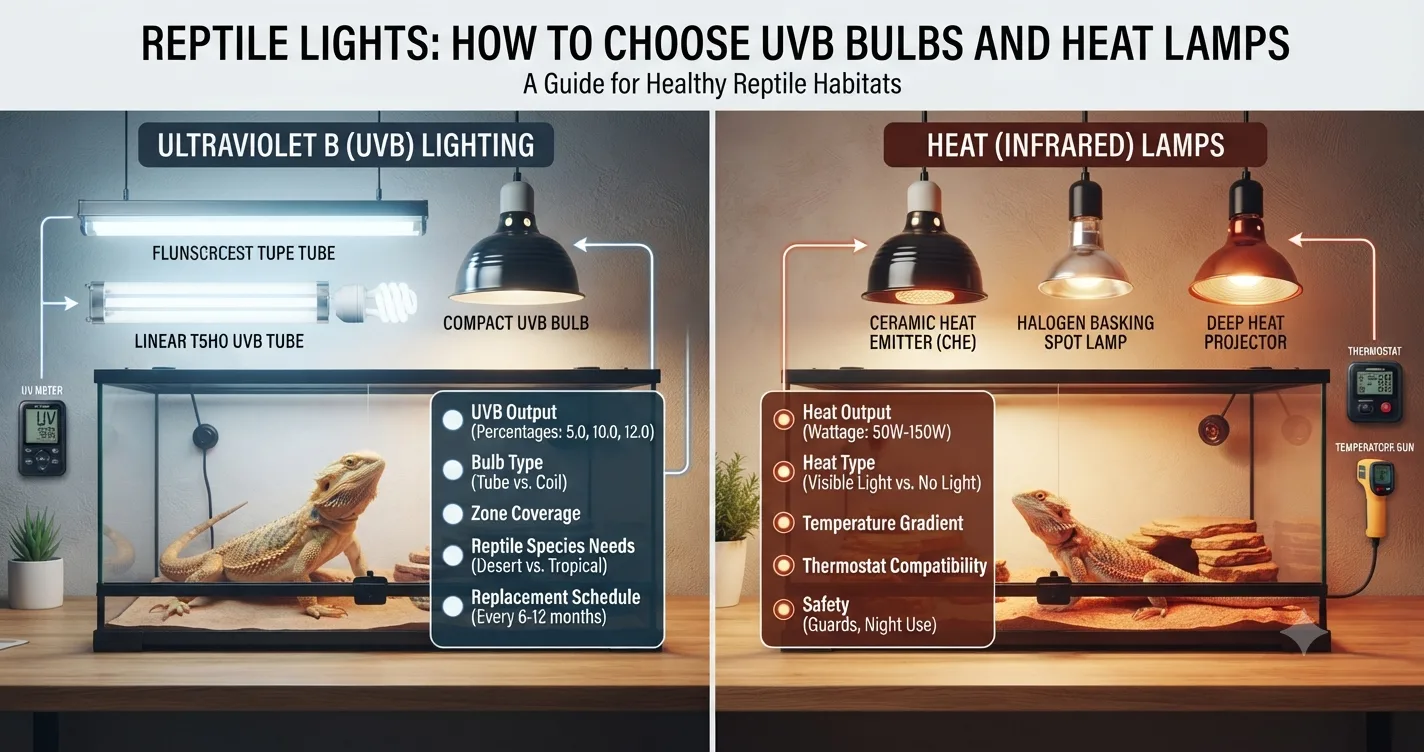
Most day-active reptiles need two kinds of light. A UVB bulb helps them make vitamin D3 and use calcium. A basking lamp creates a warm spot. A bulb can do one job or both, but only if it is labeled for it. Place UVB close, and replace it on schedule.
Shopping for reptile lights is confusing. Many boxes say “full spectrum” or “natural,” and those words alone tell you very little. This guide explains what each light does, how far away to place it, and how to avoid common mistakes.
Key Takeaways
- UVB and heat are different jobs. Check the label for UVB.
- Fluorescent UVB bulbs work best within about 12 inches of the reptile.
- Replace UVB bulbs every 9 to 12 months, even if they still glow.
- Glass and most plastics block UVB.
- Use a thermostat with every heat source.
What UVB Does
Reptiles that bask by day use UVB light to make vitamin D3, which they need to absorb calcium. The MSD Veterinary Manual explains that UVB is especially important for most day-active lizards and turtles, and that natural, unfiltered sunlight is the best source. Even one to two hours a week of unfiltered sun can make a big difference in health, MSD says.
Weak lighting causes real problems. MSD links low calcium and vitamin D3, often from poor lighting and low-calcium diets, to secondary nutritional hyperparathyroidism. It is common in pet reptiles.
How to Read the Label
MSD points out that almost every reptile light uses words like “broad,” “full,” or “natural,” which confuses owners and vets. A good bulb is clearly labeled as providing UVB. Look for that exact word on the package.
Placement and Schedule
MSD gives these guides for UVB:
- Fluorescent bulbs should sit within about 12 inches of the reptile.
- Replace fluorescent bulbs every 9 to 12 months.
- Mercury vapor bulbs reach farther, about 3 feet or more, and are replaced about every 12 months.
- Most glass and clear plastic barriers filter out UVB.
- A 12-hour day is suitable for general care.
Real Sunlight Helps
If weather allows, outdoor time adds real benefit. MSD says outdoor enclosures can be highly desirable, but warns about escape, predators, and wildlife that carry disease. Use a secure, shaded, screened space, and never leave a reptile in a closed glass tank in the sun, since it can overheat fast.
Heat Lamps for Reptiles
A basking lamp gives your reptile a warm spot to heat up. MSD’s pet owner guide says overhead basking lights suit turtles, tortoises, and lizards. Options include incandescent bulbs, infrared devices, mercury vapor lamps, and ceramic heat emitters.
Shopping for a heat lamp for reptiles? Match it to your species and enclosure. Then verify with a thermometer. MSD says to measure the temperature just above the substrate where your pet sits, so you know the real basking temperature.
Keep every heat source out of reach. MSD says heaters should be screened from the animals, so your reptile cannot touch a hot bulb. It also notes that some mercury-halide bulbs give both heat and broad-spectrum light, which can simplify a setup, though you still need a thermostat and thermometers.
Lights at a Glance
| Light type | Main job | Key point |
|---|---|---|
| UVB fluorescent tube | UVB for vitamin D3 | Within about 12 inches, replace in 9 to 12 months |
| Mercury vapor lamp | UVB and heat | Reaches farther, replace about yearly |
| Incandescent basking bulb | Heat and visible light | Use with a thermostat |
| Ceramic heat emitter | Heat only | Gives no light |
Build a Temperature Gradient
Reptiles regulate body heat by moving between warm and cool spots. MSD says heaters should be thermostat controlled, screened from the animal, and placed at one end so the enclosure has a gradient. It also advises at least two thermometers, one at the cool end and one at the warm end.
Avoid “hot rocks.” MSD says they often burn larger animals. Light bulbs also cannot provide heat at night, so ask your vet about a night heat plan for your species.
Common Mistakes
Placing a UVB tube over a glass or plastic lid blocks the rays. Using one bulb for everything leaves no gradient. Forgetting to replace an old tube means your reptile gets weaker UVB than you think. A calendar reminder fixes the last one.
A Monthly Lighting Check
Once a month, write down the bulb install dates, measure the distance from the bulb to the basking spot, and read the basking temperature. Clean dust from the fixture, and confirm the timer still works. Small checks keep your setup working as designed.
Frequently Asked Questions
How long should reptile lights stay on?
MSD says a 12-hour day suits general maintenance. Your vet can adjust this for your species and season. Use a timer so the schedule stays steady.
Do all reptiles need UVB?
MSD says UVB is essential for many day-active species, and broad-spectrum light benefits all reptiles, including night-active ones. Ask your vet about your species.
Does glass block UVB?
Yes. MSD notes that most clear plastic and glass barriers filter out UVB wavelengths. Place the bulb inside the enclosure or over a screen, not over glass.
How often should I replace a UVB bulb?
MSD says every 9 to 12 months for fluorescent bulbs, and about every 12 months for mercury vapor bulbs. Mark the install date on the fixture.
Are hot rocks safe?
MSD says no. They often cause burns in larger animals. Use an overhead basking light on a thermostat instead.
Next Steps
Check your UVB bulb’s install date today, and measure the basking spot with a thermometer. If either is off, replace the bulb or adjust the distance this week.
This article is general information, not veterinary advice. Ask your reptile vet about lighting for your species.
#heat lamp for reptiles #reptile heat lamps #lizard lights #heat lamp