
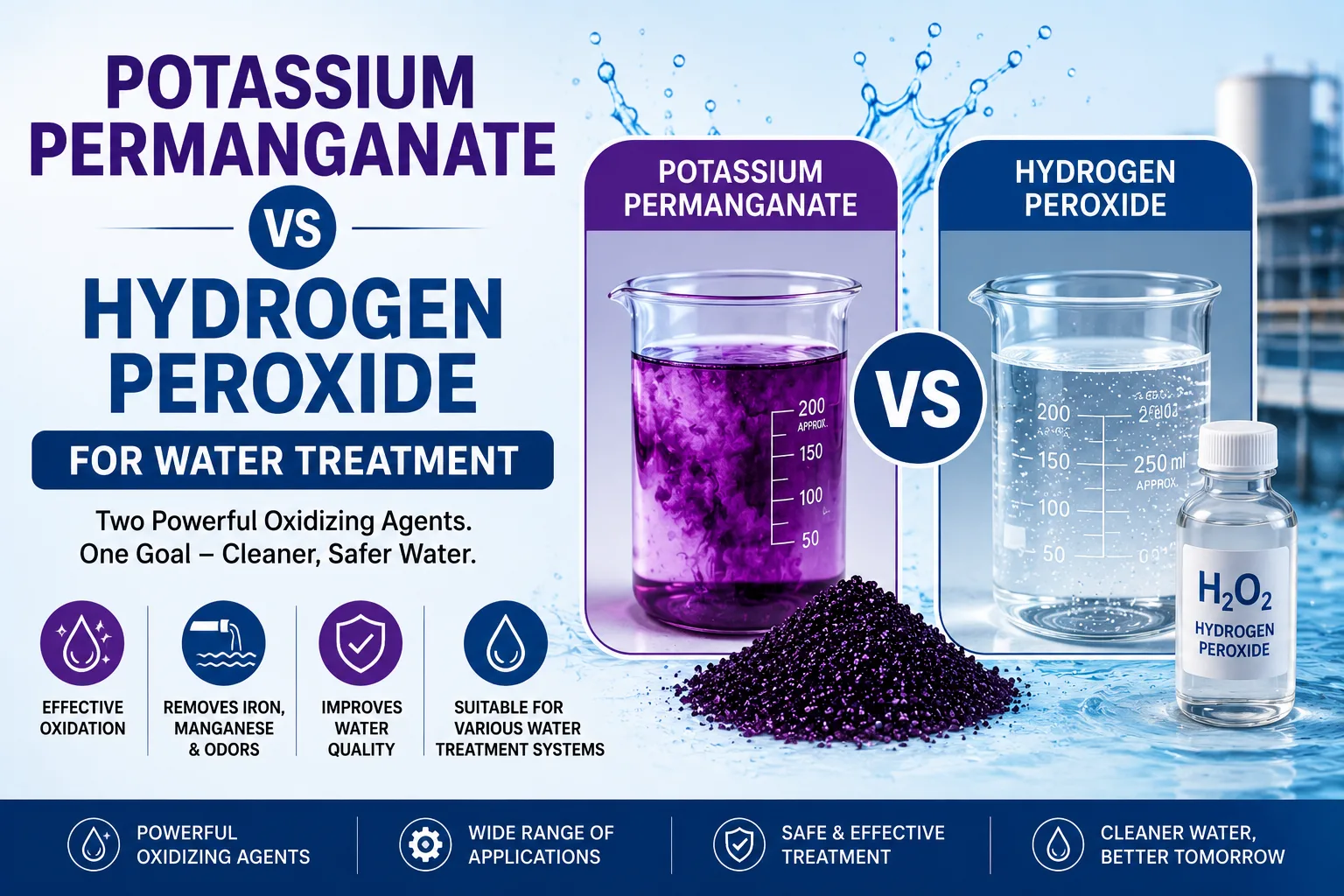
If you've been researching water treatment options, you've probably noticed that two chemicals come up again and again—potassium permanganate and hydrogen peroxide. Both are widely used, both work through oxidation, and both can solve common water quality issues. So which one is the better choice? The answer depends on your water and what you're trying to fix. In potassium permanganate vs hydrogen peroxide for water treatment, there isn't a one-size-fits-all winner because each chemical performs differently under different conditions.
Let's look at how they compare and where each one works well.
What Is Potassium Permanganate?
Potassium permanganate is a powerful oxidizing chemical that has been used in water treatment for decades. It reacts with dissolved metals and certain contaminants, converting them into particles that filtration systems can easily remove.
It is commonly used in municipal systems, industrial facilities, and private water treatment plants because of its dependable oxidation performance.
What Is Hydrogen Peroxide?
Hydrogen peroxide is another oxidizing agent used in water treatment. It breaks down into oxygen and water after reacting, making it suitable for many treatment processes.
It is often selected for applications involving organic contaminants, odor control, and biological treatment systems.
Although both chemicals rely on oxidation, they behave differently once introduced into water.
Potassium Permanganate vs Hydrogen Peroxide for Water Treatment
At first glance, both chemicals appear to perform the same job. They don't.
Each has strengths that make it more suitable for specific applications.
Iron Removal
One of the biggest reasons people use oxidation chemicals is iron removal from water.
Potassium permanganate has built a strong reputation for treating dissolved iron. Once the oxidation reaction occurs, the iron forms solid particles that filters can capture.
Hydrogen peroxide can also oxidize iron, though treatment efficiency depends on water chemistry and system design.
For water with consistently high iron levels, potassium permanganate is often selected because of its reliable performance.
Manganese Removal
Removing manganese is usually a little more challenging.
For manganese removal from water, potassium permanganate is widely recognized as one of the most effective oxidation chemicals available.
Hydrogen peroxide may also be used in certain systems, though additional treatment steps are sometimes required depending on operating conditions.
Odor and Taste Problems
Water that smells like rotten eggs or has an unpleasant taste usually contains compounds that require oxidation.
Hydrogen peroxide performs well for odor control, especially in applications involving sulfur compounds.
Potassium permanganate is also effective for treating odor-causing contaminants and is frequently used where multiple water quality issues exist at the same time.
Groundwater Treatment
Many regions across India depend on underground water sources.
In groundwater treatment, both chemicals are used depending on contaminant levels and treatment objectives.
Groundwater with high concentrations of iron and manganese often responds well to potassium permanganate because of its oxidation strength.
Borewell Water Treatment
People using borewells often deal with staining, metallic taste, or black deposits caused by naturally occurring minerals.
For borewell water treatment, potassium permanganate is commonly used alongside filtration equipment to improve overall water quality.
Hydrogen peroxide may also be incorporated into treatment systems where biological contamination or odor is the primary concern.
Drinking Water Treatment
Safe drinking water depends on a combination of treatment methods rather than a single chemical.
In drinking water treatment, either oxidizing agent may be selected after water analysis and system evaluation.
The decision usually depends on contaminant type, treatment goals, and equipment compatibility.
Industrial Water Treatment
Different industries require different treatment approaches.
In industrial water treatment, oxidation chemicals help improve process water quality, protect equipment, and support filtration systems.
Facilities often select chemicals based on contaminant load, operating cost, and treatment efficiency rather than popularity.
Key Differences Between Potassium Permanganate and Hydrogen Peroxide
Although both chemicals are used as oxidizing agents in water treatment, they have different strengths and applications.
- Potassium permanganate is widely used for treating water with high levels of iron and manganese, making it a preferred choice for many groundwater and borewell treatment systems.
- Hydrogen peroxide is commonly selected for controlling odors, reducing certain organic contaminants, and supporting biological treatment processes.
- Potassium permanganate may leave a light pink color in the water if too much is added, which can indicate overdosing. Hydrogen peroxide does not produce this effect.
- For water containing heavy metal contamination, potassium permanganate generally provides stronger oxidation and works well with filtration systems.
- Hydrogen peroxide breaks down into water and oxygen after reacting, making it useful in applications where no chemical residue is desired.
- Both chemicals can improve water quality, but the right choice depends on the contaminants present, treatment objectives, and system design.
- Potassium permanganate is frequently used in municipal water plants, borewell water treatment, and industrial filtration systems, while hydrogen peroxide is often found in industrial processes, wastewater applications, and odor control programs.
- A proper water analysis is the most reliable way to determine which oxidizing agent will deliver the desired treatment results for a particular water source.
Which One Should You Choose?
There's no universal answer.
If your water contains significant iron or manganese, potassium permanganate is often the preferred choice because it provides consistent oxidation and works well with filtration systems.
If the main concern is odor, organic matter, or certain biological issues, hydrogen peroxide may be a suitable option.
The right treatment depends on proper water testing rather than assumptions. Every water source behaves a little differently.
Choosing Quality Water Treatment Chemicals
No matter which oxidation chemical is selected, product quality matters.
Working with a trusted potassium permanganate manufacturer India helps treatment facilities maintain consistent performance and reliable product quality. Choosing experienced suppliers also provides better technical support and dependable supply for long-term operations.
Final Thoughts
Both potassium permanganate and hydrogen peroxide have valuable roles in water treatment. Neither is universally better than the other because they solve different problems. Understanding the quality of your water, the contaminants present, and your treatment goals makes the decision much easier. A proper water analysis is usually the first step toward selecting the most effective treatment solution.
Frequently Asked Questions (FAQs)
1. Which is better, potassium permanganate or hydrogen peroxide for water treatment?
It depends on the contaminants in the water. Potassium permanganate is commonly preferred for iron and manganese removal, while hydrogen peroxide is often used for odor control and organic contaminants.
2. Can hydrogen peroxide replace potassium permanganate?
In some applications it can, but not always. The choice depends on water quality, treatment objectives, and system design.
3. Is potassium permanganate effective for iron removal?
Yes. It oxidizes dissolved iron so it can be removed more efficiently through filtration.
4. Which chemical is better for manganese removal?
Potassium permanganate is generally considered one of the most effective oxidizing agents for removing manganese from water.
5. Can both chemicals be used in borewell water treatment?
Yes. Both can be used depending on the contaminants found in borewell water and the treatment process being used.
6. Why is water testing important before choosing an oxidizing chemical?
Water testing identifies contaminants and helps determine which treatment chemical is more suitable for the specific water source.
7. Is hydrogen peroxide used in drinking water treatment?
Yes. It is used in certain drinking water treatment applications as part of carefully designed treatment systems.
8. What factors should be considered when choosing between potassium permanganate and hydrogen peroxide?
Consider contaminant type, iron and manganese levels, odor issues, water chemistry, treatment equipment, and the desired treatment outcome before selecting a chemical.