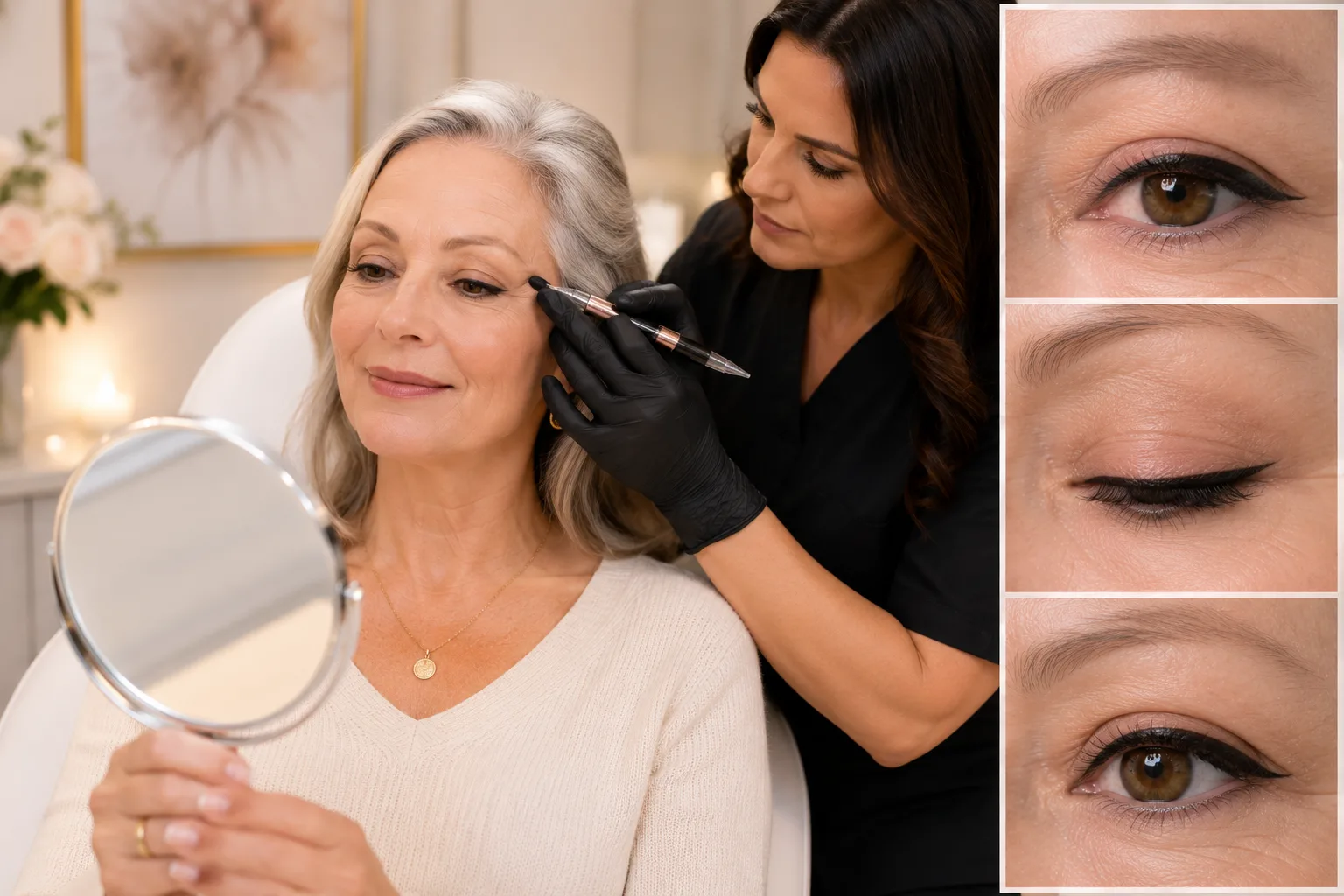
Let's start with the thing you're actually wondering about.
Yes, there is a needle involved. No, it does not go anywhere near your eye. Pigment is placed along the lash line — the strip of skin where your lashes emerge — while your eye stays closed and the lid is held gently taut. Your eyeball is never touched, never exposed, and never at risk.
We lead with that because it's the question almost everyone arrives with, and very few studios answer it plainly. At BrowLady in Dallas, a large share of the women who come to us for this are in their fifties, sixties and seventies, or are recovering from illness — and every one of them arrived with the same worry.
So before we talk about styles or healing or cost, let's take the fear apart properly.
Is permanent eyeliner safe?
When performed by a licensed artist using single-use sterile equipment, permanent eyeliner is a well-established and safe cosmetic procedure — and the eye itself is never involved.
Here's exactly what happens, so nothing is a surprise.
You lie back with your eyes closed. Your artist holds the eyelid gently taut with one hand, which keeps the skin still and stable throughout. Pigment is then deposited into the lash line — between and just above the base of the lashes — using a very fine needle. Your eye remains closed for the entire process. Nothing enters it, and nothing rests against it.
The technique is precise but shallow. Pigment sits in the upper layer of the skin, exactly as it does for brows.
Why we don't tattoo the waterline
You may have seen "waterline tattooing" or "tightlining" advertised. We don't offer it, and we'd gently encourage you to be cautious of anyone who does.
The waterline is a mucous membrane, not skin. Pigment placed there doesn't hold its position — it migrates and blurs — and the area sits directly against the eye and its tear film. The risk simply isn't proportionate to the result.
A well-placed lash line gives you the same effect of density and definition, without going anywhere it shouldn't.
Is it safe for mature eyes specifically?
This is the question we're asked most, and it deserves a proper answer rather than blanket reassurance.
Yes — but the technique must change, and any artist working on mature eyelids should be able to explain how.
Eyelid skin thins with age and loses some elasticity. It also tends to be drier. None of this rules anything out, but it does change three things:
The lid must be supported differently. Looser skin needs a gentler, more careful hold to keep it stable. This is a technique question, and experience shows.
Pigment is placed more conservatively. Thinner skin can spread pigment slightly more than younger skin, so we deliberately go finer and lighter on the first pass. It's always possible to add more at your touch-up. It is never quick to take away.
Healing takes a little longer. Where a younger client might be settled in seven days, mature skin often takes ten to fourteen. That's entirely normal and not a complication — it simply means we don't rush you between sessions.
There are also a few age-related conditions worth raising honestly. Dry eye becomes more common after menopause and can make the lids more sensitive. Blood thinners, which many of us take as we get older, increase bleeding during the procedure and affect how well pigment settles. Cataract or other eye surgery requires a waiting period set by your surgeon.
None of these are automatic refusals. All of them are conversations to have before you book.
If you've had chemotherapy, or live with alopecia
Losing lashes is one of the changes people find hardest, and it's rarely talked about. Eyes without lashes look bare in a way that's difficult to disguise, and strangers notice something without knowing what.
Before anything else, please speak to your oncologist or treating doctor. Timing depends on your treatment, your blood counts and your immune status — none of which a permanent makeup artist can assess. We will ask for medical clearance, and we won't proceed without it.
Most artists will not work during active chemotherapy. Once you're cleared, a lash line enhancement can make a genuine difference — it restores definition to the eye even where lashes are sparse or absent, and it does so without looking like makeup.
Two practical notes for skin after treatment. It can be thinner, drier and more sensitive, so a patch test is sensible and you may need an additional session. And pigment can behave unpredictably, so a conservative first pass is the right approach.
If lashes are regrowing, they often come back finer or a different colour than before. A lash line placed underneath gives them a base to sit against, which makes the regrowth look considerably fuller.
Does permanent eyeliner hurt?
Most clients find it more comfortable than brow work, which surprises almost everyone.
A topical anaesthetic is applied before we begin, and a secondary anaesthetic once the skin is open. The eyelid responds to numbing quickly and thoroughly.
The sensation people describe most often is a light fluttering or gentle vibration, sometimes with a faint tickling along the lash base. The actual pigment work usually takes 30 to 45 minutes.
If you're worried about discomfort — and plenty of people are — please say so. We can work more slowly, take breaks whenever you need one, and stop entirely if you want to. You are never trapped in the chair.
One practical note: skip caffeine on the morning of your appointment. It thins the blood slightly and makes everything more sensitive than it needs to be. If you take a daily blood thinner, don't stop it — just tell us, and speak to your doctor first.
What are the different styles?
This is where most people discover they want something far softer than they expected.
Lash line enhancement — the one we recommend most
A fine line of pigment placed between and just above the lashes, creating the appearance of a fuller lash line without looking like makeup at all.
This is by some margin our most popular option, and the most misunderstood. It doesn't read as eyeliner. It reads as thicker lashes. People notice you look rested and well; they very rarely work out why.
For mature eyes it's almost always the right starting point. It doesn't compete with a hooded lid, it doesn't age with you awkwardly, and it looks entirely natural in every light. Our lash line enhancement page shows how it settles on different eye shapes.
Classic permanent eyeliner
A defined line along the upper lash line, slightly thicker than a lash enhancement, shaped to your eye. Still natural, but visible as a deliberate definition. This suits anyone who wears eyeliner most days and would simply like to stop reapplying it. You can read more about our permanent eyeliner options and what each involves.
Winged eyeliner
A defined line extended into a soft wing. It's the most dramatic option and needs the most careful mapping. On mature or hooded lids we'd usually suggest starting softer and building at the touch-up, because a wing that looks right with the eyes closed can disappear entirely into the fold when they open.
Many clients begin with a lash enhancement and add definition later once they've lived with it. We're very happy to work that way. It's far easier to add than to remove, and there is genuinely no rush.
If your eyelids are hooded
Hooded and softer lids are extremely common, and they are not an obstacle — but placement has to account for them.
The mistake to avoid is mapping the line with your eyes closed only. A line that looks beautiful on a closed lid can vanish completely into the fold when the eye opens. We map with your eyes open as well as closed, sitting upright as well as lying back, so what you see in the mirror afterwards is what people actually see when they look at you.
What does healing look like?
Expect a defined, slightly bold line for the first few days, some flaking in week one, then a phase where it looks like it has disappeared — before settling into its true softness by week four.
Day of your appointment. The line looks sharper and darker than the final result, and your lids may feel tight. This is not what it will look like.
Days 1–3. Some swelling is normal, most noticeable the morning after. Sleeping with your head slightly elevated for two nights makes a real difference. If you take blood thinners, expect slightly more swelling and perhaps a little bruising.
Days 4–10. Light flaking begins. Please don't rub or pick — pulling a flake early takes the pigment underneath with it.
Days 10–16. The line may look surprisingly faint. The pigment is still there; a fresh layer of skin has healed over it and is temporarily veiling it. On mature skin this phase often lasts a few days longer, and it is not a sign anything is wrong.
Weeks 3–6. The true result resurfaces, softer and more natural than day one.
Weeks 6–8 — your touch-up. Included, and essential rather than an upsell. No one's skin retains all the pigment on a first pass, and mature skin retains a little less. We refine the line and adjust the depth of colour once everything has settled.
During healing: no eye makeup for ten days, no lash extensions, lifts or curlers for two weeks, avoid swimming and saunas for the same period, and don't book within a fortnight of an important occasion.
Who is permanent eyeliner really for?
It suits anyone for whom applying eyeliner has become difficult, unreliable, or simply not worth the daily effort.
The reasons we hear most often:
- You can no longer see well enough close up to apply it. This is the one nobody talks about, and it's the most common reason of all. You need reading glasses to see the detail — but you can't wear glasses while lining your eyes. It's a genuinely impossible task, and it has nothing to do with skill.
- Your hands aren't as steady as they used to be. Extremely common, entirely normal, and nothing to feel self-conscious about.
- Your lashes have thinned with age, so eyes look paler and less defined than they once did.
- Lash loss from chemotherapy, alopecia, thyroid conditions or medication.
- Contact lens wearers, who often find pencil irritating and powder worse.
- Softer, drier lids where product creases, smudges or migrates within hours no matter what you buy.
- Sensitivity or allergies to conventional eye makeup, which increases for many people with age.
Many of our clients come to us for brow work first and return for their eyes afterwards, once they've seen how much time and frustration it removes from the morning.
When it's better to wait
Please postpone and speak to your doctor first if you have active blepharitis, conjunctivitis or a stye; if you've had recent eye surgery, including cataract surgery or LASIK, and haven't yet passed the interval your surgeon specified; if you use prescription glaucoma drops; if you have significant dry eye; or if you're undergoing active cancer treatment.
If you have any existing eye condition or take any eye medication, speak to your ophthalmologist before booking. They know your eyes; we don't. Any good artist will be glad you asked them first.
How long does it last, and what does it cost?
Permanent eyeliner typically lasts two to three years before it needs refreshing, making it the most durable of the permanent makeup services.
The lash line is a protected area — less sun than brows, less friction than lips — so pigment holds well and fades gradually and evenly rather than patchily.
In the Dallas area, expect $350–$450 for lash line enhancement, $450–$600 for classic eyeliner, and $550–$700 for a winged style, with your consultation, aftercare kit and 6–8 week touch-up included. A colour refresh every two to three years generally runs $200–$300.
The most reliable way to judge any artist is to look at healed work at six to eight weeks rather than photographs taken on the day — and ideally on eyes like yours. You're welcome to browse our healed before and after results and see how the work settles over time.
Questions we're asked most often
Am I too old for this?
No. A great deal of our eyeliner work is for women in their sixties and seventies, and softly done, it's often more flattering on mature eyes than on young ones. Technique matters, age doesn't.
Will it look harsh or drawn on?
Not unless you want it to. A lash line enhancement is invisible as makeup — it simply makes lashes look denser. We agree on the style with you, in a mirror, before anything begins.
Does it work on hooded or crepey eyelids?
Yes, and it's often especially flattering. Placement must account for how the lid folds when your eyes are open, which is why we map both ways.
I take blood thinners. Does that rule me out?
Usually not, but it does change what to expect — a little more swelling, occasionally slight bruising, and sometimes an extra session. Please never stop your medication for a cosmetic procedure. Tell us, and speak to your doctor.
Can I wear it with glasses?
Yes, and many clients say it's one of the main benefits — defined eyes still read clearly behind lenses.
Can it be removed if I change my mind?
It fades naturally over two to three years. Saline lightening is available if you'd like it gone sooner, though it works more slowly here than on brows.
Will I be judged for asking about this?
Never. This is one of the most practical, sensible things you can do for yourself, and everyone who sits in our chair has a reason that makes complete sense.
Not sure yet? Let's just talk — one phone call is enough
Nerves about anything near the eyes are entirely reasonable, and we'd far rather you spoke to us first than booked something you weren't ready for.
At BrowLady in Dallas, Silvia will look at your eyes, talk through what would genuinely suit them, and explain exactly what the procedure involves — step by step, before you commit to anything. If we don't think permanent eyeliner is right for you, or that now isn't the right time, you'll hear that honestly.
You will not be rushed. You will not be upsold. And there is no question too small or too silly to ask.
Call Silvia directly on (214)454-5078
A ten-minute conversation will tell you more than an hour of reading. Tell us about your eyes, your lashes, and any medication or eye conditions you have — and we'll tell you honestly whether this is right for you, and what it would involve.
Prefer not to call? Send us a message and we'll reply with an honest first opinion. No cost, no obligation, and no pressure to book on the day.
Consultations available Monday to Saturday. Serving Dallas, Plano, Frisco, Richardson, Garland and McKinney.