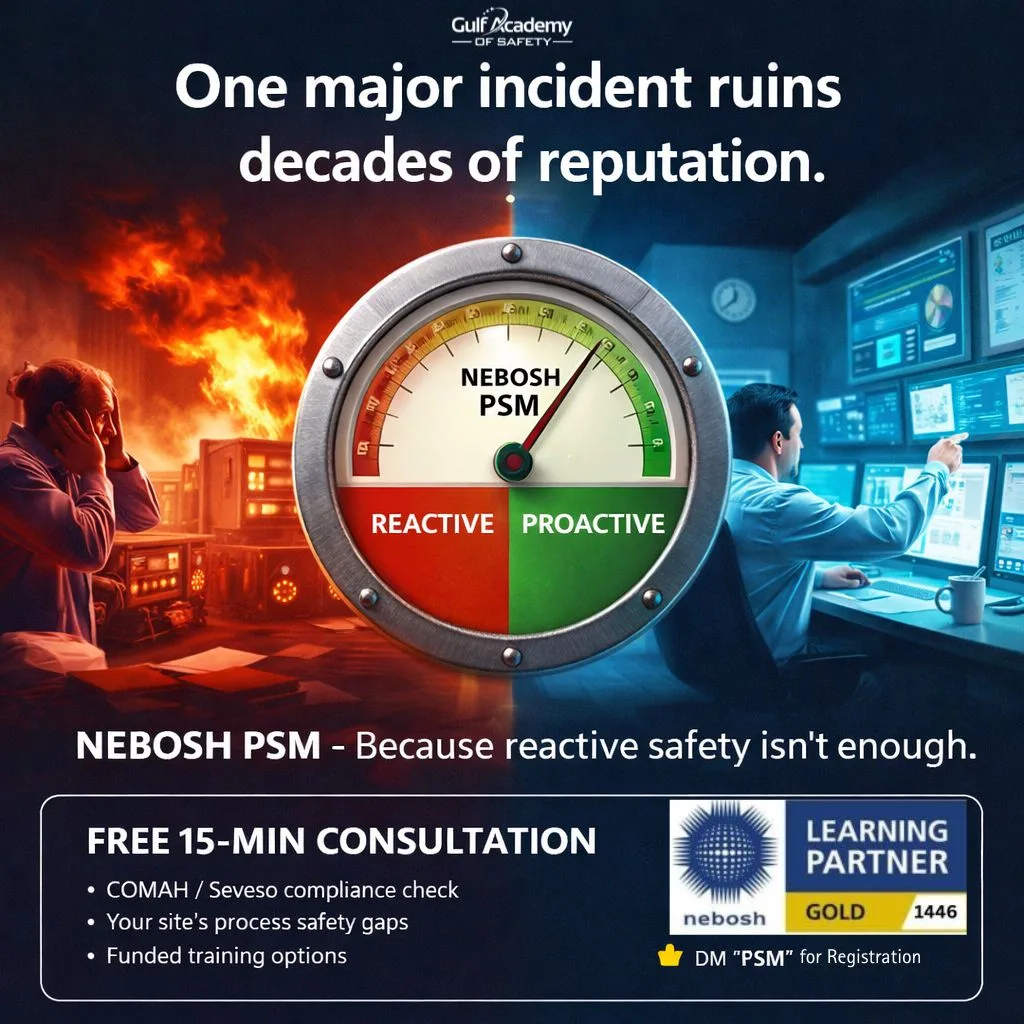
The phrase 'process safety management' describes one of the most demanding and consequential disciplines in industrial health and safety. When it is practised well, catastrophic accidents are prevented. When it fails, the consequences can be measured in lives lost, communities displaced, and industries reshaped. The NEBOSH Process Safety Management qualification exists to ensure that the professionals responsible for this discipline are equipped to practise it to the highest standard.
Gulf Academy of Safety delivers the NEBOSH Process Safety Management qualification through expert-led classroom programmes across the UAE, KSA, and India — helping professionals across high-hazard industries build the competence that the role demands.
Understanding Process Safety Management
Process safety management (PSM) is the systematic application of management systems, technical knowledge, and operational controls to prevent the unplanned release of hazardous materials or energy — and to mitigate the consequences when releases do occur. It is distinguished from occupational safety (which focuses on worker injury and illness prevention) by its focus on major accident hazards — events that have the potential to cause multiple fatalities, significant environmental damage, or major asset destruction.
The origins of modern process safety management lie in catastrophic industrial accidents. Bhopal in 1984. Piper Alpha in 1988. Texas City in 2005. Deepwater Horizon in 2010. Each of these events — and dozens of others — revealed systemic failures in how organisations identified, assessed, and managed process hazards. The regulatory frameworks and professional standards that followed shaped what we now understand as process safety management.
The NEBOSH Process Safety Management qualification is built on this body of knowledge — and on the hard lessons that generated it.
The NEBOSH Process Safety Management Framework
The NEBOSH Process Safety Management syllabus is structured around a comprehensive, integrated approach to major accident hazard management. It covers:
Regulatory and Standards Context
Candidates develop a thorough understanding of the regulatory frameworks governing process safety in different jurisdictions — including the Seveso Directive in Europe, OSHA PSM Standard 29 CFR 1910.119 in the United States, and the equivalent regulatory requirements across GCC states and India. They learn how international standards from the API, IEC, ISO, and CCPS (Centre for Chemical Process Safety) underpin professional practice.
Major Accident Hazard Identification
NEBOSH Process Safety Management teaches candidates to identify the full spectrum of major accident hazards present in process facilities — toxic releases, fires, explosions, reactive chemistry incidents, and loss of containment from pressurised systems. Hazard identification methodologies covered include HAZOP, HAZID, What-If Analysis, and preliminary hazard analysis (PHA).
Quantitative and Qualitative Risk Assessment
Moving beyond hazard identification, candidates learn to assess risk — both qualitatively (using risk matrices and bow-tie analysis) and quantitatively (using consequence modelling, frequency estimation, and Layer of Protection Analysis). They understand risk tolerability criteria and how organisations use these frameworks to prioritise investment in safeguards.
Barrier and Safeguard Management
Central to modern process safety management is the concept of barriers — the layers of protection that stand between a hazard and a major accident. NEBOSH Process Safety Management teaches candidates to identify, evaluate, and manage independent protection layers (IPLs), safety instrumented functions (SIFs), and passive and active safeguards using frameworks aligned with IEC 61511 and LOPA methodology.
Management of Change
Process accidents frequently involve modifications to plant, process, or procedures that were not properly assessed for safety impact. Management of Change (MOC) is a core element of NEBOSH Process Safety Management — candidates learn how to design, implement, and audit MOC systems that prevent safety-critical changes from being made without adequate review.
Mechanical Integrity
The physical integrity of process equipment — vessels, pipework, instruments, and safety systems — is fundamental to accident prevention. NEBOSH Process Safety Management covers inspection, maintenance, and testing programmes for safety-critical equipment, including the use of risk-based inspection (RBI) methodologies.
Human Factors and Safety Culture
Major process accidents almost always involve human and organisational factors alongside technical failures. NEBOSH Process Safety Management addresses human performance in process environments — task design, workload management, shift handover, and the role of organisational culture in creating conditions for either safety or catastrophic failure.
NEBOSH Process Safety Management vs NEBOSH General Certificate
Many professionals ask how the NEBOSH Process Safety Management qualification compares to the NEBOSH International General Certificate (IGC). The answer is that they serve different — though complementary — purposes:
- The NEBOSH IGC provides broad, foundational health and safety knowledge applicable across all industries
- The NEBOSH Process Safety Management qualification provides deep, specialist knowledge specifically for process industry environments
- Professionals in process industries should ideally hold both — the IGC as a general foundation, and the PSM qualification for their specialist sector
- For roles specifically requiring process safety competence — PSM Engineer, HAZOP Facilitator, Process Safety Manager — the NEBOSH Process Safety Management qualification is the primary credential
Gulf Academy of Safety: Expert Delivery of NEBOSH Process Safety Management
Gulf Academy of Safety's tutors for the NEBOSH Process Safety Management programme bring direct operational experience from process industry environments across the GCC and India. They understand the practical reality of managing safety in refineries, petrochemical plants, gas processing facilities, and offshore installations — and they teach accordingly.
Classroom delivery means candidates benefit from expert facilitation of HAZOP exercises, bow-tie workshops, and incident case study reviews that simply cannot be replicated in online formats. The interaction between experienced industry professionals in a classroom setting generates insights that enhance learning far beyond the syllabus alone.
Secure Your Place — Enrol in the Next Intake Today!
Register now for the NEBOSH Process Safety Management at Gulf Academy of Safety and earn a qualification that sets the global standard for process safety professionals.
📞 UAE: +971 525 700 789 | KSA: +966 542 600 789 | India: +91 8500 14 14 14
🌐 Visit: https://gulfacademysafety.com/project/nebosh-process-safety-management-classroom/