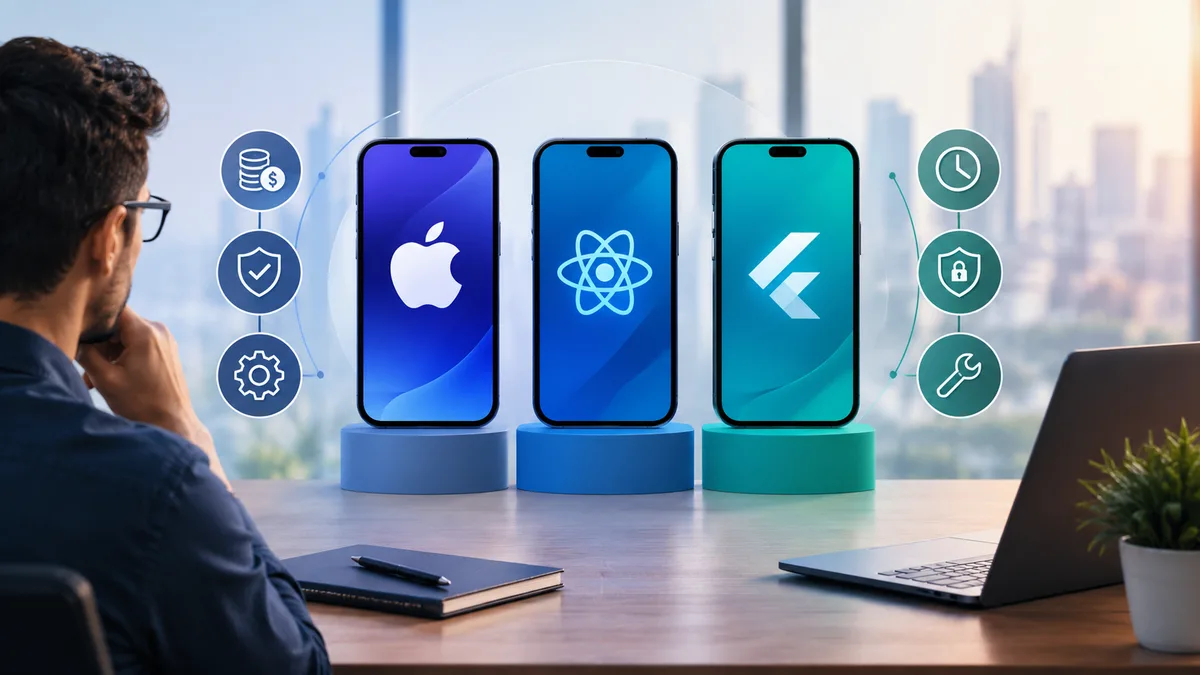
Enterprise mobile development is no longer just about launching an iOS and Android app. Businesses must manage identity access, enterprise system integrations, security updates, offline workflows, device compatibility, and long-term maintenance without allowing costs to grow uncontrollably.
Choosing between native development, React Native, and Flutter directly affects these responsibilities. Recent 2026 comparisons increasingly emphasize total cost of ownership (TCO), developer availability, dependency management, and the effort required to maintain applications after launch. React Native’s New Architecture and Flutter’s Impeller rendering engine have also narrowed many historical performance differences.
For organizations evaluating enterprise mobile application development services, the right decision depends on the application's technical requirements, internal expertise, and three-year operating budget—not simply the initial development quote.
1. Understanding the Three Development Approaches
Native development: Swift and KotlinNative development uses Swift or SwiftUI for iOS and Kotlin with Jetpack Compose for Android. Each platform has its own codebase, development workflow, and release process.
This approach suits enterprise applications that depend on advanced Bluetooth or NFC integrations, background processing, specialized device hardware, or immediate access to new operating-system capabilities. It also provides direct access to platform security features, including the iOS Keychain and Android Keystore.
The trade-off is duplicated implementation and testing. A new authentication flow, offline synchronization feature, or security patch may require separate changes and validation across both platforms.
React Native: Shared development with native integrationReact Native uses JavaScript or TypeScript and React to build mobile applications with a shared codebase. Its New Architecture—including Fabric, TurboModules, and JavaScript Interface (JSI)—improves communication between JavaScript and native functionality.
It can be particularly cost-effective for businesses with existing React developers, shared web and mobile business logic, or frequent product updates. However, advanced native integrations may still require Swift, Objective-C, Kotlin, or Java expertise.
Flutter: Consistent interfaces across platformsFlutter uses Dart and its own rendering system to create consistent interfaces across iOS and Android. Its Impeller rendering engine improves rendering predictability for supported configurations.
Flutter is suitable for enterprise products requiring consistent branding, complex dashboards, custom workflows, or visually rich interfaces. The main consideration is maintaining Dart expertise and ensuring third-party plugins support the required native functionality.
For businesses comparing enterprise mobile application development services, all three approaches can support enterprise-grade applications. Their differences become more apparent in staffing, platform integration, testing, and maintenance.
2. Three-Year Cost Comparison: What Enterprises Should Budget For
The initial development estimate rarely represents the full cost of an enterprise application. Over three years, businesses must also budget for regression testing, operating-system updates, third-party SDK upgrades, security assessments, infrastructure integration, and ongoing feature development.
The following model illustrates how the approaches can differ.
Illustrative planning estimates in USD for a moderately complex iOS and Android application. These are budgeting assumptions, not vendor quotations or industry averages.
Cost componentNativeReact NativeFlutterInitial development$120,000$80,000$85,000Maintenance over 3 years$75,000$48,000$45,000QA and regression testing$45,000$30,000$28,000Security and OS upgrades$30,000$24,000$24,000Three-year total$270,000$182,000$182,000These estimates assume the same business scope and exclude shared backend development, cloud infrastructure, major feature expansions, and licensing costs. Actual spending depends on team rates, application complexity, and internal engineering capabilities.
Illustrative 3-year ownership cost
Estimated total development, maintenance, QA, and security costs.

In this scenario, either cross-platform approach costs approximately 33% less than native development over three years. This is not a guaranteed saving: a React Native or Flutter application requiring extensive native modules can narrow the difference, while a feature-heavy native app can cost considerably more.
For enterprises evaluating enterprise mobile application development services, ask vendors to itemize initial delivery, annual maintenance, security updates, platform migrations, and post-launch support separately. A lower quote is meaningful only if the scope and service commitments are comparable.
3. Security: Which Approach Reduces Enterprise Risk?
Framework choice alone does not make an application secure. Authentication, authorization, encryption, secure storage, network protection, dependency management, and release controls determine the actual security posture.
The OWASP Mobile Application Security Verification Standard (MASVS) provides a useful framework for evaluating these controls across native and cross-platform applications.
- Native: Offers direct access to platform security APIs and can simplify specialized device-level controls. However, separate implementations must remain consistent across iOS and Android.
- React Native: Supports secure enterprise applications, but teams must review npm packages, native modules, JavaScript runtime behavior, and third-party SDKs. Sensitive credentials should never be embedded in application code.
- Flutter: Supports platform-backed secure storage and native security integrations. Dart compilation does not eliminate risks from insecure APIs, vulnerable plugins, or poorly designed backend authorization.
A practical example is a field-service app that stores customer records offline. All three approaches need encrypted local storage, secure session expiry, appropriate device authentication, and a defined policy for remotely revoking access.
Enterprises should include software composition analysis, dependency vulnerability scanning, mobile penetration testing, and release signing in their budgets. OWASP's mobile security guidance also emphasizes checking third-party components for known vulnerabilities.
Security requirements should be written into the statement of work for enterprise mobile application development services, rather than treated as a final testing phase.
4. Maintenance: The Costs That Appear After Launch
Three-year ownership costs depend heavily on how the application evolves. An enterprise product might undergo annual operating-system changes, identity-provider updates, API migrations, new compliance requirements, and continuous feature releases.
Native maintenance involves coordinating two codebases and two release pipelines. It offers maximum platform control but requires ongoing iOS and Android expertise.
React Native maintenance can be efficient when the organization already uses React and TypeScript. Shared business logic reduces duplication, although framework upgrades, native dependencies, and platform-specific bugs still require careful testing.
Flutter maintenance benefits from a unified UI implementation. This can reduce visual inconsistencies and duplicated interface work. However, teams must track Flutter releases, Dart dependencies, plugin compatibility, and platform-specific behavior.
The important distinction is that shared code does not eliminate platform testing. Biometric login, push notifications, background tasks, deep links, and offline synchronization must still be validated on real devices.
Before choosing enterprise mobile application development services, ask how the vendor handles framework upgrades, dependency updates, critical security patches, regression automation, and support after the original developers leave.
5. Which Approach Fits Your Enterprise?
Business requirementBest starting pointWhyAdvanced device hardware or platform-specific workflowsNativeDirect access to operating-system APIsExisting React web team and shared business logicReact NativeReuses relevant JavaScript and TypeScript expertiseConsistent branded interfaces across platformsFlutterUnified rendering and UI implementationHighly specialized iOS experienceNativeMaximum control over Apple platform capabilitiesBudget-conscious internal business applicationReact Native or FlutterShared code can reduce duplicated implementationThese are starting points, not rigid rules. A proof of concept should validate the application's most difficult requirement before the architecture is finalized.
For example, a banking application with complex device attestation, biometric authentication, and specialized security controls may justify native development—or a cross-platform interface with carefully engineered native security modules. An internal inventory app with standard authentication, barcode scanning, and API-driven workflows may benefit more from shared code and a simpler maintenance structure.
6. How to Evaluate Enterprise Mobile Application Development Services
Before signing a development contract, evaluate the complete delivery plan rather than comparing frameworks in isolation.
- Define a three-year roadmap. Document expected users, integrations, release frequency, offline requirements, and planned features.
- Request a realistic proof of concept. Test the riskiest integration, such as SSO, MDM deployment, biometric authentication, or offline data synchronization.
- Validate the security architecture. Require documented controls, dependency scanning, penetration testing, and remediation procedures.
- Compare fully loaded ownership costs. Include hiring, training, QA, upgrades, support, and infrastructure dependencies.
- Establish exit and handover terms. Require source-code ownership, build documentation, automated tests, dependency inventories, and deployment access.
Debut Infotech can be considered when evaluating a delivery partner for enterprise mobile projects. Buyers should assess its proposed architecture, security practices, framework expertise, and maintenance commitments against the same measurable requirements used for other vendors.
Businesses needing platform-specific development can also explore iOS App Development Services for Apple-focused applications or react native app development services when shared iOS and Android development aligns with their product strategy.
Conclusion
Native, React Native, and Flutter can all support enterprise mobile applications, but their three-year economics differ according to the product and the team maintaining it.
Native development is worth the additional investment when platform control, specialized hardware, or demanding native workflows are central requirements. React Native is attractive for organizations with established React expertise and integration-heavy applications. Flutter is compelling when interface consistency and shared UI development are major priorities.
The best enterprise mobile application development services partner will explain these trade-offs, validate critical requirements through testing, and provide a transparent three-year ownership estimate. Choose the architecture that your organization can secure, upgrade, and maintain—not simply the one that delivers the cheapest first release.