
Introduction
For years, seed phrases have been the foundation of crypto wallet security. The standard 12-word or 24-word recovery phrase became widely accepted as the safest way for users to control digital assets. However, as blockchain adoption expanded beyond retail users into enterprises, fintech platforms, institutions, and Web3 Development ecosystems, the limitations of seed phrase-based wallets became increasingly visible.
The biggest issue is usability. Most users struggle to securely store recovery phrases, and a single mistake can permanently lock access to funds. Lost seed phrases, phishing attacks, clipboard malware, social engineering, and poor storage practices continue to cause millions in losses every year. What once worked for early crypto enthusiasts is now proving insufficient for enterprise-grade digital asset management.
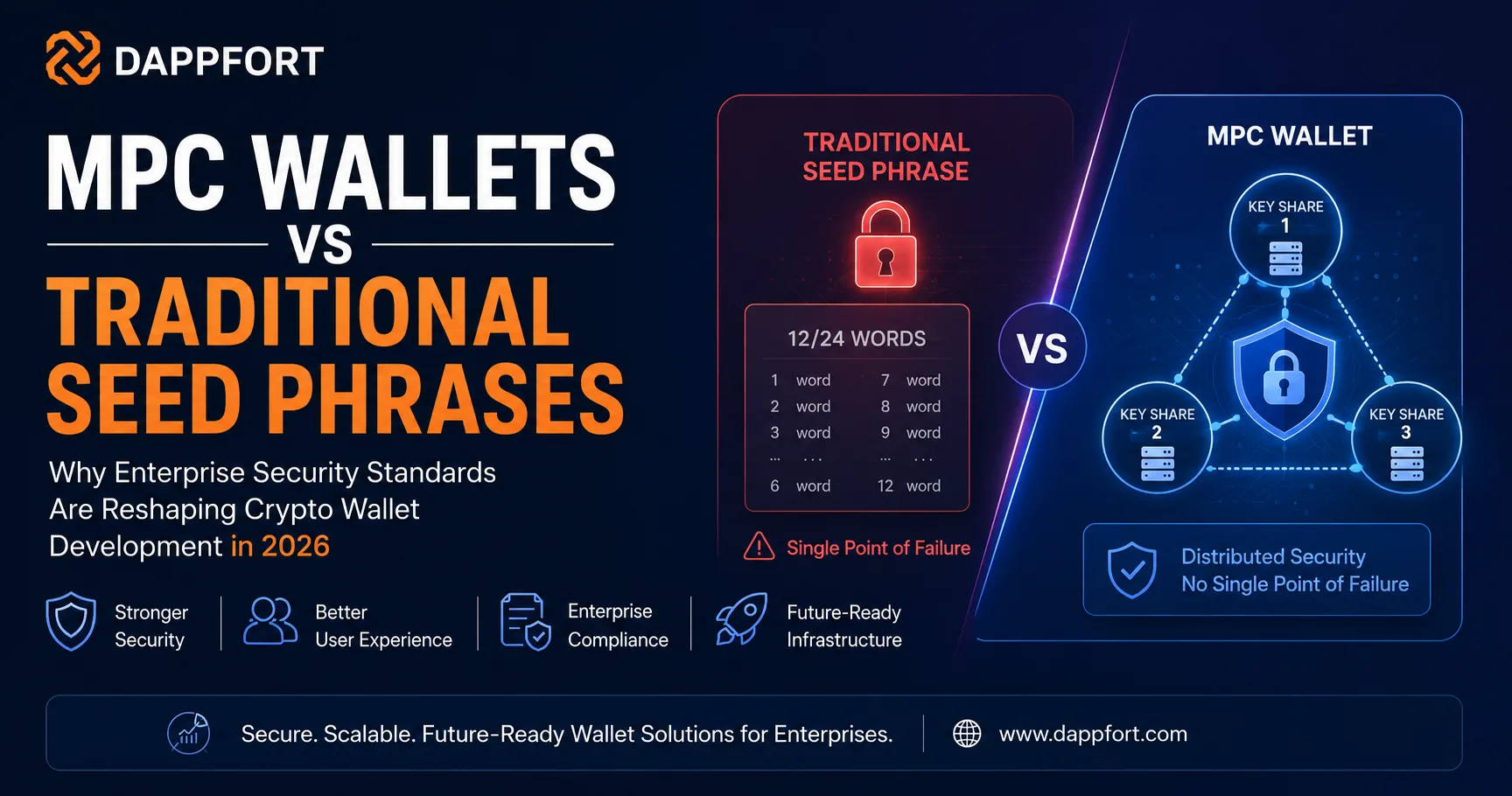
In 2026, wallet infrastructure is evolving rapidly. Businesses are now focusing on intelligent wallet systems powered by Multi-Party Computation (MPC), account abstraction, and advanced cryptographic security layers. Instead of relying on a single private key stored in one location, MPC wallets distribute signing authority across multiple independent key shares, dramatically reducing single points of failure.
This shift is changing how organizations approach digital asset custody, transaction authorization, and wallet recovery mechanisms. Institutional investors, exchanges, fintech companies, and decentralized applications increasingly demand wallet architectures that combine security, compliance readiness, scalability, and better user experiences.
As a result, every modern Cryptocurrency wallet development company is now evaluating MPC infrastructure as a core component of enterprise wallet architecture. Understanding how MPC differs from traditional seed phrase systems is becoming essential for developers, startups, and businesses building secure Web3 ecosystems in 2026.
What Is MPC & Why It Matters
Multi-Party Computation (MPC) is a cryptographic technique that allows multiple parties or devices to jointly perform operations on sensitive data without revealing the actual data to each other. In crypto wallets, MPC is primarily used to protect private keys by splitting them into multiple independent key shares.
Unlike traditional wallets where a single private key exists in one location, MPC wallets divide the signing authority into separate shards distributed across devices, servers, or trusted environments. No single shard alone can reconstruct the full private key. Transactions are approved collaboratively through cryptographic computation.
This architecture significantly improves wallet security because attackers cannot compromise a wallet by accessing a single server, database, or user device.
Traditional Seed Phrase Architecture
Traditional wallets rely on one master private key derived from a seed phrase. Whoever controls the seed phrase controls the assets.
This creates several problems:
- Single point of failure
- Risk of phishing attacks
- Human storage mistakes
- Exposure through screenshots or cloud backups
- Vulnerability to device compromise
Even highly security-conscious users often struggle with securely managing recovery phrases over long periods.
How MPC Works
In MPC systems:
- The private key is mathematically split into multiple shares
- Each share is stored independently
- Transaction signatures are generated collaboratively
- The full private key is never reconstructed during operations
This creates a decentralized trust model inside wallet infrastructure itself.
For example:
- Share 1 → User device
- Share 2 → Secure cloud infrastructure
- Share 3 → Backup recovery environment
An attacker would need simultaneous access to multiple independent environments to compromise the wallet.
Why Enterprises Prefer MPC
Enterprises managing digital assets require:
- Strong internal access controls
- Compliance-friendly transaction approval
- Institutional-grade security
- Disaster recovery mechanisms
- Auditability
MPC enables all of these without sacrificing usability.
Instead of asking employees to manage sensitive seed phrases manually, organizations can implement controlled authorization workflows using distributed cryptographic signing.
This improves operational security while reducing human error.
The Technical Difference
Traditional Wallet Key Storage
Traditional crypto wallets generate a single private key derived from a mnemonic seed phrase.
Simplified Architecture
User → Wallet App → Private Key → Blockchain Signature
In this model:
- The wallet locally stores the private key
- The seed phrase acts as master recovery access
- A compromised device can expose wallet credentials
This architecture works well for individual users but creates challenges for enterprise environments.
Weaknesses
Centralized Key ExposureIf attackers gain access to:
- Local storage
- Browser extensions
- Clipboard memory
- Cloud backups
- Screenshots
the wallet can be compromised.
Recovery RisksSeed phrase recovery depends entirely on human responsibility.
Problems include:
- Lost phrases
- Incorrect storage
- Insider theft
- Social engineering attacks
Traditional wallets are difficult to integrate into enterprise-grade approval systems because transactions depend on single-key authorization.
MPC Wallet Architecture
MPC wallets distribute signing authority cryptographically.
Simplified MPC Architecture
User Device + Cloud Service + Secure Recovery Node → Distributed Signature → Blockchain
Key benefits include:
- No complete private key stored anywhere
- Distributed authorization
- Secure transaction signing
- Granular access controls
Transaction Flow
- User initiates transaction
- Key shards independently compute signature fragments
- Fragments combine mathematically
- Final signature is broadcast
The private key never exists in a fully assembled state.
Account Abstraction & ERC-4337 Integration
MPC wallets increasingly integrate with ERC-4337 account abstraction frameworks.
This enables:
- Gasless transactions
- Social recovery
- Multi-device authorization
- Biometric authentication
- Programmable spending rules
Combined with MPC, account abstraction allows wallets to behave more like secure smart accounts instead of static key containers.
Example Use Cases
- Daily transaction limits
- Time-based approvals
- DAO treasury permissions
- Automated compliance workflows
This combination is becoming foundational for enterprise Web3 applications.
Example: Key Shard Distribution
const keyShares = { userDevice: "Shard_A", cloudNode: "Shard_B", recoveryNode: "Shard_C" }; function approveTransaction(shards) { if (shards.length >= 2) { return "Transaction Signed"; } return "Authorization Failed"; }
In this simplified example:
- No single shard can sign independently
- Multiple approvals are required
- Compromise resistance increases dramatically
Performance & Latency Considerations
MPC systems require communication between multiple nodes.
Potential tradeoffs include:
- Slightly higher transaction latency
- Additional server coordination
- Infrastructure complexity
However, modern MPC frameworks have significantly optimized performance.
Most enterprise wallets now operate with near real-time signing while maintaining distributed security.
Enterprise Use Cases
Institutional Custody
Institutions managing millions in digital assets cannot rely on consumer-grade seed phrase systems.
MPC enables:
- Shared authorization
- Segregated approval layers
- Internal governance controls
- Secure treasury management
This is especially important for exchanges, custodians, hedge funds, and fintech platforms.
Compliance Integration
Modern regulations increasingly require:
- Transaction monitoring
- Role-based access
- Audit trails
- Approval logging
MPC architectures integrate more naturally into compliance environments because authorization can be distributed across departments and systems.
Multi-Signature + MPC Hybrid Models
Some organizations combine:
- Multi-signature wallets
- MPC authorization
- Hardware security modules
This layered approach creates highly resilient custody infrastructure.
Example:
- CFO approval
- Compliance approval
- Automated risk engine verification
before transaction execution.
Enterprise Wallet Architecture Example
A fintech company managing institutional assets may implement:
- User authentication layer
- MPC transaction engine
- AI fraud monitoring
- Hardware enclave backup
- Compliance logging infrastructure
This architecture creates enterprise-grade operational resilience.
Development Implementation
MPC Libraries & Frameworks
Popular MPC technologies include:
- Threshold Signature Schemes (TSS)
- GG18 Protocol
- Frost Signatures
- ZenGo MPC Infrastructure
- Coinbase WaaS architecture
- Fireblocks MPC solutions
Developers increasingly rely on these frameworks to build scalable wallet ecosystems.
Cloud Security Integration
Modern MPC wallets integrate with:
- AWS KMS
- Azure Confidential Computing
- Google Cloud HSM
- Secure enclaves
This improves enterprise infrastructure security while maintaining distributed trust models.
Recovery Without Seed Phrases
MPC wallets introduce alternative recovery systems:
- Social recovery
- Trusted device recovery
- Biometric verification
- Encrypted backup authorization
This dramatically improves user experience.
Instead of memorizing seed phrases, users recover wallets through secure identity-based workflows.
Testing & Security Audits
Enterprise MPC implementations require:
- Smart contract audits
- Penetration testing
- Infrastructure audits
- Cryptographic validation
- Red-team simulations
Security validation is critical because MPC systems involve highly sensitive cryptographic operations.
Security Comparison Matrix
FeatureTraditional WalletsMPC WalletsPrivate Key StorageSingle locationDistributed shardsSeed Phrase DependencyRequiredOptionalSingle Point of FailureHighVery lowEnterprise CompatibilityLimitedExcellentCompliance ReadinessModerateHighRecovery OptionsManual seed phraseFlexible recoveryUser ExperienceComplexImprovedInsider Threat ProtectionWeakStrongMulti-Device AuthorizationLimitedNative supportInstitutional SecurityModerateEnterprise-grade
The Future: 2027 & Beyond
Wallet infrastructure is evolving beyond simple private key storage systems.
Emerging trends include:
- AI-assisted fraud prevention
- Autonomous smart wallets
- Identity-linked recovery systems
- Cross-chain account abstraction
- Embedded compliance automation
Regulators are also becoming more involved in digital asset security standards. Enterprise-grade custody infrastructure will likely become mandatory for large-scale financial applications.
As Web3 adoption grows, MPC wallets may eventually replace traditional seed phrase systems entirely for mainstream enterprise usage.
The future of wallet development will focus on balancing:
- Security
- Usability
- Compliance
- Scalability
within intelligent decentralized ecosystems.
Conclusion
Traditional seed phrase wallets helped bootstrap the early crypto ecosystem, but enterprise adoption demands stronger infrastructure. MPC technology addresses many of the limitations associated with single-key wallet systems by distributing trust across multiple secure environments.
For businesses building secure blockchain platforms in 2026, MPC-based wallet architecture is quickly becoming the new standard for institutional-grade digital asset security.
Organizations investing in wallet infrastructure today should evaluate MPC implementation strategies early to ensure scalability, compliance readiness, and long-term operational security.
Need expert guidance for secure wallet infrastructure?
Get professional consultation on enterprise MPC wallet architecture, scalable blockchain security systems, and next-generation digital asset platform development.