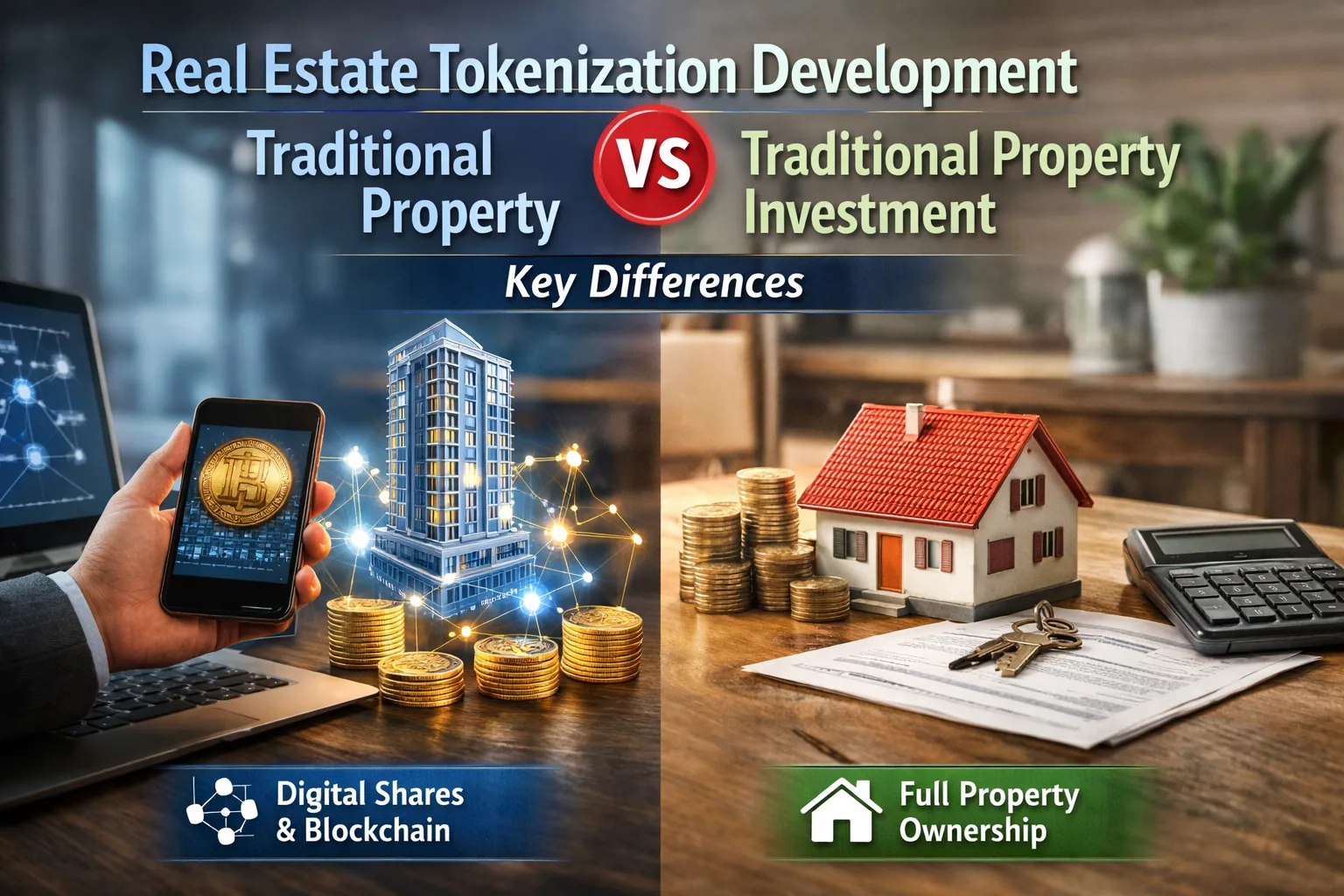
The real estate sector is entering a major structural transition driven by blockchain-enabled asset digitization. For decades, property investment operated through conventional ownership structures involving brokers, intermediaries, legal documentation, mortgage systems, and geographically restricted participation. While the traditional model remains dominant, emerging tokenization frameworks are introducing an alternative investment architecture that emphasizes liquidity, fractional ownership, automation, and borderless participation.
Real estate tokenization development is redefining how property assets are issued, traded, and managed within digital ecosystems. Instead of relying solely on centralized ownership mechanisms, tokenization converts physical real estate assets into blockchain-based digital tokens representing economic ownership rights. This transformation is gaining traction among institutional investors, fintech firms, real estate operators, and private equity participants seeking more efficient capital deployment models.
Understanding the differences between tokenized real estate and traditional property investment is essential for investors evaluating future-ready real estate strategies.
Understanding Traditional Property Investment
Traditional property investment refers to the direct acquisition of residential, commercial, industrial, or mixed-use real estate through conventional financial and legal frameworks. Investors generally purchase assets either independently or through syndicates, REITs, or private partnerships.
This model has historically been associated with wealth preservation, rental income generation, and long-term capital appreciation. However, the operational structure of traditional real estate investment often introduces significant inefficiencies.
Some of the defining characteristics include:
- High capital entry requirements for asset acquisition
- Illiquid ownership structures with extended exit timelines
- Dependence on intermediaries such as brokers, banks, and legal advisors
- Manual compliance and documentation processes
- Geographic limitations restricting cross-border participation
- Lengthy settlement cycles during transactions
Although traditional property investment provides tangible asset ownership and regulatory familiarity, scalability challenges remain a major concern for modern investors seeking flexible portfolio allocation.
In large commercial transactions, due diligence alone can consume weeks or months due to title verification, escrow processing, legal negotiations, and financing approvals. These structural delays reduce transactional agility and limit accessibility for smaller investors.
What Is Real Estate Tokenization Development?
Real estate tokenization development involves the creation of blockchain-based digital representations of real-world property assets. Through smart contract infrastructure, ownership rights are divided into programmable digital tokens that can be purchased, transferred, or traded within compliant blockchain ecosystems.
A professional Real Estate Tokenization Development Company typically develops the technical architecture required for token issuance, investor onboarding, compliance integration, smart contract automation, digital wallet compatibility, and asset governance management.
Unlike traditional ownership models, tokenization introduces fractional participation. Instead of purchasing an entire building or commercial unit, investors can own smaller tokenized shares representing partial economic rights.
Core components of tokenized real estate ecosystems include:
- Smart contracts for automated ownership execution
- Blockchain ledgers for immutable transaction records
- Fractionalized investment structures
- Integrated KYC and AML verification systems
- Secondary marketplace functionality for token trading
- Automated dividend or rental income distribution
This framework transforms real estate from a relatively illiquid asset class into a digitally accessible financial instrument capable of broader market participation.
Liquidity and Accessibility Differences
One of the most significant differences between tokenized real estate and traditional property investment is liquidity efficiency.
Traditional real estate assets are notoriously illiquid. Selling a property often requires broker coordination, valuation assessments, legal documentation, buyer negotiations, and financial approvals. Depending on market conditions, liquidation can take several months.
Tokenized real estate ecosystems aim to reduce this friction by enabling digital ownership transfer mechanisms through blockchain networks. Investors can potentially buy or sell fractional asset ownership more efficiently through regulated secondary marketplaces.
This introduces several accessibility advantages:
- Lower investment barriers for retail participants
- Increased portfolio diversification opportunities
- Faster settlement execution
- Simplified cross-border investment participation
- Reduced dependency on institutional intermediaries
Fractional ownership also changes investor psychology. Instead of allocating large capital reserves into a single physical asset, investors can distribute smaller amounts across multiple property categories such as hospitality, logistics, healthcare infrastructure, or commercial office spaces.
This diversification capability improves risk management flexibility while expanding participation beyond high-net-worth individuals.
Operational Efficiency and Transparency
Operational efficiency represents another major distinction between the two investment models.
Traditional real estate transactions rely heavily on paper-intensive workflows and centralized verification systems. Property transfers often involve multiple stakeholders including banks, registrars, legal teams, tax authorities, brokers, and escrow agents. This creates administrative overhead and increases transaction costs.
Real estate tokenization development introduces programmable automation through blockchain infrastructure. Smart contracts can automatically execute predefined conditions including ownership transfers, investor payouts, compliance validation, and transaction recording.
Blockchain-based transparency also enhances investor confidence because transaction histories remain immutable and auditable.
Key operational improvements include:
- Automated compliance workflows
- Reduced administrative processing costs
- Real-time ownership verification
- Faster transaction settlement
- Transparent asset performance reporting
- Secure digital audit trails
Additionally, tokenized ecosystems reduce reconciliation complexities that commonly arise in traditional property management systems. Stakeholders gain access to synchronized data environments where ownership records and transaction histories are consistently maintained.
For institutional participants, this operational standardization supports more scalable real estate investment frameworks.
Risk, Regulation, and Market Adoption Challenges
Despite its advantages, real estate tokenization is still an evolving segment facing regulatory and infrastructure-related complexities.
Traditional real estate investment benefits from decades of legal precedent, established financing systems, and mature regulatory oversight. Investors are familiar with mortgage structures, title registration frameworks, and property taxation systems.
Tokenized real estate, however, operates within a developing regulatory landscape that differs across jurisdictions. Securities classification, digital asset taxation, investor accreditation standards, and cross-border compliance obligations continue evolving globally.
Market adoption challenges include:
- Regulatory uncertainty in certain regions
- Limited standardized tokenization frameworks
- Cybersecurity concerns involving digital wallets and smart contracts
- Secondary market liquidity limitations
- Institutional hesitation toward blockchain integration
Furthermore, token valuation models for tokenized real estate are still maturing. Since secondary markets remain relatively early-stage, pricing mechanisms can occasionally experience volatility or reduced trading activity.
However, enterprise adoption momentum continues growing as financial institutions and property firms explore blockchain-enabled infrastructure modernization. Large-scale tokenization pilots are already emerging across commercial real estate, luxury properties, hospitality assets, and infrastructure financing projects.
The Future Outlook of Property Investment
The comparison between traditional real estate investment and real estate tokenization development is not simply a debate between old and new systems. Instead, it reflects a broader transformation in how ownership, liquidity, and capital participation are being redesigned for digital economies.
Traditional property investment will likely continue serving investors seeking direct ownership stability and long-term physical asset control. At the same time, tokenization introduces an alternative framework optimized for scalability, accessibility, operational automation, and global participation.
As blockchain infrastructure matures and regulatory clarity improves, tokenized real estate may increasingly integrate with mainstream investment ecosystems rather than operate as a parallel financial model.
The future of property investment is expected to combine traditional asset fundamentals with digitally programmable ownership mechanisms, creating hybrid ecosystems capable of supporting both institutional and retail investor participation at scale.