Modern businesses need web applications that can adapt to changing customer expectations, increasing data volumes, and emerging technologies. In 2026, enterprise applications are expected to deliver responsive user experiences, integrate artificial intelligence (AI), protect sensitive information, and scale as business demands grow. Choosing the right technology stack is therefore an important part of application development.
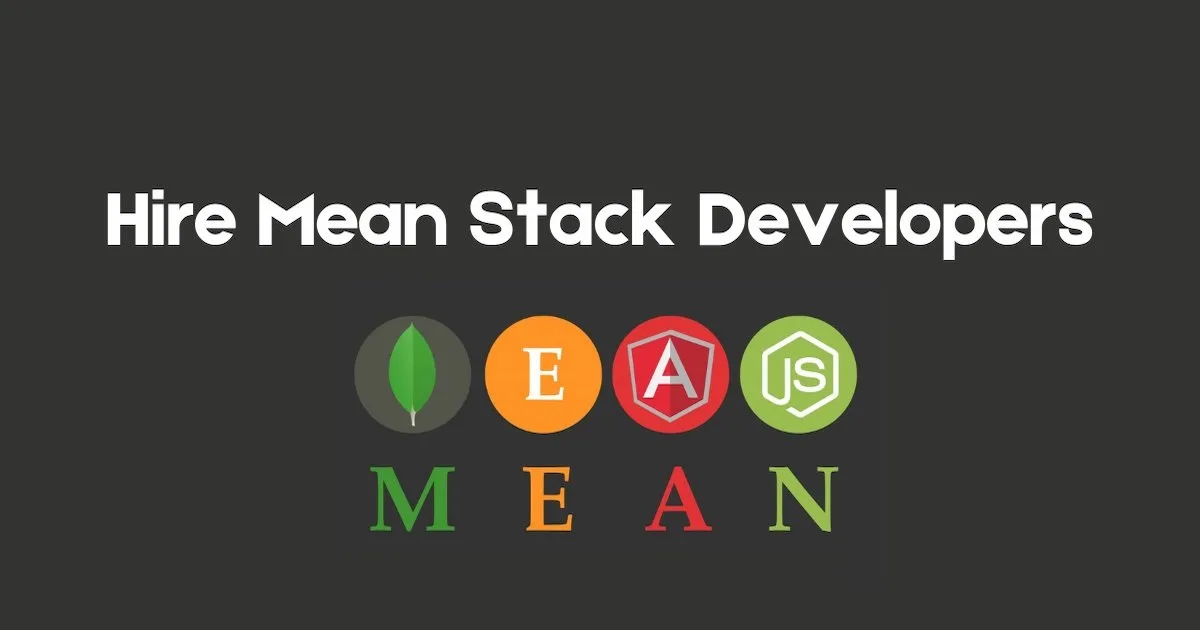
The MEAN stack—MongoDB, Express.js, Angular, and Node.js—provides a JavaScript-based foundation for building dynamic web applications. Its components support database management, backend services, frontend development, and server-side execution within a cohesive technology ecosystem.
However, building a successful MEAN application requires more than selecting the right technologies. Businesses must consider architecture, AI integration, application security, performance optimization, and long-term maintainability. Organizations looking to hire MEAN Stack developers should prioritize professionals who understand these requirements and can translate business objectives into scalable software solutions.
What Is the MEAN Stack Architecture?
MEAN is a full-stack development combination consisting of four technologies that work together to support modern web applications.
- MongoDB: A document-oriented NoSQL database for storing structured and flexible application data.
- Express.js: A backend framework for building APIs, handling requests, and implementing application logic.
- Angular: A frontend framework for developing interactive, component-based user interfaces.
- Node.js: A JavaScript runtime that executes backend code and supports asynchronous operations.
In a typical MEAN architecture, users interact with an Angular interface. Requests are sent to backend APIs developed with Express.js and Node.js, which validate inputs, apply business rules, and communicate with MongoDB or external services. Responses are then returned to the frontend for display.
For enterprise applications, developers can extend this architecture with caching, message queues, authentication services, cloud infrastructure, and monitoring tools.
A modular architecture helps teams separate application responsibilities, simplify testing, and maintain individual components as requirements evolve.
How MEAN Stack Supports AI Integration in 2026
AI integration is becoming an important consideration for businesses developing intelligent applications. MEAN supports AI-enabled features through APIs, external model providers, and additional AI infrastructure.
1. Generative AI and LLM Integration
Node.js and Express.js can connect applications to large language models (LLMs) through secure APIs. Businesses can use these integrations to develop conversational assistants, automated content processing, intelligent search, and customer support applications.
For example, an enterprise portal could allow employees to ask questions about internal documentation and receive relevant answers through an AI-powered interface built with Angular.
2. Retrieval-Augmented Generation
Retrieval-augmented generation (RAG) combines information retrieval with AI-generated responses. A RAG-enabled MEAN application can retrieve relevant information from approved business documents before sending contextual information to an AI model.
MongoDB can store application records and document metadata, while a vector search system can help retrieve semantically relevant information. Depending on the requirements, businesses may use MongoDB's vector search capabilities or integrate a separate vector database.
Access controls must be applied during retrieval to prevent users from receiving information they are not authorized to view.
3. AI Agents and Workflow Automation
MEAN can provide the application infrastructure for AI agents that interact with business systems and execute defined tasks.
For example, an AI agent could classify customer requests, retrieve order information, prepare a response, and create a support ticket through approved APIs.
Such systems require an orchestration layer, controlled tool access, execution limits, and human approval for sensitive actions. An AI model should not receive unrestricted access to business databases or operational systems.
Businesses that hire dedicated MEAN Stack developers with AI integration experience can build these capabilities while maintaining a clear separation between application logic and AI services.
Scaling secure, AI-ready applications can be complex and costly to manage. Hire MEAN Stack developers to build secure, scalable enterprise applications.
Security Best Practices for MEAN Stack Applications
Security is essential when developing applications that process customer information, financial records, employee data, or AI-generated content.
1. Implement Strong Authentication and Authorization
Developers should implement secure authentication and role-based or attribute-based access controls according to application requirements. Sensitive API endpoints must verify permissions before returning data or executing actions.
2. Protect APIs and Database Access
Input validation, rate limiting, secure session management, and appropriate request-size limits can help reduce common application risks. MongoDB queries should be designed carefully, and database credentials should never be exposed in frontend code.
3. Secure AI Integrations
AI-enabled applications introduce additional risks, including prompt injection, sensitive-data exposure, unsafe tool execution, and untrusted model outputs.
Developers should validate tool arguments, restrict agent permissions, apply output checks, and require approval for high-impact actions. AI responses should not automatically be treated as trusted instructions.
4. Manage Secrets and Dependencies
API keys, database credentials, and other secrets should be stored in appropriate secret-management systems. Teams should regularly update dependencies, review security advisories, and scan applications for vulnerabilities.
5. Maintain Audit Trails
Logging authentication events, administrative changes, and important application actions supports troubleshooting and security investigations. Logs should avoid unnecessarily recording passwords, access tokens, or sensitive personal information.
These practices help businesses build more reliable applications while reducing security risks as systems evolve.
Scalability and Performance Optimization
A scalable application must support increasing traffic and data volumes without compromising performance or reliability. MEAN can support scalable architectures when each component is designed and configured appropriately.
Optimize MongoDB Queries
Developers should analyze query patterns, create suitable indexes, and avoid retrieving unnecessary data. Database schema design should reflect application access patterns, particularly for frequently accessed enterprise records.
Improve Node.js Performance
Node.js supports asynchronous operations, but CPU-intensive workloads can still block the event loop. Developers should use suitable worker processes, background jobs, and queues for computationally expensive or long-running tasks.
Use Caching Strategically
Caching frequently accessed information can reduce database load and improve response times. Distributed caching systems may be useful for applications with high traffic or multiple backend instances.
Scale Application Services
Stateless backend services can be replicated behind a load balancer to handle increasing demand. Containerization and cloud deployment can simplify scaling, although the architecture must also account for database capacity, connection management, and external API limits.
Monitor Application Performance
Monitoring tools can help teams track response times, errors, resource utilization, database performance, and service availability. AI-enabled systems should additionally monitor model latency, token consumption, tool failures, and task completion rates.
When Should Businesses Hire MEAN Stack Developers?
Businesses should consider MEAN Stack developers for hire when they need to develop or modernize applications that combine interactive interfaces, backend services, data management, and external integrations.
Experienced developers can support projects such as:
- Enterprise resource planning and CRM platforms
- SaaS applications and customer portals
- Real-time analytics dashboards
- AI-powered knowledge assistants
- Workflow automation platforms
- E-commerce applications
- Business process management systems
- Legacy application modernization
Before selecting a development team, evaluate its experience with Angular, Node.js, MongoDB, API design, application security, and cloud deployment.
For AI-driven projects, assess additional experience with LLM APIs, RAG, agent orchestration, and secure integration patterns.
Choosing dedicated MEAN Stack developers can be useful when a project requires continuous development, ongoing maintenance, or close collaboration with internal product teams. The engagement model should match the project's complexity, delivery timeline, and long-term support needs.
Why Choose Hidden Brains for MEAN Stack Development?
Selecting the right development partner can help businesses reduce implementation risks and establish a sustainable application architecture.
Hidden Brains provides software development expertise to help organizations build, modernize, and scale digital solutions. Businesses evaluating MEAN for enterprise applications should consider a development approach that covers requirements analysis, architecture planning, implementation, testing, deployment, and ongoing optimization.
Organizations looking to hire MEAN Stack developers should prioritize technical expertise, communication, security practices, and the ability to align technology decisions with business objectives.
For applications involving AI integration, the development team should also consider data governance, model selection, integration complexity, and the safeguards required for production deployment.
Conclusion
The MEAN stack remains a practical option for building modern web applications in 2026. MongoDB, Express.js, Angular, and Node.js provide a flexible foundation for enterprise platforms, while AI integrations can introduce intelligent search, conversational interfaces, and automated workflows.
Long-term success depends on more than the technology stack itself. Businesses must invest in secure architecture, efficient data management, performance monitoring, and scalable deployment practices.
Whether you are developing an enterprise platform from scratch or upgrading an existing application, choosing experienced developers can help establish a reliable foundation for future growth. By evaluating technical skills, AI integration capabilities, and security expertise, businesses can build MEAN applications that remain adaptable as their needs change.