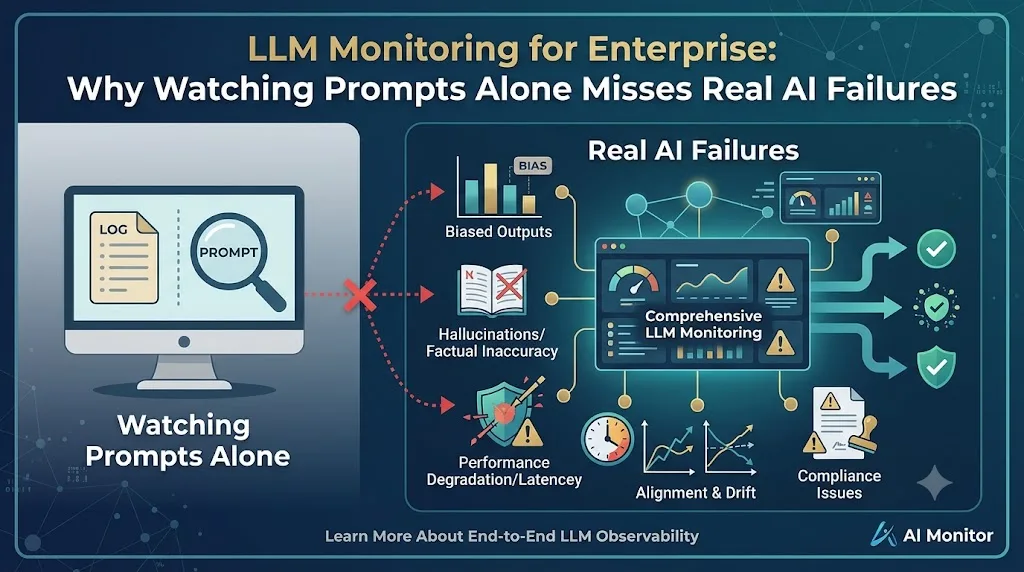
Most teams start monitoring a large language model the way they would monitor any API: log the request, log the response, watch latency and error rates. It feels sensible. It also leaves a large blind spot. The failures that hurt a business rarely show up in a single prompt and response. They show up three steps later, when a flawed answer has already been used to approve a loan, close a ticket, or brief an employee.
That gap is why LLM monitoring for enterprise needs a different starting point than classic application monitoring. This article explains what gets missed when you watch prompts in isolation, and what a workflow-level approach looks like in practice.
Why single-prompt monitoring falls short
A language model rarely works alone inside a company. A typical production flow retrieves documents, builds a prompt, calls the model, applies business logic to the output, and hands the result to a person or another system. Each step can be healthy on its own while the overall decision is wrong.
Consider three common patterns:
- A retrieval step returns an outdated policy document, and the model summarizes it fluently and accurately. The answer is well written and wrong for today.
- The model gives an acceptable answer to each individual question, but contradicts itself across a multi-turn conversation.
- An output passes a format check, then a downstream rule treats an ambiguous phrase as approval.
None of these would trip a latency alarm or a simple keyword filter. All of them are monitoring failures, because nobody was watching the decision.
What LLM monitoring for enterprise should track
Workflow-level monitoring treats the whole chain as the unit of observation. Instead of asking whether a response looks reasonable, it asks whether the end-to-end outcome followed the rules the business set. That typically involves four layers:
- Inputs and context: which documents, data, and instructions actually reached the model.
- Outputs: whether responses are accurate, consistent, and within policy.
- Decisions: what the system did with the output, and whether that matched business rules.
- Evidence: a record detailed enough to reconstruct what happened later.
Teams that want a fuller definition of the discipline can read the overview of LLM monitoring for enterprise published by Trusys, which covers prompt-response tracking, policy adherence, and context-aware behavior across workflows. The important point is the shift in perspective: the monitored object is the decision flow, not the model call.
Turning policy into something you can measure
The hardest part of monitoring is rarely the tooling. It is agreeing on what good looks like. A credit team might say an assistant must never quote a rate that is not in the current rate sheet. A support team might say the assistant must never promise a refund the policy does not allow.
Written down as concrete, testable rules, these statements become checks that can run on live traffic. Vague goals such as be accurate or sound professional cannot be monitored. Specific rules can. A useful exercise is to take your five riskiest AI use cases and write three pass-fail rules for each. Those fifteen rules are a better monitoring foundation than any generic quality score.
Alerts that people will actually act on
Monitoring that produces noise gets ignored. To keep alerts meaningful:
- Score risk by consequence. A wrong answer in an internal drafting tool is not the same as a wrong answer in a customer-facing eligibility decision.
- Alert on patterns, not only single events, so a slow drift is caught before it becomes an incident.
- Route each alert to an owner who can fix the cause, whether that is a prompt, a data source, or a policy.
Where to begin
You do not need to instrument everything on day one. Pick one workflow where an AI output feeds a real decision. Map each step, write the policy rules that govern it, and add validation at the points where an error would be hardest to undo. Expand from there.
The lesson holds across industries: LLM monitoring for enterprise works when it follows decisions, enforces explicit policy, and leaves a trail that someone else can read months later. Watching prompts is a start. Watching workflows is what keeps AI trustworthy at scale.
Frequently Asked Questions
1. What is the difference between prompt-level and workflow-level LLM monitoring?
Prompt-level monitoring inspects individual requests and responses. Workflow-level monitoring follows the full chain, including retrieval, model output, business logic, and the final decision, so it can catch failures that only appear across steps.
2. Why do healthy-looking LLM responses still cause incidents?
A response can be fluent and well formed while being based on outdated context or being misread by a downstream rule. The error sits in the workflow, not in the sentence.
3. Which metrics matter most for enterprise LLM monitoring?
Output accuracy, consistency across turns, policy compliance rate, anomaly frequency, and latency, ideally weighted by the business consequence of each use case.
4. How many workflows should be monitored first?
Start with one high-impact workflow where an AI output feeds a real decision, then expand once the policy rules and alerting are working.
5. Does LLM monitoring replace pre-deployment testing?
No. Testing finds known risks before release, while monitoring catches behavior that changes once real users and real data arrive. Strong programs use both.
Want to see how this works in a real environment? Book a demo with Trusys to walk through your own AI workflows.