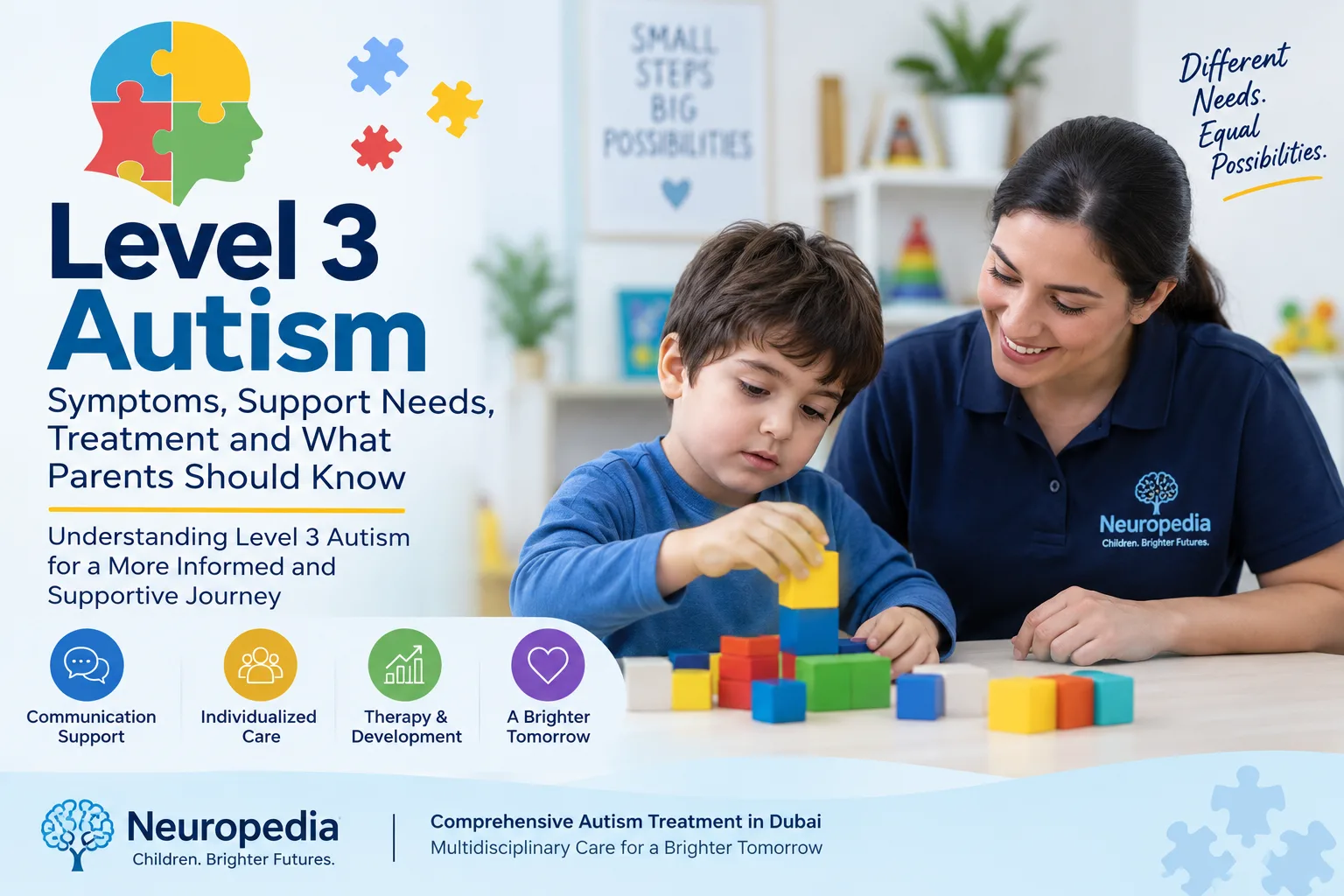
Level 3 autism is the highest support level described in the Diagnostic and Statistical Manual of Mental Disorders (DSM-5). It refers to autism spectrum disorder (ASD) in which a person requires very substantial support because of significant difficulties with social communication and restricted or repetitive behaviours.
Autism is a spectrum, which means that characteristics and support needs can vary considerably from one individual to another. A diagnosis of level 3 autism does not describe every aspect of a person's abilities, personality, learning potential or future. Instead, the level indicates the degree of support required for everyday functioning.
For families looking for Autism Treatment in Dubai, understanding level 3 autism can help them recognize support needs, seek an appropriate assessment and work with professionals to develop an individualized care plan.
What Is Level 3 Autism?
The DSM-5 describes three autism severity levels:
- Level 1: Requiring support
- Level 2: Requiring substantial support
- Level 3: Requiring very substantial support
Level 3 autism is associated with severe difficulties in verbal and nonverbal social communication. Individuals may have very limited initiation of social interactions and may respond minimally to social approaches from other people. The DSM-5 also describes significant inflexibility, extreme difficulty coping with change and restricted or repetitive behaviours that can interfere substantially with everyday functioning.
It is important to understand that the term "level 3" is primarily about support requirements, rather than a simple measurement of intelligence or overall ability. Two people with the same autism support level can have very different strengths, communication abilities and developmental profiles.
Common Characteristics of Level 3 Autism
The characteristics associated with level 3 autism can affect communication, social interaction, behaviour, sensory experiences and daily living.
1. Significant Communication Difficulties
One of the most noticeable challenges may involve communication. Some individuals with level 3 autism have very limited spoken language, while others may not use spoken language to communicate their needs consistently. Difficulties can also occur with nonverbal communication.
A person may have difficulty initiating interaction, communicating wants and needs, or responding to social communication from others. These challenges can make everyday situations difficult, particularly when the person cannot easily express discomfort, preferences or emotions.
Alternative and augmentative communication (AAC) approaches may be useful for some individuals. Depending on the person's abilities and needs, communication may involve pictures, communication devices, sign language or other methods.
The goal is not simply to encourage spoken language. Effective communication means helping the individual express needs, choices, feelings and preferences in a way that works for them.
2. Difficulty With Social Interaction
Social communication can be particularly challenging for individuals with level 3 autism. They may have significant difficulty starting interactions or responding to attempts by others to engage with them.
This does not necessarily mean that a person has no interest in other people. Communication difficulties, sensory challenges and other developmental factors can make social interaction difficult even when the individual wants to connect with others.
Support may therefore focus on practical communication and social skills rather than expecting the person to interact in a particular way.
3. Repetitive Behaviours and Restricted Interests
Restricted or repetitive behaviours are another important part of autism. In level 3 autism, these behaviours can significantly interfere with functioning.
Examples described in resources about level 3 autism include repetitive movements, repeated sounds or words, arranging objects in particular ways and intense interests.
Repetitive behaviours should be understood in the context of the individual. A professional assessment can help determine whether a behaviour serves a communication, sensory, emotional or other function and what type of support may be appropriate.
4. Difficulty Coping With Change
People with level 3 autism may experience considerable difficulty when routines, activities or expectations change. Unexpected events can result in significant distress.
For this reason, predictable routines and appropriate preparation for changes can be helpful. Visual schedules and advance notice of changes are examples of strategies that may support some children.
However, strategies should always be adapted to the individual rather than applied in exactly the same way to every child.
5. Sensory Challenges
Some individuals with level 3 autism experience significant sensitivity to sensory information. Everyday sounds, lights, smells, tastes or textures may become overwhelming.
Sensory difficulties can affect participation in school, therapy, family activities and other everyday situations. Understanding an individual's sensory profile can therefore be an important part of planning support.
How Does Level 3 Autism Affect Daily Life?
Because level 3 autism involves very substantial support needs, challenges may extend across multiple areas of daily life.
Communication difficulties can make it harder to communicate basic needs or preferences. Social difficulties can affect participation with peers and family members. Changes in routine may cause significant distress, while sensory experiences can make ordinary environments difficult to tolerate.
Some individuals may also need assistance with self-care and everyday activities. The degree of assistance required varies between individuals and can change as skills develop.
Support may therefore be needed at home, at school and in community environments. Educational adaptations, communication support, behavioural strategies and assistance with daily living skills can all form part of an individual's overall care plan.
How Is Level 3 Autism Identified?
Autism diagnosis requires a comprehensive assessment by appropriately qualified professionals. A detailed developmental history, observation of behaviour and information from parents or caregivers can contribute to the assessment. Standardized assessments may also be used to evaluate communication, social interaction and adaptive behaviour.
A professional evaluation is important because behaviours associated with autism can vary considerably from one person to another. Assessment should consider the child's developmental history, current abilities, communication, behaviour and support needs.
Parents should avoid trying to determine an autism severity level solely from a checklist or comparison with another child. A qualified professional can interpret the overall developmental picture and determine appropriate next steps.
What Does Treatment for Level 3 Autism Involve?
There is no single treatment plan that is appropriate for every person with level 3 autism. Support should be individualized according to the child's communication abilities, developmental needs, strengths, behaviours and goals.
Depending on the child, intervention may involve several professionals and therapies.
Behavioural Therapy
Behavioural interventions may be incorporated into individualized autism support plans. Applied Behavior Analysis (ABA) is one approach used to teach communication, socialization and functional skills and to address behaviours that interfere with everyday functioning.
The specific goals and methods should be tailored to the individual child.
Speech and Language Therapy
Speech and language therapy can focus on developing functional communication. For a child with limited spoken language, therapy may also consider alternative communication methods.
The priority is to give the child effective ways to communicate needs, choices and preferences rather than relying solely on spoken language.
Occupational Therapy
Occupational therapy can address functional abilities and participation in everyday activities. It may be particularly relevant when a child experiences difficulties with daily living skills or sensory processing.
Educational Support
Children with significant autism support needs may require adapted educational approaches and specialized support. Collaboration between parents, educators and therapists can help maintain consistency across environments.
Family and Caregiver Support
Parents and caregivers play an important role in supporting children with level 3 autism. Consistency across home, school and therapy environments can help children apply skills in different situations.
Caregivers may also benefit from guidance on communication strategies, routines, behavioural support and ways to respond to sensory needs.
Can Level 3 Autism Improve?
Autism is a lifelong developmental condition, but an individual's abilities and support needs can change over time. Progress may occur in communication, adaptive skills, learning and other areas with appropriate support and intervention.
It is not appropriate to assume that every child with level 3 autism will eventually move to another support level. Development varies considerably between individuals. The more useful approach is to focus on meaningful, individualized goals, such as improving communication, developing functional skills, increasing participation and supporting quality of life.
Choosing Autism Treatment in Dubai
Families searching for Autism Treatment in Dubai should consider whether the care provider can assess the child's individual needs and coordinate appropriate therapies.
A multidisciplinary approach can be particularly useful when a child has communication, behavioural, developmental, sensory or other needs. Families may wish to ask about:
- Developmental and autism assessment
- Pediatric neurology services
- Behavioural therapy
- Speech and language therapy
- Occupational therapy
- Psychological support
- Feeding therapy when appropriate
- Family involvement in treatment planning
- Long-term follow-up and developmental monitoring
The appropriate combination of services depends on the individual child's needs.
Autism Treatment at Neuropedia in Dubai
Neuropedia Children's Neuroscience Center provides pediatric neuroscience care in Dubai and describes a multidisciplinary approach involving pediatric neurologists, child psychiatrists and allied health professionals. The center provides care for children and young people with neurological, developmental, behavioural and psychological conditions.
Neuropedia lists Autism Treatment / ADHD among its treatment areas and offers several relevant specialties, including pediatric behavioral therapy (ABA), pediatric psychology, pediatric occupational therapy, and speech and language therapy.
Its services also include pediatric neurology, child neurodiagnostics and other pediatric therapies. According to Neuropedia, its care model brings different professionals together and keeps the child and family at the center of decision-making.
For families considering Autism Treatment in Dubai, a multidisciplinary setting can make it easier to address different aspects of a child's development through coordinated professional support.
What Can Parents Do at Home?
Parents can support a child with level 3 autism by creating an environment that takes the child's communication and sensory needs into account.
Useful approaches may include maintaining predictable routines, preparing the child for changes when possible, providing appropriate communication supports and working consistently with the child's professional team. Visual schedules may also help some children understand daily routines and upcoming changes.
Parents should also pay attention to changes in behaviour. When a child has limited communication, distress or behavioural changes may sometimes be the only observable indication that something is wrong or that a need is not being met. Professional evaluation may be appropriate when there are significant or persistent changes.
Frequently Asked Questions About Level 3 Autism
Is level 3 autism the most severe autism level?
Level 3 is the highest of the three DSM-5 autism support levels and is described as requiring very substantial support. It involves significant difficulties with social communication and restricted or repetitive behaviours that substantially affect functioning.
Can a child with level 3 autism communicate?
Yes, communication abilities vary. Some individuals may have very limited or no spoken language, while others may develop functional communication skills. Alternative communication methods can be considered when spoken communication is limited.
Does level 3 autism mean a child cannot learn?
No. The support level describes the amount of support required because of autism-related difficulties; it does not provide a complete description of a child's abilities or potential. Individual strengths and developmental progress can vary considerably.
What therapies may be used for level 3 autism?
Depending on the child's needs, support may include behavioural therapy, speech and language therapy, occupational therapy, psychological services and educational support. A multidisciplinary approach can help address different developmental needs.
When should parents seek professional help?
Parents who have concerns about their child's communication, social interaction, behaviour or development should discuss those concerns with an appropriately qualified healthcare professional. A comprehensive assessment can help determine whether autism or another developmental condition is present and identify appropriate support.
Final Thoughts
Level 3 autism involves substantial challenges with social communication, flexibility and restricted or repetitive behaviours, and individuals at this level generally require very substantial support.
At the same time, every child is different. The most useful treatment approach is one that recognizes the child's individual strengths and needs while focusing on practical goals such as communication, participation, learning, daily living skills and quality of life.
For families looking for Autism Treatment in Dubai, seeking an experienced multidisciplinary team can help ensure that assessment and intervention are tailored to the child's developmental profile. Neuropedia offers pediatric neurological and developmental services in Dubai, including autism-related care, behavioural therapy, speech and language therapy, occupational therapy and pediatric psychology.
Early recognition of support needs and consistent, individualized intervention can help families build an appropriate framework for supporting a child with level 3 autism through different stages of development.