
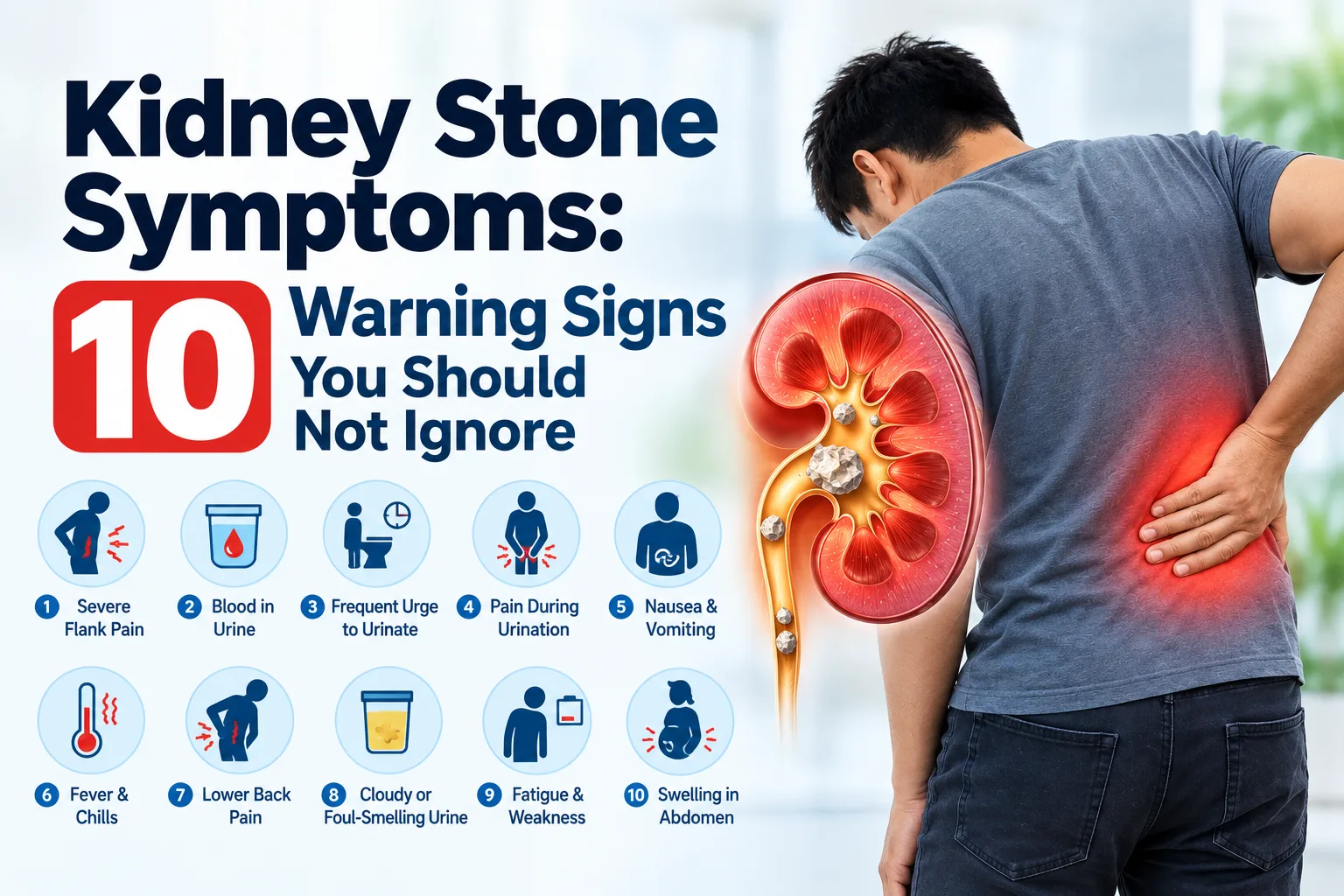
Whether you are young, middle aged or elderly, kidney stones can affect us all. These are hard mineral deposits which form when salt and other substances, present in urine, crystallize and stick together inside the kidney.
Though small kidney stones may pass through the body without causing much of a problem, when a stone moves into the ureter or blocks the flow of urine, it could lead to excruciating pain, and other complications.
Knowing the early kidney stone symptoms can help you get timely treatment.
Kumaran Medical Center, Coimbatore has a team of Urology specialists and advanced facilities in treating kidney stones. Patients are treated with advanced endoscopic procedures like laser lithotripsy, ureteroscopy and PCNL depending on the condition.
What are kidney stones?
The kidney stone symptoms begin when hard deposits of salts and minerals called kidney stones, form anywhere in the kidney. Stones that form when calcium, oxalate or uric acid levels in urine become high enough to encourage crystal formation around a core. Tiny stones, sometimes, may pass out of the body without causing much of a problem. But, larger stones can block the ureter and cause kidney stone complications like pain, blockage in flow of urine and other issues.
10 early warning signs of kidney stones:
1. Side back pain:Severe pain in the side and the back just below the ribs is the most common kidney stone symptom. One may feel pain coming in waves, which comes and goes and can lead to sharp, throbbing pain. The pain can start in the back or on the side and might radiate towards the lower abdomen area or the groin.
2. Groin pain:Kidney stone pain may start in the lower back, and might radiate towards the lower abdomen area or the groin.
3. Pain and burning during urination:Patients with kidney stones may experience pain or a burning sensation while urinating due to kidney stones passing from the kidney to the bladder through the ureter. But, pain while urinating may also be indicative of UTI or other bladder infection.
4. Having frequent urge to urinate:When a person is having kidney stones the lower urinary tract may become inflamed, hence, there may be a frequent urge to urinate. There may be a frequent need to go although a little amount of urine passes each time.
5. Blood in the urine:Blood in the urine may happen when a stone passes, and causes irritation to the kidney and urinary tract. Urine may look pink or red, but sometimes, it may only be visible on a lab test. Blood in the urine is common for kidney stones, but it also may be caused by a number of other kidney problems. So, it is important that you consult a doctor at the earliest.
6. Nausea and vomiting:Nausea and vomiting may occur due to kidney stone pain. If vomiting occurs for a long time it might also lead to dehydration. Please consult a doctor if vomiting persists for a long time and if you have an urge to throw up.
7. Painful, cloudy or smelly urine:Sometimes, you may find that you have cloudy, malodorous urine, and you may have a painful or uncomfortable feeling while urinating.
These could be signs that you have a kidney infection or UTI. It is important to get these symptoms checked out by a doctor.
8. Difficulty in passing urine:The kidney stone might cause the urinary tract to narrow or block the ureter leading to pain and difficulty in passing urine. If you have an issue in passing urine, it is essential that you consult a doctor since untreated obstruction of the urinary tract can lead to kidney damage.
9. Fever and chills:High fever and chills are not a common kidney stone symptom. If you feel feverish and have chills along with kidney stone like pain, it may be because of an infection. So, it is important to consult a doctor if you have fever and chills.
10. Constant shifting due to pain:Kidney stone pain can be so severe that you might find yourself constantly shifting positions seeking comfort.
If you have severe pain and any other kidney stone complication, you must report to your doctor and get a proper diagnosis.
When should I visit a urologist specialist?
Although kidney stones do not always require to be removed surgically but consult a specialist if you have the following kidney stone symptoms:
• Pain anywhere in the lower abdominal area and back
• Passing blood in the urine
• Pain or burning while passing urine
• Increased urge to urinate
• Difficulty in passing urine
• Having a kidney stone before
• Nausea and vomiting associated with pain
• Fever, chills along with other kidney stone symptoms mentioned above
Visit a doctor if you have severe pain and are unable to get relief. Also, get treated if you are unable to pass urine or if you have a low urine output.
How are kidney stones diagnosed?
Depending upon your symptoms, the urologist or kidney stone specialist may perform a few tests to know if you have kidney stones. The tests could be:
• Urine tests
• Blood tests
• Imaging tests like Ultrasound, X-rays, CT scans to view the stones.
• Testing the stone that has been passed or removed during the procedure.
The imaging test results will help the specialist understand the size and location of the stone, and if it is causing any blockage in the urinary tract.
Treating kidney stones at Kumaran Medical Center, Coimbatore:
Depending upon the size, shape and location of the stone; and your general health condition, the kidney stone treatment in Kumaran Medical Center will be planned. The urology specialist may recommend:
Laser Lithotripsy:It is an endoscopic procedure that uses a laser to break a kidney stone, or a stone in the ureter, into smaller pieces that can pass out of the body. Laser lithotripsy for kidney stones may be recommended depending on the size and location of the stone.
Ureteroscopy:The stone in the ureter or the kidney may be broken or removed using a procedure called ureteroscopy. A narrow telescope is inserted up the urethra to the kidney to see the stone. Laser energy or other tools can be used to break the stone into smaller pieces that can be taken out.
PCNL (Percutaneous nephrolithotomy):It is a minimally invasive surgical procedure that can be used to remove a large kidney stone. During this procedure a small incision is made in the back and a narrow tunnel is created from the skin to the kidney to remove the stone.
So, a specialist in kidney stone surgery should decide which treatment approach would be the best for you.
How to prevent kidney stones:
Preventive measures are recommended for everyone because there are risk factors for developing kidney stones. Some people, who have had kidney stones or who have a family history of kidney stones, may need to take special steps to reduce their risk of developing kidney stones.
Following are some general measures that may be helpful in preventing kidney stones.
• Drink plenty of water and other fluids.
• Limit salt in your diet because too much salt in the urine may increase your risk of developing kidney stones.
• Eat healthy food and maintain a healthy body weight.
• Follow any diet advice given to you by your kidney stone specialist.
• Take medicines to help prevent stones if your doctor prescribes them.
• Follow up with your doctor if you have passed stones and you are at continued risk for developing kidney stones.
If you have had kidney stones or you continue to have kidney stone problems, you may need to see a specialist to determine why you are having stones and to find the best treatment.
Don’t ignore kidney stone symptoms:Kidney stones can be a real pain, literally! They range in size from a grain of sand to a golf ball. The pain from kidney stones can vary from a dull ache to an agonizing cramping sensation. Kidney stone complications can arise when the stone blocks the flow of urine causing excruciating pain and potentially leading to kidney damage. It is important to know what are kidney stone symptoms.
If you are experiencing severe side or back pain, pain while urinating, frequent urge to urinate, fever or chills, it might be kidney stone symptoms. You may also notice that your urine has blood or unusual odor.
If you feel that you have kidney stone symptoms and you are unsure, please consult with your local specialist. At Kumaran Medical Center, Coimbatore, we have a team of experts and advanced technology to treat kidney stone problems. Visit us today to get proper treatment.
Urology care at Kumaran Medical Center:
Kumaran Medical Center is a 200 bedded multi specialty hospital providing 24×7 dedicated medical care. We specialize in providing expert urology care including treatment of kidney stones, urinary difficulties, prostate problems, bladder issues and kidney cancer. Get in touch with us for any urology related problems you might be facing. You can reach us at 499/500, Sathy Road, Kurumbapalayam, S.S. Kulam, Coimbatore – 641107.
Book a free appointment with our urology specialist today!
FAQs:
What are the most common symptoms of kidney stones?
Severe pain in the side or back is one of the most common kidney stone symptoms, especially when the stone is passing into the ureter. The pain often comes in waves, from your back down to your lower abdomen or groin.
Can kidney stones cause blood in urine?
Yes, kidney stones can cause blood in urine but blood in your urine can also be caused by many other health problems. For that reason, it is important to let your doctor know if you are experiencing blood in your urine or any other kidney stone symptoms.
Can kidney stones cause frequent urination?
Yes, a kidney stone that blocks the ureter can cause you to have frequent urge to urinate.
Can kidney stones cause fever?
Fever is not usually a symptom of an isolated kidney stone. But, fever, chills, and a painful, frequent urge to urinate may be signs of a kidney infection.
Do all kidney stones require surgery?
No, some kidney stones do not require any treatment and pass on their own. But, a patient must consult with a specialist and get treated depending on the stone size, position and patient’s symptoms.
What are the treatments for kidney stones?
Depending on your situation, your treating physician may recommend one or more of the following kidney stone treatments.
When should I consult a urology specialist for kidney stones?
If you have kidney stone symptoms like severe pain, blood in the urine, difficulty urinating, or if you have recurrent kidney stones, you should report to a urology specialist immediately. A specialist will be able to provide you with the best form of treatment.
Disclaimer:
The information provided in this article is for educational purposes only and is not intended to replace medical consultation. Kidney stone symptoms can be similar to other health issues. Please consult a specialist if you are experiencing any health problems.