
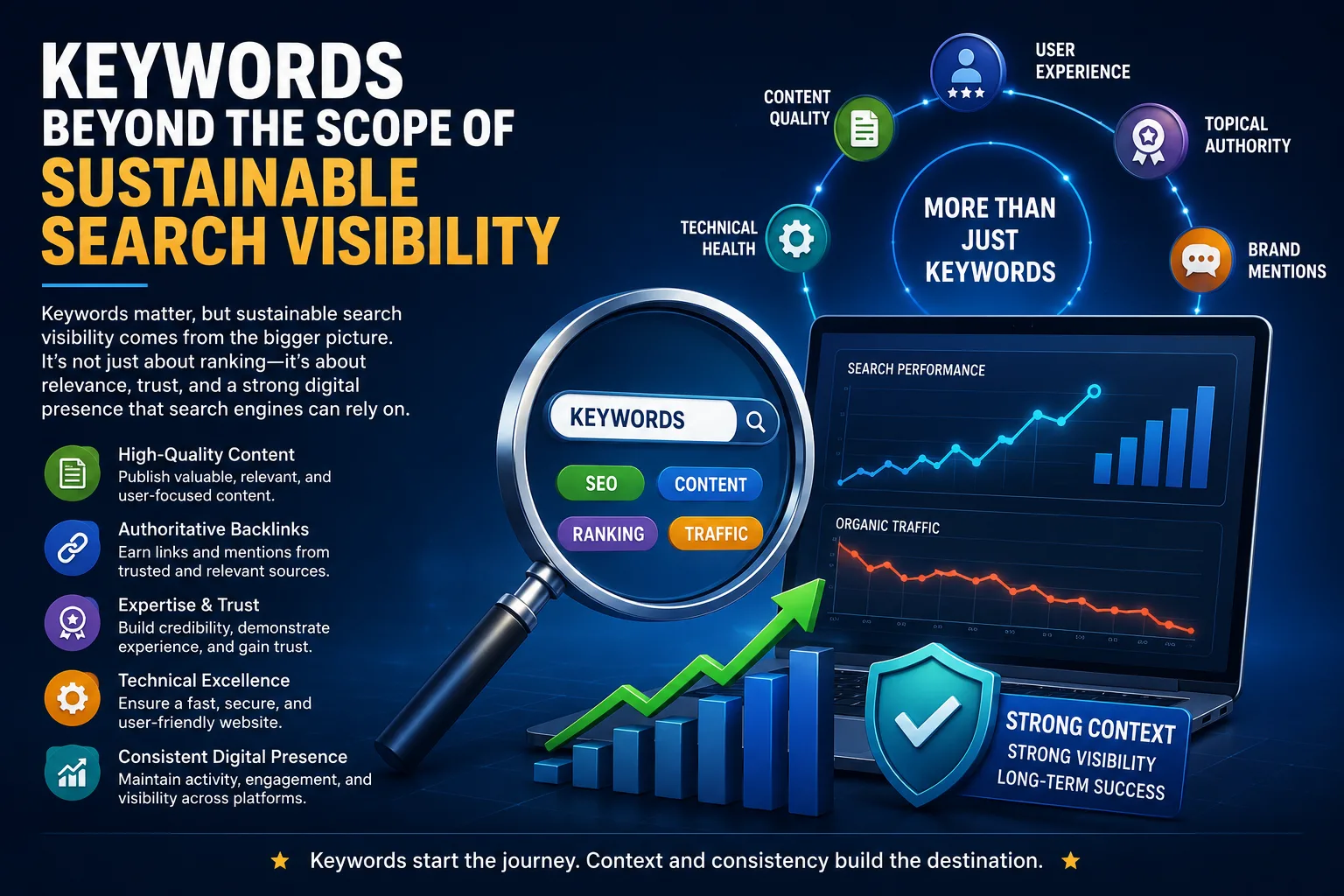
What would happen if a business owner checked website performance one day and noticed that traffic generated through organic search had been decreasing over the past few weeks? Nothing seems to have changed. The website still offers the same products, services, and keyword strategy that had previously generated reliable online visibility. However, search performance continues to weaken.
Such cases are surprisingly common. It is also worth noting that these situations reveal an important insight into modern search visibility. Keywords have remained essential for SEO, yet they no longer seem sufficient to explain why one website improves while another declines.
Modern search engines have become increasingly sophisticated in interpreting available information. They no longer evaluate isolated pieces of data. Instead, they assess the overall consistency, usefulness, and credibility of the information they find. A page may contain excellent content and a carefully planned keyword strategy. However, this alone does not necessarily mean that search systems will reward it with strong visibility.
The reason becomes clearer when considering two companies working with the same set of keywords. One continues growing in search results through the consistent publication of valuable content, references from reputable websites, an active digital presence, and the ongoing development of expertise. The other focuses primarily on keyword optimization while overlooking the broader factors that help build search engines' confidence in a website.
Similar situations may occur with other search signals as well. While keywords remain important, they are not the only elements whose influence depends on the surrounding context. Some signals may appear very strong and valuable on their own, yet still lose part of their significance when the context around them is unfavorable. The article available at https://backlinksense.com/strong-context-can-produce-weak-signals/ explores this aspect using the example of backlink evaluation.
For businesses, this approach suggests that sustainable search visibility should be viewed as a continuous process rather than a series of isolated activities. Publishing valuable content, maintaining technical website quality, demonstrating expertise, earning mentions, and building a consistent digital presence all play an important role in how search systems interpret a website.
These aspects reinforce one another, creating a stronger foundation for search systems to interpret a website than any keyword strategy could achieve on its own.
It also changes the way success in search visibility should be measured. Rankings for several keywords may fluctuate for many reasons, but long-term visibility often reflects something different. Businesses that continuously improve the quality of their digital presence are generally better positioned to adapt to new technologies. Their visibility depends on multiple interconnected signals rather than on individual optimization strategies alone.
This does not mean that keywords have become useless. They remain essential for helping search systems understand the topic of a page. However, sustainable search visibility increasingly depends on how well those keywords are supported by the overall quality of the website and the broader context surrounding it.