Introduction
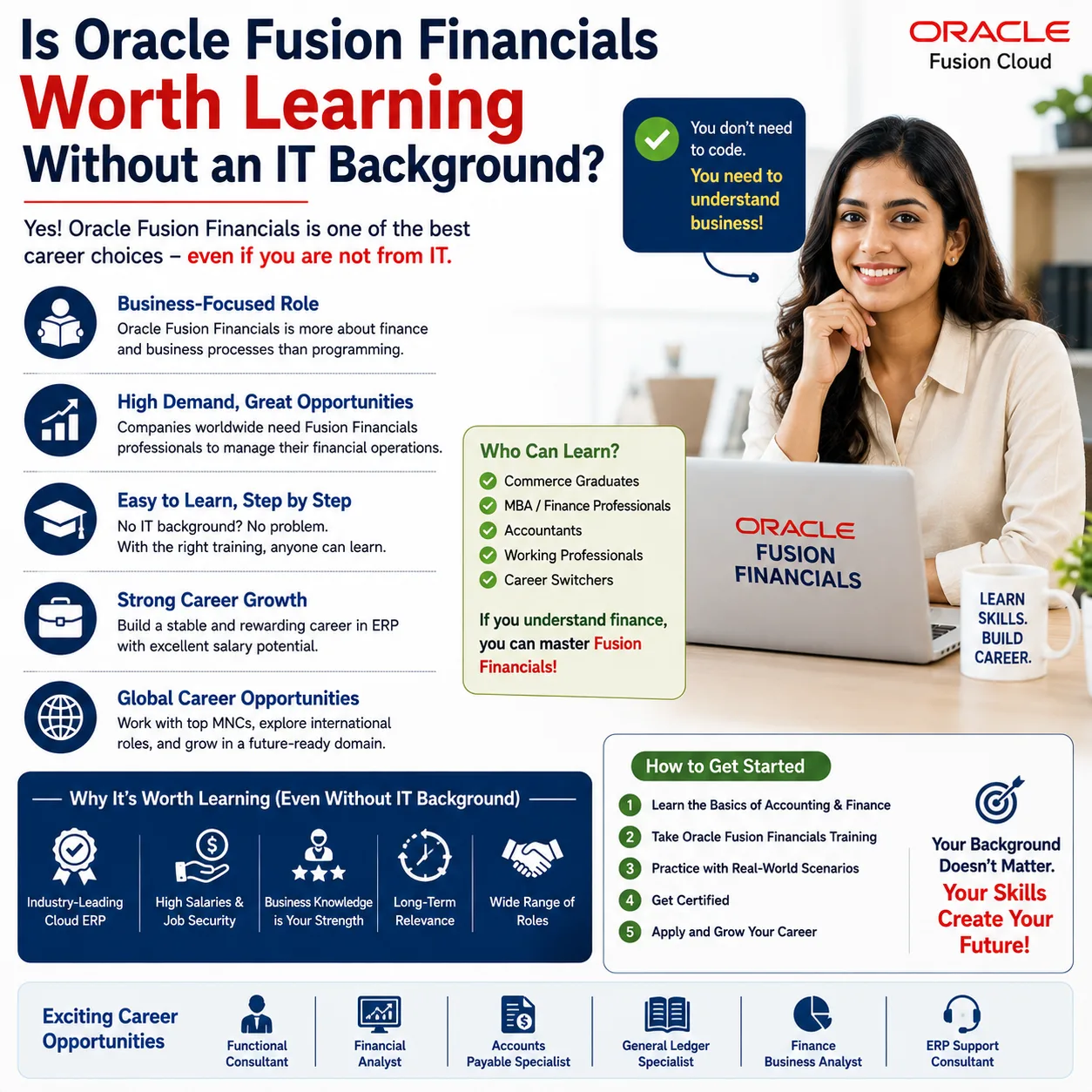
One of the most common hesitations people have before starting a new ERP skill is wondering whether they even belong in the room. Soft Online Training hears this question constantly from finance professionals, accountants, and business graduates who assume Oracle Fusion Financials is reserved for people who already have a coding background or a technical degree. That assumption, as it turns out, isn't really true.
This article looks at whether someone without an IT background can genuinely succeed with the Oracle Fusion Financials Course, what actually matters more than a technical degree, and why finance and accounting knowledge often turns out to be the bigger advantage.
Fusion Financials Was Built for Finance People First
It's easy to assume that any ERP platform must be primarily a technical tool, but Fusion Financials was designed with finance and accounting professionals in mind from the start. The interface, the workflows, and the terminology are all rooted in real financial processes, general ledger, accounts payable, accounts receivable, fixed assets rather than in software engineering concepts.
This is exactly why Oracle Fusion Financials Online Training attracts so many learners with backgrounds in accounting, finance, or business administration rather than computer science. The platform expects users to understand financial operations, not to write code, which puts non-technical learners on far more familiar ground than they might expect.
Functional Knowledge Matters More Than Technical Skill
Most roles built around Fusion Financials fall under what's known as "functional" work, meaning the focus is on configuring the system to match how a business actually manages its money not on programming or system architecture. That's a completely different skill set from software development, and it leans heavily on understanding how finance departments operate day to day.
A well-designed Oracle Fusion Financials Course reflects this reality by spending the bulk of its time on financial processes, module configuration, and reporting rather than on technical infrastructure. Someone who already understands how a general ledger works or how invoices move through an approval cycle often grasps these concepts faster than someone with a purely technical background but no finance exposure.
The Learning Curve Is Manageable With the Right Structure
No new system is entirely without a learning curve, and Fusion Financials is no exception. But the curve tends to be steeper around navigation and system logic, not around abstract technical concepts. With structured guidance, most learners without any IT background pick up the platform's logic within a matter of weeks rather than months.
This is where Oracle Fusion Financials Online Training earns its value, since a well-paced course breaks the platform down step by step instead of assuming prior technical exposure. Learners aren't expected to already understand system architecture; they're walked through it in a way that builds confidence gradually.
Real-World Roles Prove This Skill Isn't IT-Exclusive
Across the industry, plenty of professionals working with Fusion Financials come from purely financial or business backgrounds. Roles like financial systems analyst, functional consultant, and finance business partner are frequently filled by people who transitioned from traditional accounting or finance positions rather than from IT departments.
This pattern is a strong argument for taking a practical Oracle Fusion Financials Course seriously, even without any coding experience. Employers hiring for these roles are often more interested in whether a candidate understands financial operations and business logic than whether they can write a line of code.
Confidence With Numbers Beats Comfort With Code
Working through Fusion Financials day to day involves interpreting reports, reconciling accounts, understanding approval workflows, and configuring processes around company policy. None of that requires programming knowledge. What it does require is comfort working with numbers, an eye for accuracy, and a willingness to learn how a new system organizes financial data.
This is exactly the kind of foundation that Oracle Fusion Financials Online Training is designed to build on. Rather than teaching technical skills from scratch, it takes existing financial knowledge and channels it into platform-specific expertise, which tends to be a faster and more natural path than trying to learn finance and technology at the same time.
A Non-Technical Background Can Actually Be an Advantage
There's a reasonable argument that people without an IT background bring something valuable to Fusion Financials work: a genuine understanding of what finance teams actually need from the system. Technical skill alone doesn't guarantee someone understands why a particular approval workflow matters or how a compliance requirement should shape a configuration decision.
A strong Oracle Fusion Financials Course recognizes this and often blends technical walkthroughs with real financial scenarios, which plays directly to the strengths of learners coming from non-technical, finance-focused backgrounds.
Final Thoughts
Oracle Fusion Financials isn't a platform reserved for people with programming backgrounds. It was built around financial processes, and it rewards people who understand how businesses manage money just as much as, if not more than, people who understand code. The learning curve is real, but it's manageable, especially with the right training structure behind it.
For anyone weighing whether to invest in this skill without an IT background, well-structured Oracle Fusion Financials Online Training, paired with a practical Oracle Fusion Financials Course, offers a realistic and genuinely achievable path into a field that values financial thinking just as highly as technical know-how.