The Internet of Things is connecting more devices, machines, sensors, and systems than ever before. From smart homes and buildings to factories, water management systems, energy networks, and industrial equipment, connected devices continuously collect valuable information. But collecting data is only the first step. That data also needs to be processed, managed, secured, and transferred to the right platform.
This is where an IoT gateway becomes important. It acts as a communication bridge between connected devices and cloud or local applications. By managing communication between different devices, protocols, and platforms, a gateway helps create a more reliable and organized IoT environment.
Whether an organization wants to monitor machines, track energy consumption, manage water systems, or connect industrial equipment, understanding the role of an IoT gateway is essential.
What Is an IoT Gateway?
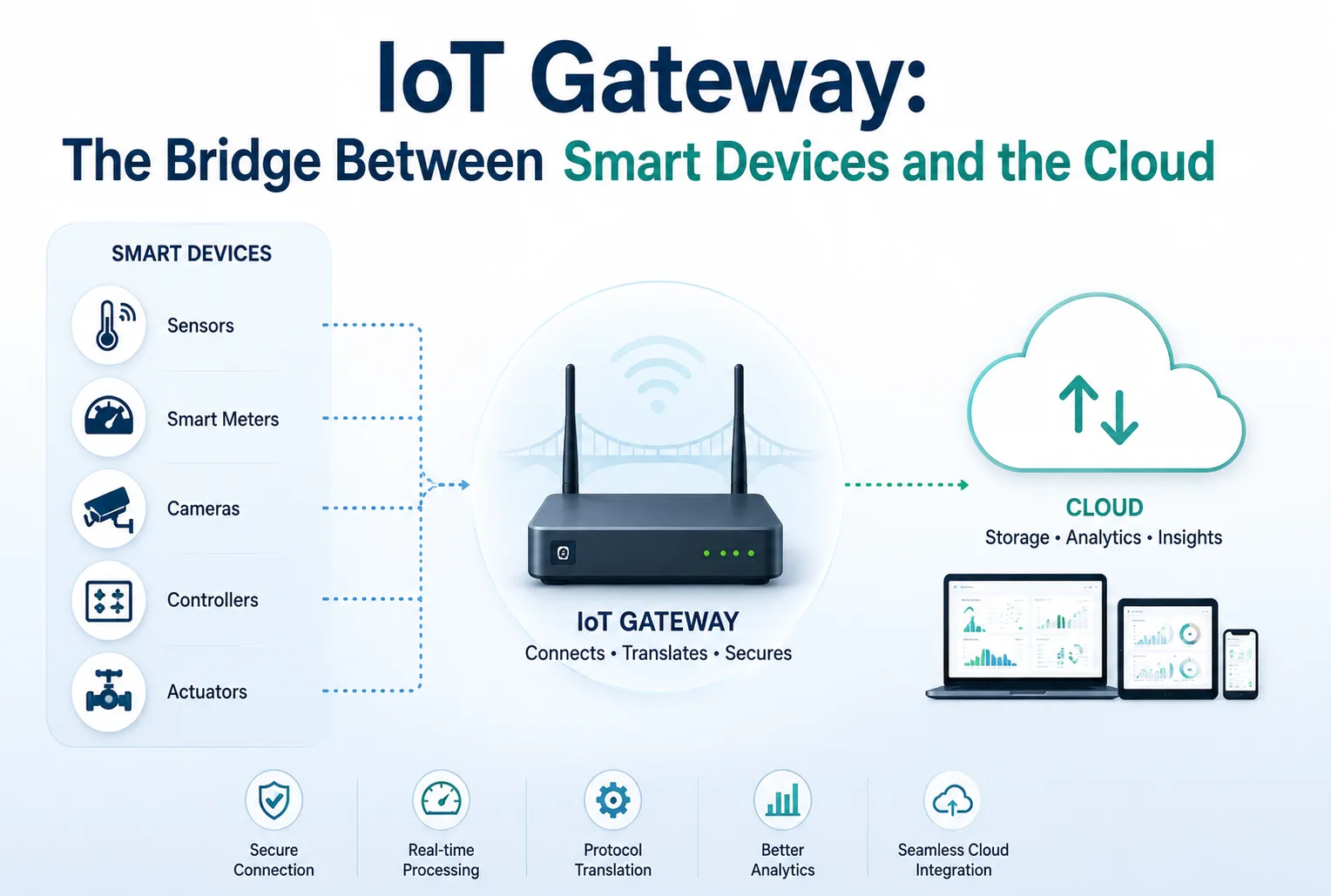
An IoT gateway is a hardware or software device that connects IoT devices to a network, cloud platform, or local system.
In a typical IoT environment, many sensors and devices may generate data. These devices may use different communication technologies or protocols. Sending all this information directly to the cloud may not always be practical.
The gateway sits between the devices and the application platform.
It can collect information from multiple sensors, process some of the data locally, convert communication protocols, and send the required information to the cloud.
In simple terms, an IoT gateway works like a smart bridge between devices and the systems that use their data.
Why Is an IoT Gateway Important?
IoT systems can contain hundreds or thousands of connected devices.
These devices may come from different manufacturers and use different communication methods. Without an effective communication layer, managing these devices can become complicated.
An IoT gateway helps organize this communication.
For example, a factory may have temperature sensors, vibration sensors, energy meters, pressure sensors, and machines. Each device may communicate differently.
The gateway can collect information from these devices and provide a common connection to the central monitoring platform.
This makes the overall IoT architecture easier to manage.
How Does an IoT Gateway Work?
The working process can be explained through a few basic steps.
1. Data Collection
Sensors and connected devices collect information from the physical environment.
For example, a temperature sensor may measure machine temperature while a flow meter measures water movement through a pipeline.
The gateway receives this information from connected devices.
2. Data Processing
Instead of sending every piece of raw data to the cloud, the gateway can process information locally.
It may filter unnecessary data, organize readings, perform basic calculations, or identify important events.
This can reduce the amount of information that needs to be transmitted.
3. Protocol Conversion
Different IoT devices may use different communication protocols.
An industrial machine may communicate through one protocol while a modern sensor uses another.
The gateway can help translate information between these protocols so that different devices can communicate with the same platform.
4. Data Transmission
After processing the information, the gateway sends the required data to a cloud or local monitoring platform.
The platform can then store, analyze, and display the information through dashboards.
5. Receiving Commands
Communication is not always one-way.
The cloud or monitoring platform may also send commands back through the gateway.
For example, a system may send a command to control a pump, switch equipment, or change a device setting based on predefined conditions.
This creates two-way communication between devices and applications.
IoT Gateway vs IoT Device
An IoT device is generally responsible for sensing, measuring, controlling, or performing a specific task.
For example, a temperature sensor measures temperature. A water meter measures water consumption. A vibration sensor monitors equipment movement.
An IoT gateway performs a different role.
It connects multiple devices and manages communication between those devices and the application platform.
Think of an IoT device as a data producer and the gateway as a communication and data management layer.
Both are important, but they perform different functions within an IoT architecture.
Key Functions of an IoT Gateway
An IoT gateway can perform several important functions.
Device Connectivity
It connects multiple sensors, machines, meters, and other devices to a common system.
Protocol Translation
It can support communication between devices that use different protocols.
Data Filtering
The gateway can filter unnecessary information before sending data to the cloud.
Local Processing
Some data can be processed locally instead of being sent to a remote server.
Security
Gateways can provide an additional security layer between connected devices and external networks.
Device Management
They can help monitor connected devices and their communication status.
Remote Communication
Gateways can transfer information between local devices and cloud-based platforms.
These functions make gateways particularly useful in large and complex IoT environments.
Edge Computing and IoT Gateways
Edge computing is closely connected with modern IoT gateways.
Traditional IoT systems may send large amounts of data directly to the cloud for processing.
With edge computing, some processing happens closer to where the data is generated.
An IoT gateway can act as an edge computing point.
For example, a machine may generate hundreds of sensor readings every minute. Instead of sending every raw reading to the cloud, the gateway can analyze the information locally and send only important results.
This can reduce bandwidth usage and improve response time.
Benefits of Using an IoT Gateway
Using a gateway can provide several benefits for organizations.
1. Better Connectivity
A gateway can connect different types of devices and communication technologies.
2. Reduced Data Traffic
Local filtering and processing can reduce the amount of data transmitted to the cloud.
3. Faster Response
Local processing can allow systems to respond quickly to certain events.
4. Improved Security
A gateway can provide additional controls between devices and external networks.
5. Easier Device Management
Multiple devices can be managed through a centralized communication layer.
6. Support for Legacy Equipment
Older machines may not have modern internet connectivity. Gateways can help connect such equipment to newer IoT platforms.
7. Better Reliability
Some gateways can continue performing local functions even when cloud connectivity is temporarily unavailable.
IoT Gateways in Industrial Environments
Industrial environments are one of the most important applications for IoT gateways.
Factories often contain machines from different manufacturers and generations. Some equipment may be modern and connected, while other machines may be older.
A gateway can help bring these different systems together.
For example, a manufacturing facility may use sensors to monitor machine temperature, vibration, pressure, energy consumption, and operating status.
The gateway can collect information from these sensors and send it to a centralized platform.
Managers can then monitor machine performance from a single dashboard.
IoT Gateways for Smart Water Management
Water management is another important application.
Water systems can include flow meters, level sensors, pressure sensors, water quality sensors, pumps, and other connected devices.
A gateway can collect information from these different devices and transfer it to a centralized monitoring platform.
For example, a smart water management system may monitor:
- Water flow
- Tank levels
- Pipeline pressure
- Water consumption
- Pump status
- Water quality
- Energy consumption
The gateway can bring this information together and make it available to a cloud dashboard.
If abnormal water consumption or pressure is detected, the monitoring platform can generate an alert.
IoT Gateways for Energy Monitoring
Energy monitoring systems can also benefit from gateways.
Businesses may have multiple energy meters installed across different buildings, machines, or production areas.
A gateway can collect readings from these meters and send the information to a central platform.
Managers can then compare energy consumption across different areas and identify unusual usage.
This can help organizations understand their energy patterns and identify opportunities for efficiency improvements.
IoT Gateways for Smart Buildings
Smart buildings may contain many connected systems, including lighting, HVAC equipment, security systems, energy meters, water meters, and environmental sensors.
A gateway can help connect these systems to a central management platform.
This creates better visibility into building operations.
For example, temperature sensors can provide environmental data while energy meters provide consumption information. The platform can use this information to help building managers understand overall performance.
Security Considerations
Security is an important consideration when deploying IoT gateways.
Because gateways connect devices to networks and cloud platforms, they should be properly secured.
Organizations should consider secure authentication, encrypted communication, access controls, software updates, device monitoring, and network protection.
The gateway should also be configured according to the organization's security requirements.
Security should be considered from the beginning of an IoT project rather than added after deployment.
Choosing the Right IoT Gateway
Not every gateway is suitable for every application.
Organizations should consider several factors before selecting a gateway.
Connectivity
The gateway should support the communication technologies required by the connected devices.
Protocol Support
It should be compatible with the protocols used by existing equipment.
Processing Capability
Applications that require local analytics may need a gateway with greater processing capacity.
Scalability
The gateway should be able to support additional devices as the IoT system grows.
Security
Security features should match the organization's operational requirements.
Environmental Conditions
Industrial gateways may need to operate in environments with heat, dust, vibration, or other challenging conditions.
Cloud Compatibility
The gateway should work effectively with the selected monitoring or cloud platform.
Selecting the right gateway can make a significant difference to the reliability and scalability of an IoT project.
Common Challenges
Although gateways provide many benefits, implementation can also present challenges.
Different devices may use different protocols, making integration complex.
Network connectivity may not always be reliable, especially in remote or industrial environments.
Large deployments can also create device management and security challenges.
Organizations should therefore plan the architecture carefully and choose hardware and software that can support their long-term requirements.
The Future of IoT Gateways
As IoT deployments continue to grow, gateways are becoming more intelligent.
Future gateways are expected to perform more local analytics, support advanced edge computing, improve security, and manage larger numbers of connected devices.
Artificial intelligence and machine learning may also be increasingly used at the edge.
Instead of sending all information to a cloud platform, gateways may be able to identify patterns and important events locally.
This can make IoT systems faster, more efficient, and more responsive.
How KarIoT Can Help
For organizations looking to build connected monitoring systems, KarIoT provides IoT solutions that can help connect devices, collect operational data, and provide real-time visibility.
KarIoT solutions can support applications such as industrial equipment monitoring, water monitoring, energy monitoring, tank-level monitoring, flow measurement, remote monitoring, alerts, and data analytics.
An effective gateway and connectivity layer can help bring information from different sensors and devices into a centralized monitoring environment. This allows organizations to move from isolated equipment and manual monitoring toward connected, data-driven operations.
For industries, commercial facilities, residential communities, and water management applications, connected monitoring can provide better visibility and help organizations respond to important changes more quickly.
Final Thoughts: Build a Connected Future
IoT gateways play an important role in connecting the physical world with digital platforms.
They collect data from sensors and machines, support different communication protocols, process information, improve connectivity, and help transfer useful data to cloud or local applications.
As organizations connect more equipment and systems, having a reliable communication layer becomes increasingly important.
Whether you are building a smart factory, monitoring water infrastructure, managing energy consumption, or developing a smart building, an IoT gateway can provide the connection needed to bring different devices and systems together.