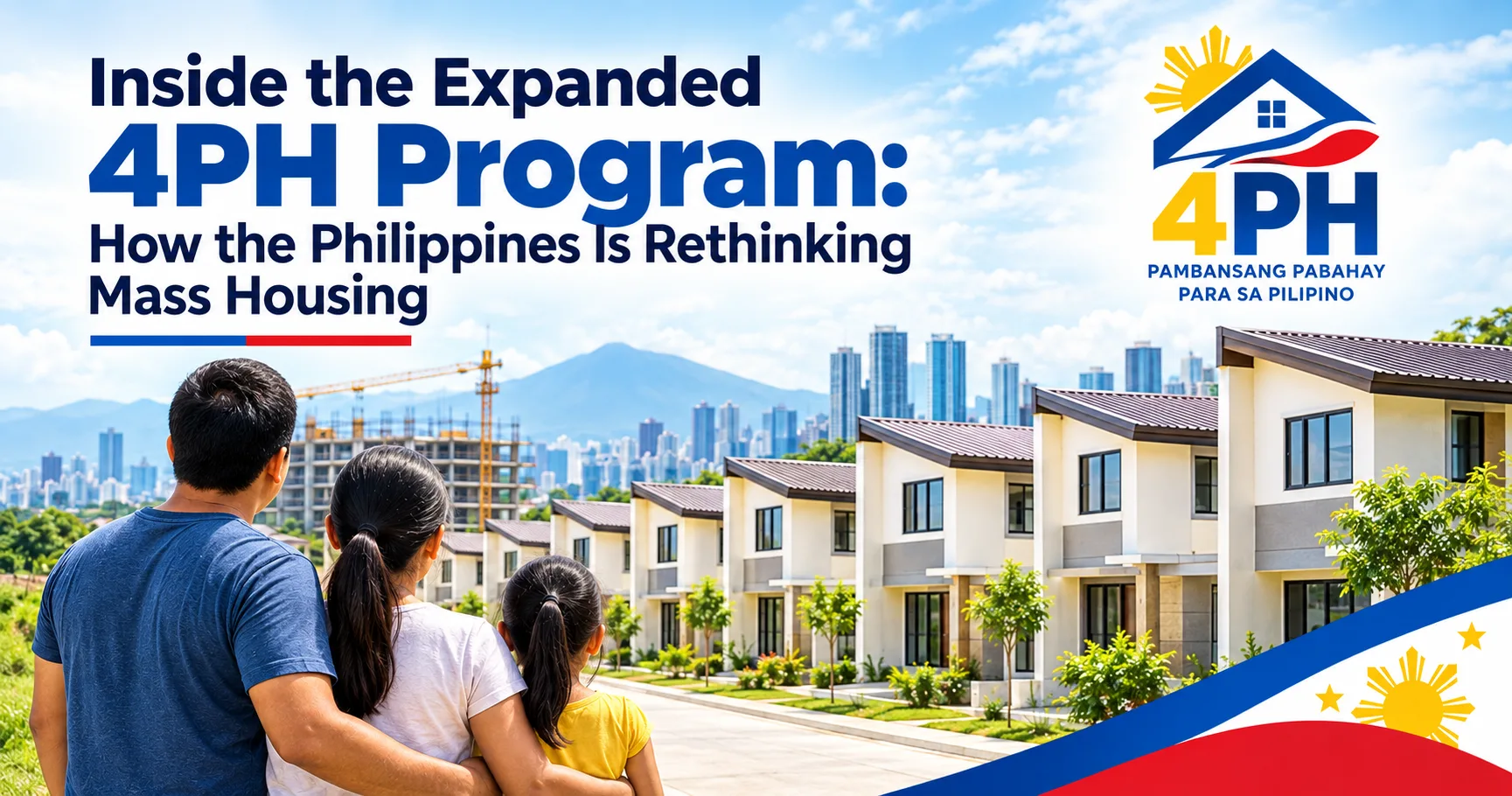
The Philippines is trying to close one of the largest housing gaps in its history. Even after a methodology revision by the Philippine Statistics Authority narrowed the widely cited 6.5-million-unit figure to a projected 3.7-million-unit housing need through 2028, the core problem stands unchanged: millions of Filipino families still live in overcrowded, substandard, or otherwise inadequate housing. In response, the Marcos administration has spent the past year and a half reworking its flagship shelter initiative, the Pambansang Pabahay Para sa Pilipino Program, into what is now called the Expanded 4PH Program. The changes go beyond a name. They touch financing, housing types, beneficiary targeting, and the government's expectations of the private sector.
From Condos-Only to a Menu of Options
When 4PH launched in September 2022, it leaned almost entirely on vertical construction — condominium-type buildings meant to house informal settlers displaced from waterways and other danger zones. That approach ran into a practical wall: not every city has the land economics or population density to justify high-rise housing, and not every displaced family wants to live in one.
The Department of Human Settlements and Urban Development (DHSUD) began widening the program's scope in mid-2025, and regional offices reported the expanded rules in force through the first half of 2026. Horizontal subdivisions — house-and-lot packages — are now eligible for the same government support once reserved for condominiums. Secretary Aliling has described the expanded program as covering several modalities beyond vertical housing: horizontal subdivisions, lot-only packages, rental housing, community mortgage, and usufruct arrangements. Every modality carries an incremental housing approach, where beneficiaries start with the basic unit they can afford and upgrade later with Pag-IBIG financing. DHSUD officials have framed the recalibration as a move from a production-centric model to a beneficiary-centric one: instead of building a fixed unit type and finding occupants for it, the program now tries to match housing options to what families can actually afford and where they can realistically live.
A Tiered Price Structure
The expanded framework is being restructured around three price tiers. Socialized housing remains the entry point, covering units priced under roughly ₱1.8 million. Economic housing sits above it, with a ceiling that officials have discussed raising from ₱2.5 million to somewhere between ₱3.6 million and ₱3.8 million — a change still pending final agreement with the Board of Investments and the Department of Trade and Industry. A third, open-market tier has also entered the conversation, aimed at middle-income buyers and structured to help developers absorb unsold condominium inventory that has weighed on a slower property market.
Financing has moved in step with the housing tiers. Through Pag-IBIG Fund, qualified members can now access loans at rates as low as 3% per year — a steep discount from standard end-user financing. The subsidized rate applies to the first five years of the loan term, with the first 30,000 qualified borrowers under Pag-IBIG's Early Bird Promo keeping it for the first ten. Eligibility is reserved for first-time homeowners who own no registered property and earn ₱34,000 or less per month outside Metro Manila, or ₱47,000 or less within it. For horizontal projects specifically, Pag-IBIG has introduced a fixed package price of ₱950,000 for units that would otherwise appraise between ₱1.4 million and ₱1.5 million, giving members an effective built-in discount. Developers building rental units get their own terms: 3% on construction and development loans for the first ten years, with repayment stretched to as long as 30 years, against the usual three-year term at 5.875% to 6.25%. DHSUD has said it eventually wants to push the subsidized end-user rate down to 1%.
The Numbers So Far
By mid-2026, DHSUD reported that the government had produced or facilitated 575,693 housing units from July 2022 to June 2026 — about 51% of its recalibrated goal of 1.13 million units by the end of the current administration. The breakdown: 81,295 units through direct housing provision, 368,731 assisted through government financing programs, and 125,667 produced under the Expanded 4PH Program. Pag-IBIG alone released ₱69.19 billion in housing loans in the first half of 2026, helping 43,051 members acquire homes, while socialized housing financing more than doubled over the same period, with 6,601 minimum-wage and low-income members securing homes under the expanded program.
Regional rollout has been steady rather than concentrated in Metro Manila. In Negros Occidental, DHSUD led the concrete pouring ceremony for Victorias Residences, one of the program's pilot rental housing projects, while in Iloilo the Uswag 4PH Condominium Complex is rising on city-owned land. In Northern Mindanao, the regional office reported 2,336 units delivered as of 2025 — 605 socialized and 1,731 economic or open-market. In Luzon, Pag-IBIG committed ₱2.9 billion through a preferred-share subscription to fund more than 7,300 homes across 10 developments in Batangas, Laguna, and Pampanga, with an 80-20 split favoring socialized units over economic ones.
Why the Private Sector Matters Now More Than Ever
DHSUD has been direct about the limits of what government financing and direct construction can achieve alone. At the department's 2027 budget briefing before the House Committee on Appropriations in August 2026, Housing Secretary Jose Ramon Aliling stated plainly that the administration's recalibrated 1.13-million-unit target will not clear the 3.7-million-unit backlog by 2028 without private-sector production. He also broke that backlog into three roughly equal parts: 1.1 million substandard units needing repair, 1.1 million doubled-up households where more than one family shares a dwelling, and 1.1 million newly formed families seeking to live apart. That is a notable admission from an agency running a flagship presidential program: government supply and subsidized financing can move the needle, but they cannot substitute for developers and contractors building at scale.
This is where the program's expansion into horizontal housing, rental units, and a defined open-market tier becomes more than a policy footnote. It creates distinct entry points for private developers and construction firms with different specializations — vertical builders who can deliver dense housing in urban centers, horizontal developers who can move faster on subdivision-scale projects in provincial areas, and firms equipped to absorb unsold inventory into the economic and open-market tiers. An established EPC company in the Philippines — one that handles engineering, procurement, and construction under a single mandate — is particularly well positioned here, since speed and cost control matter as much as design in a program built around affordability ceilings.
The Honest Caveats
None of this erases the program's track record of missed annual targets. Reported causes span typhoons, right-of-way disputes, and procurement delays, with market analysts adding tighter public spending in early 2026 tied to ongoing infrastructure corruption probes. Independent economists have also cautioned against reading the 575,693-unit figure as proof the housing crisis is nearing resolution; the revised 3.7-million-unit estimate covers housing need through 2028, including newly formed households and homes requiring repair, meaning the goalposts move even as construction continues.
What has changed is the program's honesty about what it will take to hit them. A national housing initiative that started as a government-led vertical construction push has evolved into a multi-tier, multi-format financing and construction framework that explicitly depends on private capacity. For an industry watching where the next several years of residential demand will land, that shift in structure — as much as the unit counts — is the story worth following.