
An offshore merchant account is more than just a way to accept payments—it can be the difference between growing your business globally or watching valuable sales disappear at checkout. For companies that rely on international payment processing, every approved transaction protects revenue, while every unnecessary decline creates frustration for both the business and the customer.
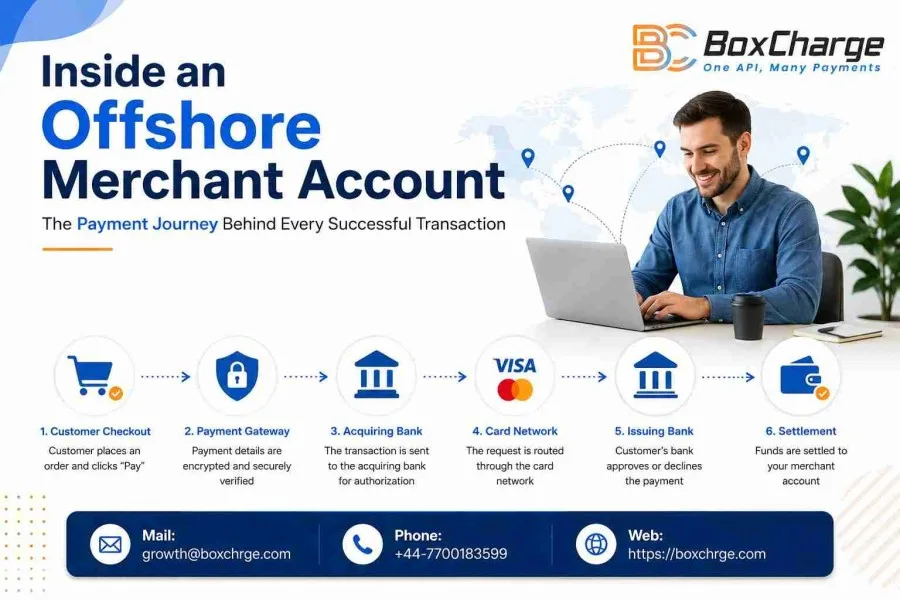
If you've ever wondered why a genuine customer receives a "Transaction Declined" message despite having sufficient funds, the answer often lies behind the scenes. A payment doesn't move directly from a customer's card to your bank account. Instead, it travels through a network of payment gateways, fraud detection systems, acquiring banks, card networks, and issuing banks before a final decision is made.
Understanding that journey isn't just useful for payment professionals. It's essential for businesses that operate internationally or in industries where payment approvals are more challenging.
Every Payment Starts Long Before the Money Moves
From a customer's perspective, paying online takes only a few seconds. They enter their card details, click Pay, and expect an instant confirmation.
Behind that simple action, however, multiple systems begin working simultaneously.
The payment gateway provider encrypts sensitive card information and securely forwards it for authorization. At the same time, fraud prevention tools evaluate the transaction, checking factors such as device behaviour, location, purchase patterns, and authentication results.
Only after these security checks are completed does the transaction move to the acquiring bank that supports the merchant's account.
When everything works together, customers never notice the complexity. They simply receive a successful payment confirmation.
Why Some Genuine Payments Still Get Declined
Many merchants assume declined transactions happen because customers enter incorrect card details.
That isn't always the case.
One online subscription business in the United Kingdom began receiving emails from loyal customers whose monthly renewals were suddenly failing. The business hadn't changed its pricing, billing cycle, or services. Customer demand remained strong.
The real issue was the payment infrastructure.
Its domestic acquiring bank had introduced stricter risk rules for recurring international transactions. Legitimate payments were being rejected before they ever reached the customer's bank.
After moving to an offshore merchant account supported by international acquiring partners, payment approvals became more consistent, customer complaints dropped, and recurring revenue stabilised.
Situations like this are surprisingly common for businesses expanding across the United States, Canada, Germany, Australia, Singapore, and the United Arab Emirates, where customers expect fast, reliable online payments.
The Role of the Acquiring Bank
Once a payment passes its initial security checks, it reaches the acquiring bank.
Think of the acquiring bank as the financial institution that represents the merchant during the transaction. Its responsibility is to communicate with card networks and request authorization from the customer's issuing bank.
For businesses operating internationally, the acquiring bank plays a much bigger role than many realise.
Banks experienced in high-risk merchant accounts and cross-border payments often have a deeper understanding of international commerce, recurring billing models, and industries that traditional financial institutions may consider higher risk.
That experience can lead to stronger approval rates and fewer unnecessary payment interruptions.
Fraud Prevention Isn't About Blocking More Payments
One of the biggest misconceptions in online payments is that stronger fraud protection means more declined transactions.
In reality, modern fraud prevention focuses on identifying suspicious activity without creating friction for genuine customers.
Today's payment processing solutions analyse hundreds of signals within seconds, including device fingerprinting, spending behaviour, transaction velocity, billing consistency, CVV verification, Address Verification Service (AVS), and 3D Secure authentication.
The objective isn't simply to stop fraud.
It's to approve as many legitimate transactions as possible while filtering out fraudulent ones.
Finding that balance is one of the reasons experienced merchant services providers consistently outperform generic payment solutions.
Settlement: When the Money Finally Arrives
Receiving an approval message doesn't mean the funds instantly appear in the merchant's account.
After authorization, approved transactions are grouped and submitted for settlement. During this stage, funds move from the issuing bank through the card network to the acquiring bank before reaching the merchant.
For businesses processing hundreds or thousands of transactions every day, efficient settlement improves cash flow and simplifies financial planning.
Reliable global merchant services are designed to make this process predictable, helping businesses avoid unnecessary delays while supporting international growth.
Why Offshore Merchant Accounts Matter for High-Risk Businesses
Businesses operating in sectors such as SaaS, online marketplaces, digital services, travel, subscription platforms, and other higher-risk industries often face challenges that domestic payment providers aren't designed to handle.
As sales grow internationally, businesses may encounter lower approval rates, delayed settlements, increased fraud exposure, or banking restrictions.
An offshore merchant account helps overcome many of these obstacles by providing access to experienced acquiring partners, multi-currency payments, flexible underwriting, and payment infrastructure built for international commerce.
The result isn't just smoother payment processing—it's a better customer experience and more opportunities to grow across global markets.
Choosing the Right Payment Partner
A payment provider should do more than process transactions.
It should help businesses improve authorization rates, reduce payment friction, manage chargebacks, and support long-term expansion.
Before selecting a provider, look for one with proven expertise in international payment processing, strong fraud prevention capabilities, reliable customer support, and experience working with high-risk industries.
The right payment partner becomes an extension of your business rather than simply another technology vendor.
Final Thoughts
Most businesses spend significant time improving their products, marketing campaigns, and customer experience. Yet one overlooked area—the payment journey—can have an equally significant impact on revenue.
Every approved transaction strengthens customer trust. Every unnecessary decline creates friction that may cost future business.
Understanding how an offshore merchant account processes payments helps merchants make informed decisions about their payment infrastructure, improve approval rates, and prepare for sustainable international growth.
If your business is experiencing unexpected payment declines, expanding into new markets, or looking for a more reliable payment gateway provider, reviewing your payment setup could be one of the smartest investments you make. Working with an experienced provider such as BoxCharge can help you build a payment ecosystem that supports long-term growth rather than limiting it.
Frequently Asked Questions
Q: What is an offshore merchant account?
An offshore merchant account is a merchant account held with an acquiring bank outside a business's home country. It helps businesses process international payments, support multiple currencies, and manage higher-risk transactions more effectively.
Q: Why do genuine online payments sometimes fail?
Legitimate transactions can be declined because of fraud screening, acquiring bank policies, card issuer rules, or payment routing issues—not just incorrect card details.
Q: Can an offshore merchant account improve payment approval rates?
Yes. Businesses operating internationally often experience better authorization rates when working with acquiring partners that specialise in high-risk merchant accounts and cross-border payment processing.
Q: Who benefits most from offshore merchant accounts?
Businesses involved in SaaS, subscriptions, travel, digital services, online marketplaces, and other international or high-risk industries often benefit from the flexibility and global reach that offshore merchant accounts provide.