
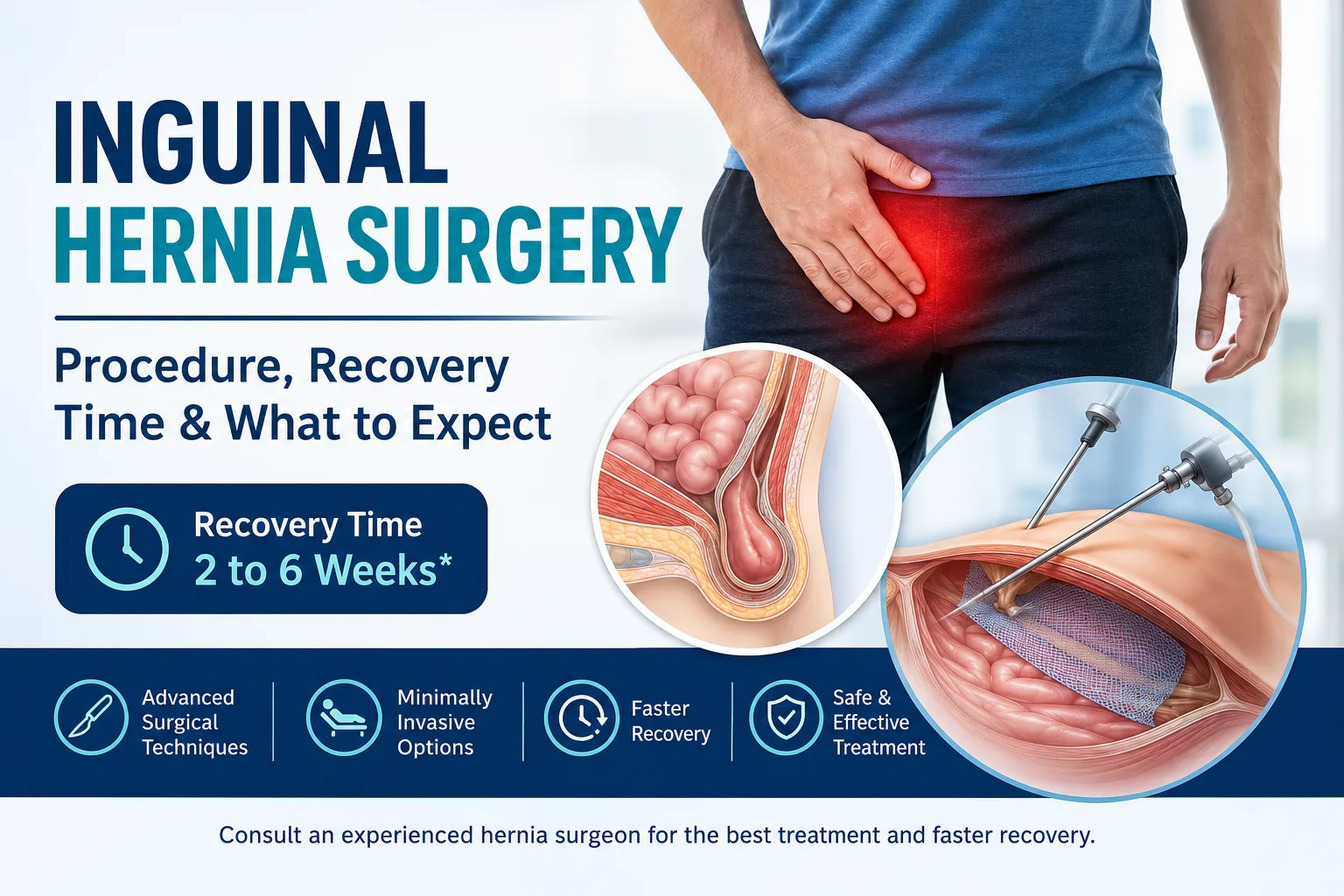
An inguinal hernia is a common condition in which tissue, sometimes including part of the bowel, pushes through a weak area in the abdominal wall near the groin. It can appear as a lump or swelling and may cause pain or discomfort, particularly during activities such as lifting, coughing, prolonged standing, or straining.
For people diagnosed with an inguinal hernia, one of the most common questions is whether surgery is necessary and, if it is, what the inguinal hernia surgery recovery time will be. The answer depends on several factors, including the type of repair, the patient's general health, the nature of the hernia and the type of work or physical activity they need to return to.
This article explains what patients can expect from inguinal hernia surgery, including the available surgical approaches, recovery after surgery, activity restrictions and when medical attention may be necessary.
What Is an Inguinal Hernia?
An inguinal hernia develops when the inner layers of the abdominal wall become weak and tissue pushes through that weakened area. It commonly produces a bulge in the groin, although some patients may experience pain or discomfort without an obvious persistent bulge. Symptoms can become more noticeable with heavy lifting, coughing, straining during bowel movements or urination, or prolonged standing or sitting.
An inguinal hernia does not normally repair itself. SAGES notes that hernias do not resolve on their own and may become larger over time. However, not every inguinal hernia requires immediate surgery. Hernias without symptoms may sometimes be observed, while repair is generally considered when symptoms interfere with daily activities.
The NHS also states that an inguinal hernia may not require treatment if it is not causing symptoms, while surgery may be recommended when there is pain or to prevent complications such as bowel obstruction or strangulation.
When Is Inguinal Hernia Surgery Recommended?
The decision to have surgery should be made after an assessment by a qualified surgeon. Factors such as symptoms, the size and location of the hernia, general health and the risk of complications can influence the treatment approach.
Surgery may be considered when an inguinal hernia causes persistent pain or discomfort or interferes with normal daily activities. Repair may also be necessary when there are concerns about the hernia becoming incarcerated or strangulated.
A hernia that becomes stuck and cannot be pushed back, particularly when accompanied by severe or continuous pain, redness or tenderness, can require urgent medical assessment. SAGES identifies a non-reducible bulge and severe continuous pain with redness and tenderness as critical warning signs.
Types of Inguinal Hernia Surgery
There are two main approaches to inguinal hernia repair: open surgery and minimally invasive surgery. Minimally invasive repair can be performed laparoscopically and, in some settings, with robotic assistance.
Open Inguinal Hernia Repair
During open repair, the surgeon makes an incision in the groin to reach the weakened area. The hernia is repaired at the level of the abdominal wall defect, and surgical mesh is often used to reinforce the weakened area. The incision is then closed.
Healthdirect states that open inguinal hernia repair usually takes about 45 minutes, although the actual duration can vary depending on the individual procedure and circumstances.
Laparoscopic Inguinal Hernia Repair
Laparoscopic repair involves several small abdominal incisions. A laparoscope, which is a thin instrument with a camera, allows the surgeon to see the hernia from inside the abdomen. Other instruments are inserted through additional small incisions, and mesh is placed to cover the hernia defect.
According to SAGES, minimally invasive inguinal hernia repair is generally associated with an easier recovery and a shorter return to work and normal activities compared with open repair. However, whether laparoscopic surgery is appropriate depends on the patient's individual circumstances.
The NHS notes that the choice between keyhole and open surgery depends on factors including the location and size of the hernia and the patient's general health.
What Happens During Inguinal Hernia Surgery?
The exact procedure depends on the surgical technique selected.
For open repair, the surgeon makes an incision in the groin, accesses the hernia, returns the herniated tissue to the appropriate position and repairs the weakened area, often with mesh reinforcement.
For laparoscopic repair, several small incisions are made in the abdomen. A camera and specialized instruments are introduced through these openings, allowing the surgeon to repair the hernia from inside and place mesh over the defect.
The NHS states that inguinal hernia repair generally takes between 30 and 90 minutes, although the duration can vary according to the procedure.
Most inguinal hernia repairs can be performed as day-case procedures, meaning many patients are able to return home on the same day once they have recovered sufficiently from anaesthesia and meet the discharge requirements.
Inguinal Hernia Surgery Recovery Time
One of the most important considerations for patients is inguinal hernia surgery recovery time.
The NHS states that recovery from inguinal hernia repair usually takes up to 4 to 6 weeks, although some people may take longer. Healthdirect reports that many patients can return to work and normal activities within 2 to 4 weeks, depending on their recovery and the type of work they perform.
This means there is no single recovery time that applies to every patient.
Someone with a desk-based job may be able to return to work sooner than someone whose occupation involves frequent lifting or strenuous physical activity. Healthdirect specifically notes that patients may be advised to avoid manual work for a period and not to lift heavy objects for at least six weeks.
The NHS similarly advises that people may need to stay away from work for at least one to two weeks, while those whose jobs involve heavy lifting may require up to six weeks away from work.
What to Expect During the First Few Days
Some soreness around the surgical area is expected after inguinal hernia surgery. SAGES states that soreness is common during the first 48 hours and can sometimes continue for longer. Patients are encouraged to walk from the day after surgery, while the exact activity restrictions should be discussed with their surgeon.
The NHS notes that patients may experience pain around the wound for several days, as well as bruising or swelling around the wound or genital area for a couple of weeks. After laparoscopic surgery, bloating or shoulder discomfort can also occur for a couple of days because of the gas used during the procedure.
Gentle movement is generally encouraged during recovery. The NHS recommends keeping active with gentle exercise such as walking and gradually increasing activity as recovery progresses.
When Can You Return to Normal Activities?
Returning to normal activities should be gradual rather than based solely on a fixed number of days.
The NHS advises avoiding heavy lifting and strenuous activity for at least four to six weeks. It also recommends discussing the appropriate time to return to driving with the healthcare team and checking relevant insurance requirements.
For people with physically demanding jobs, the recovery period can be longer. Healthdirect states that patients should be able to return to work and normal activities after two to four weeks depending on recovery and the type of work, while heavy lifting should be avoided for at least six weeks.
Patients should follow the specific instructions provided by their surgeon because recovery recommendations can differ according to the operation and individual circumstances.
Possible Side Effects and Complications
As with any surgical procedure, inguinal hernia repair has potential risks. SAGES identifies bleeding and infection among the primary complications, although these are uncommon with open or minimally invasive inguinal hernia repair. Other possible problems include difficulty passing urine, bruising or swelling, persistent groin pain and recurrence of the hernia.
The NHS also lists wound infection, swelling or bruising, prolonged groin pain or numbness, recurrence and injury to nearby structures among possible complications.
Patients should contact their healthcare team if they develop concerning symptoms after surgery. These can include worsening wound redness or swelling, pus or other drainage, fever, increasing abdominal or groin swelling, significant bleeding, persistent vomiting or difficulty urinating.
Severe breathing difficulty or chest pain requires immediate emergency attention.
Inguinal Hernia Surgery in Dubai
People considering inguinal hernia surgery in Dubai have access to both open and minimally invasive surgical approaches. The appropriate procedure should be determined after an individual assessment rather than choosing a technique based only on recovery time.
If you are researching Hernia surgery Dubai options, it is important to discuss the type of hernia you have, the recommended surgical approach, anaesthesia, expected recovery, activity restrictions and possible complications with your surgeon before proceeding.
Dr. Rajesh Nambiar for Hernia Surgery in Dubai
Dr. Rajesh Nambiar is a Specialist Laparoscopic and Gastrointestinal Surgeon in Dubai practicing at Mediclinic Welcare Hospital in Dubai. Mediclinic lists his qualifications as MBBS, MS and DNB (GI Surgery), and states that he has extensive experience in basic and advanced laparoscopic gastrointestinal surgery.
His official profile also highlights extensive experience in laparoscopic hernia procedures and describes his practice as including laparoscopic and open hernia surgery.
For patients considering inguinal hernia surgery in Dubai, a consultation with an experienced surgeon can help determine whether surgery is appropriate and which approach best fits their individual condition, health and lifestyle.
Final Thoughts
The inguinal hernia surgery recovery time varies from person to person. While many patients can return to work and normal activities within two to four weeks, complete recovery can take around four to six weeks or longer, particularly when the work involves heavy physical activity.
Open and minimally invasive techniques are both established approaches for inguinal hernia repair. The choice depends on factors such as the hernia itself, the patient's health and the surgeon's assessment.
If you have an inguinal hernia, speak with a qualified surgeon to understand whether observation or surgery is appropriate for you. If you develop severe pain, a hernia that becomes stuck, vomiting or other signs of a possible complication, seek urgent medical assessment rather than waiting for a routine appointment.
Medical disclaimer: This article is for general educational purposes and does not replace an examination or personalised medical advice from a qualified healthcare professional.