
I'll be honest with you — before I visited North India, I thought I understood what "overwhelming" meant. I didn't.
The moment my train pulled into Old Delhi and the smell of chai, marigolds, and street food hit me all at once, I realized I had massively underestimated this part of the world. North India doesn't ease you in. It grabs you by the collar, spins you around, and demands your full attention — and you love every second of it.
If you're planning a trip to India and wondering where to begin, this article is for you. Specifically, I want to make the case for the Golden Triangle tour with Amritsar — a route that, in my opinion, is the single best introduction to North India that exists.
What Is the North India Tour Everyone Keeps Talking About?
When people say "North India tour," they usually mean a circuit through the most historically and culturally significant cities in the northern part of the country. The classic version covers Delhi, Agra, and Jaipur — famously known as the Golden Triangle.
But here's the thing: stopping at just those three cities is like watching a brilliant film and leaving before the final act. Adding Amritsar to the route transforms a great trip into an extraordinary one.
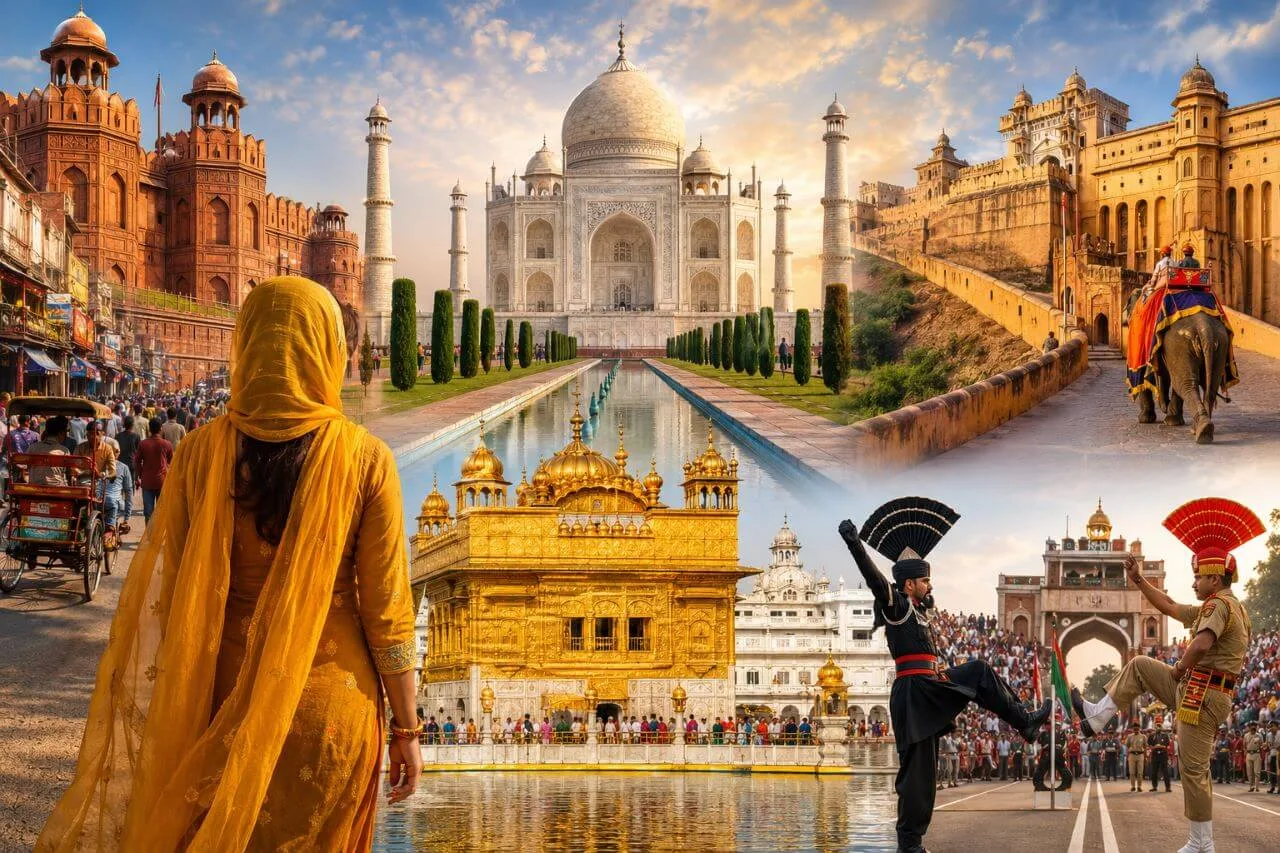
The extended route — Delhi → Agra → Jaipur → Amritsar — gives you ancient Mughal history, Rajput grandeur, the most iconic monument on earth, and one of the most spiritually moving experiences you'll ever witness. It's a lot, yes. But it's the kind of "a lot" that you'll spend years trying to describe to people who weren't there.
Delhi: Chaotic, Layered, and Completely Magnetic
Every North India tour begins in Delhi, and for good reason. This city is basically several cities stacked on top of each other — each era leaving behind monuments, markets, and moods that somehow coexist.
Old Delhi is where you'll lose yourself (possibly literally — the lanes of Chandni Chowk are genuinely maze-like). Eat a plate of chole bhature at a roadside stall. Visit the Jama Masjid, one of India's largest mosques, and climb the minaret for a view that'll reframe everything you thought you knew about the city. Wander through Dariba Kalan, the silver market, where craftsmen have been working the same way for generations.
New Delhi, meanwhile, is wide boulevards, colonial architecture, and the quiet dignity of places like Humayun's Tomb — a precursor to the Taj Mahal that most visitors rush past on their way to Agra. Don't be one of those people. Humayun's Tomb is stunning, and since it gets a fraction of the crowds, you can actually breathe there.
Spend at least two full days in Delhi. One is never enough.
Agra: Home of the Monument That Lives Up to the Hype
I know, I know. You've seen a thousand photos of the Taj Mahal. You're half-convinced it can't possibly be as impressive in person as it looks in pictures.
It's more impressive.
I don't say that lightly. The Taj Mahal is one of those rare things that genuinely exceeds expectation. The scale, the symmetry, the way the white marble seems to glow differently depending on the time of day — it's not just a beautiful building, it's a meditation on grief and love that took 22 years and 20,000 workers to complete.
Go at sunrise if you can. The golden light hits the dome and the reflecting pool comes alive, and for about twenty minutes before the crowds arrive, you get something close to a private audience with one of the world's greatest human achievements.
But Agra on a Golden Triangle tour with Amritsar is more than just the Taj. The Agra Fort, a UNESCO World Heritage Site, tells the complicated story of Mughal power with every sandstone corridor and marble pavilion. And if you have time, the Fatehpur Sikri — a ghost city built and abandoned in the 16th century — is one of the most hauntingly beautiful places in all of India.
Jaipur: The Pink City That Earns Every Superlative
The drive from Agra to Jaipur cuts through Rajasthan's scrubland, and somewhere along the way the landscape shifts and you start to feel like you've entered a different country entirely. Jaipur doesn't look like Delhi or Agra. It looks like someone decided an entire city should feel like a palace.
The Amber Fort, perched on a hillside above the city, is the kind of place that makes you forget to check your phone for hours. Walk through the Sheesh Mahal (Hall of Mirrors) and watch a single candle multiply into what looks like a thousand stars. The City Palace in the heart of Jaipur is still partially occupied by the royal family, which gives it a living, breathing quality that most historical sites lack.
And then there's the Hawa Mahal — the Palace of Winds — five stories of pink sandstone latticework that was designed so that royal women could observe street life without being seen. It's become the iconic image of Jaipur, and even after countless photos, seeing it in person stops you mid-step.
Jaipur is also where you eat. Dal baati churma, ghevar, laal maas — Rajasthani cuisine is its own reason to visit. Find a rooftop restaurant near the old city and eat well.
Amritsar: Where the North India Tour Finds Its Soul
Amritsar sits in the Punjab, about six hours from Jaipur by road or a short flight from Delhi. It's not always included in the classic Golden Triangle, which is exactly why adding it is such a good idea. While the Golden Triangle gives you history and architecture, Amritsar gives you something harder to describe — a kind of stillness inside all the noise.
The city's heart is the Golden Temple (Harmandir Sahib), the holiest shrine of the Sikh faith. No photograph — and I've looked at many — adequately captures what it's like to walk through the entrance, step onto the white marble causeway, and see that gold-plated shrine reflected in the still water of the Amrit Sarovar (Pool of Nectar) at dawn.
Go for the Palki Sahib ceremony in the evening, when the Guru Granth Sahib (the holy scripture) is ceremonially carried to its resting place for the night. The chanting, the golden light on the water, the thousands of people gathered in quiet devotion — it's one of those experiences that rewires something in you.
Don't leave Amritsar without visiting the Wagah Border ceremony either. Every evening at sunset, the border between India and Pakistan closes with a theatrical changing-of-the-guard ceremony that manages to be simultaneously absurd and genuinely moving. Thousands of Indians gather in the stands, singing, cheering, and waving flags. It's nationalistic, yes — but it's also strangely human.
And eat. Amritsari kulcha with chole, lassi in terracotta cups, makki di roti with sarson da saag — Punjab's food culture is legendary for a reason.
How to Plan Your Golden Triangle Tour with Amritsar
Recommended Duration: 10–14 days is ideal for a relaxed pace. You can compress it to 8 days if you're pushed for time, but you'll feel it.
Best Time to Visit: October to March is the sweet spot. Winters in North India are mild and pleasant — perfect for walking around forts and temples. Avoid May and June; the heat in Rajasthan especially can be punishing.
Getting Around:
- Delhi to Agra: Yamuna Expressway by car (3–4 hours) or the Gatimaan Express train (1.5 hours)
- Agra to Jaipur: By road (4–5 hours) through Rajasthan — the drive itself is scenic
- Jaipur to Amritsar: Fly (about 1.5 hours) or overnight train
Where to Stay:
- Delhi: Stay in the Connaught Place area or near Hauz Khas for easy access to everything
- Agra: Book a hotel with a Taj view — waking up to that sight is worth the premium
- Jaipur: Heritage havelis and boutique hotels are a Jaipur speciality; they're genuinely wonderful
- Amritsar: Stay near the Golden Temple so you can visit at dawn without the hassle of a long commute
Should You Hire a Guide? Yes, especially in Delhi and Jaipur. A good local guide will show you context you'd never find on your own — the histories behind the histories, the alleyways, the stories that don't make it into guidebooks.
A Few Things Nobody Tells You
Pace yourself in Delhi. It's tempting to try to see everything in a day. Don't. The city rewards slowness.
The Taj Mahal is best on weekdays. Weekend crowds can be intense; if you can time your visit for a Tuesday or Wednesday, do it.
At the Golden Temple, cover your head and remove your shoes. This is non-negotiable, and scarves are available at the entrance if you forget one.
Bargain in markets — but gently. In Jaipur's textile markets and Agra's crafts bazaars, negotiation is expected. But be fair about it. These are livelihoods.
Download an offline map before you go. Signal can be unreliable in old city areas, and nothing ruins a vibe like standing in the middle of Chandni Chowk staring helplessly at a loading screen.
The Bottom Line
A North India tour is one of those rare travel experiences that changes your reference points. After you've stood in front of the Taj Mahal at sunrise, wandered through Jaipur's bazaars, and sat by the Golden Temple in the early morning quiet, you see everything else slightly differently.
The Golden Triangle tour with Amritsar is the fullest version of this experience. It's not the easiest trip you'll ever take — North India is a lot, in the best possible way — but it is, without question, one of the most rewarding.