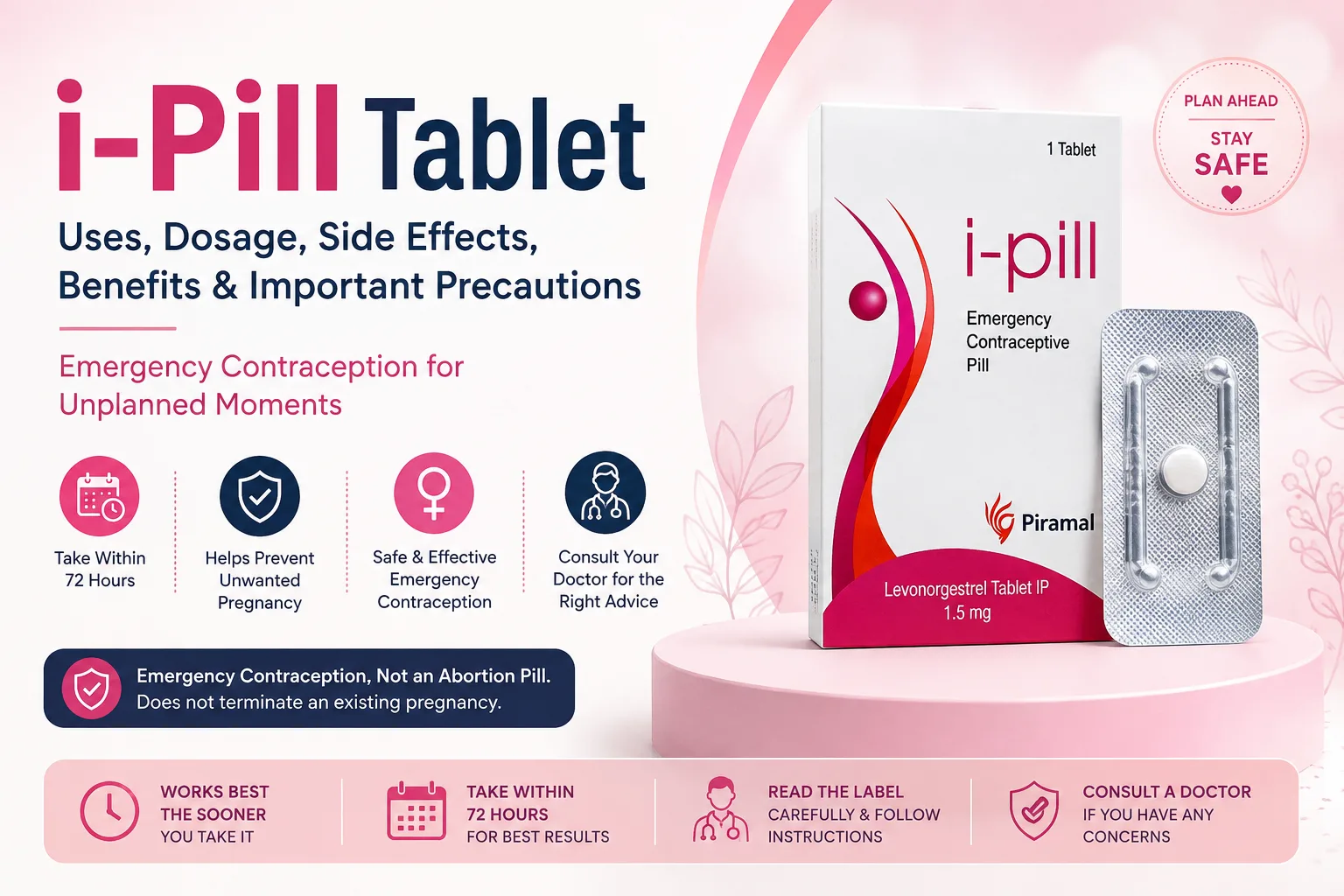
An unplanned sexual encounter or contraceptive failure can sometimes create anxiety about an unwanted pregnancy. In such situations, emergency contraception can provide a backup option. The i-Pill tablet is one of the commonly known emergency contraceptive pills used in India to help reduce the risk of pregnancy after unprotected sex or contraceptive failure.
However, many people have questions about i-Pill, including how it works, when it should be taken, how effective it is, whether it causes side effects, and whether it can terminate an existing pregnancy.
Understanding these points is important before using any emergency contraceptive pill. i-Pill is intended for emergency contraception and should not be considered a replacement for regular birth control.
What Is an i-Pill Tablet?
i-Pill is an emergency contraceptive tablet containing levonorgestrel, a synthetic form of the hormone progestin. Levonorgestrel is also used in emergency contraceptive pills in many countries.
Emergency contraception is designed to prevent pregnancy after unprotected sexual intercourse or when regular contraception may have failed. According to the World Health Organization, levonorgestrel emergency contraception can be taken as a single 1.5 mg dose. Emergency contraceptive pills work mainly by preventing or delaying ovulation.
The important point is that i-Pill is an emergency contraceptive, not an abortion pill. It does not terminate an established pregnancy and cannot be used to end an existing pregnancy.
When Is i-Pill Used?
An emergency contraceptive such as i-Pill may be considered when there is a possibility of pregnancy following:
- Unprotected sexual intercourse
- A broken or slipped condom
- Incorrect use of contraception
- Missed regular contraceptive pills
- Failure of the withdrawal method
- Other contraceptive accidents
Emergency contraception can also be considered following sexual assault when effective contraception was not already being used.
The sooner emergency contraception is used after unprotected intercourse, the better it generally works.
How Does i-Pill Work?
The active ingredient in i-Pill, levonorgestrel, primarily works by delaying or preventing ovulation. Ovulation is the release of an egg from the ovary.
If ovulation is delayed or prevented, sperm may not encounter an egg, reducing the possibility of fertilization.
This is why taking emergency contraception promptly is important. Once ovulation has already occurred, levonorgestrel emergency contraception may be less effective.
It is also important to understand what i-Pill does not do. Emergency contraceptive pills do not terminate an established pregnancy, and they are not the same as medicines used for medical abortion. WHO specifically states that emergency contraceptive pills do not induce abortion.
When Should i-Pill Be Taken?
Timing is one of the most important factors when considering an emergency contraceptive pill.
Levonorgestrel emergency contraception should ideally be taken as soon as possible after unprotected sex. WHO recommends levonorgestrel emergency contraception within 120 hours, or five days, but effectiveness is generally better when it is taken sooner.
Many clinical resources describe levonorgestrel emergency contraception as being intended for use within 72 hours, particularly because its effectiveness decreases as time passes.
Therefore, if you believe you need emergency contraception, delaying for several days is not advisable.
i-Pill Dosage
The usual levonorgestrel emergency contraceptive dose is 1.5 mg taken as a single dose. WHO lists 1.5 mg levonorgestrel as the recommended single-dose emergency contraception regimen.
Always check the strength and instructions on the specific product packaging and follow advice from a doctor or pharmacist when appropriate.
If vomiting occurs soon after taking an emergency contraceptive pill, another dose may be necessary. WHO notes that if vomiting occurs within two hours, the dose should be repeated.
If this happens, speaking with a healthcare professional or pharmacist is advisable rather than simply assuming the first tablet was absorbed.
How Effective Is i-Pill?
No emergency contraceptive is 100% effective.
The effectiveness of levonorgestrel emergency contraception depends on several factors, especially how soon it is taken and where a person is in their menstrual cycle.
Research summarized by WHO reports pregnancy rates of approximately 1.2% to 2.1% among users of levonorgestrel emergency contraceptive pills in the studies reviewed.
However, these figures should not be interpreted as a guarantee that an individual cannot become pregnant after taking i-Pill.
Emergency contraception works best when taken promptly.
For people seeking the most effective emergency contraception, a copper intrauterine device (IUD) inserted within five days of unprotected intercourse is the most effective option and is more than 99% effective when used for emergency contraception.
i-Pill Side Effects
Most people tolerate emergency contraceptive pills without serious problems. However, temporary side effects can occur.
Possible i-Pill side effects may include:
- Nausea
- Vomiting
- Headache
- Tiredness or fatigue
- Abdominal discomfort
- Breast tenderness
- Dizziness
- Mild vaginal bleeding or spotting
- Changes in the timing of the next period
- Heavier or lighter menstrual bleeding
WHO notes that side effects associated with emergency contraceptive pills are generally mild and short-lived.
Menstrual changes are particularly important to understand. Your next period may arrive earlier or later than expected after taking emergency contraception.
A delayed period does not automatically mean pregnancy, but a pregnancy test may be appropriate if your period is significantly late or if you develop pregnancy symptoms.
Does i-Pill Delay Periods?
Yes, emergency contraception can temporarily affect the menstrual cycle.
After taking i-Pill, some people may notice that their next period comes earlier or later than usual. The flow may also be different from what they normally experience.
This happens because emergency contraception temporarily affects the reproductive cycle.
However, if your period is considerably delayed after taking i-Pill, taking a pregnancy test can help determine whether pregnancy has occurred.
If you are unsure about when to test or have concerns about symptoms, consult a healthcare professional.
Is i-Pill an Abortion Pill?
No.
This is one of the most important differences to understand.
i-Pill is an emergency contraceptive pill, not an abortion medicine.
Emergency contraception is used after unprotected sex to reduce the possibility of pregnancy. It works mainly by preventing or delaying ovulation.
An abortion medication is used under appropriate medical guidance to end an established pregnancy. The two have different purposes and should never be treated as interchangeable.
WHO confirms that emergency contraceptive pills do not interrupt an established pregnancy and do not induce abortion.
Can i-Pill Cause Infertility?
There is no evidence that levonorgestrel emergency contraception causes permanent infertility.
WHO states that emergency contraceptive pills do not harm future fertility and that there is no delay in the return to fertility after their use.
This means taking an emergency contraceptive pill does not generally prevent someone from becoming pregnant in the future.
However, emergency contraception is not designed to be a regular birth control method. If you frequently need emergency contraception, it may be worth discussing a more reliable long-term contraceptive option with a healthcare professional.
Can i-Pill Be Taken More Than Once?
Emergency contraception can be used again when needed, but relying on it repeatedly is not ideal as a primary contraceptive strategy.
Repeated use may lead to more menstrual irregularities and other temporary side effects. WHO also recommends counselling about regular contraceptive options when emergency contraceptive pills are being used repeatedly.
If you find yourself needing emergency contraception frequently, consider discussing options such as:
- Condoms
- Regular oral contraceptive pills
- Long-acting reversible contraception
- Intrauterine devices
- Contraceptive implants
- Other methods recommended by a healthcare professional
The right method depends on individual health, preferences, reproductive plans, and medical history.
Does i-Pill Protect Against Sexually Transmitted Infections?
No.
i-Pill helps reduce the risk of pregnancy after unprotected sex, but it does not protect against sexually transmitted infections (STIs) such as HIV, gonorrhea, chlamydia or syphilis.
Condoms remain important when there is a risk of sexually transmitted infections. WHO also emphasizes that condoms are the contraceptive method that provides protection against both pregnancy and STI transmission.
If you are concerned about possible STI exposure, speak with a healthcare professional about testing and appropriate preventive care.
What If You Become Pregnant After Taking i-Pill?
Emergency contraception is not completely effective, so pregnancy can still occur.
If you take i-Pill and later discover that you are pregnant, do not panic. Levonorgestrel emergency contraception is not intended to terminate pregnancy, and WHO reports no harmful effect on future fertility from its use.
A healthcare professional can help confirm the pregnancy and explain the available options based on your individual circumstances.
Seek medical advice promptly if you have a positive pregnancy test accompanied by severe abdominal pain, fainting, heavy bleeding or other concerning symptoms.
Factors That May Affect Emergency Contraception
Several factors can influence how well emergency contraception works.
Timing
The sooner levonorgestrel emergency contraception is taken after unprotected intercourse, the better.
Ovulation
Levonorgestrel mainly works by preventing or delaying ovulation. If ovulation has already occurred, it may not work as effectively.
Vomiting
Vomiting shortly after taking the tablet can affect absorption. If vomiting occurs within two hours, WHO advises repeating the dose.
Body Weight and BMI
Some evidence suggests levonorgestrel emergency contraception may be less effective in women with obesity, although WHO states that safety concerns do not mean obese women should be denied emergency contraception.
Because individual circumstances differ, speaking with a healthcare provider can help identify the most appropriate emergency contraception.
i-Pill vs Regular Birth Control Pills
i-Pill and regular contraceptive pills serve different purposes.
i-Pill:
- Used for emergency contraception
- Taken after unprotected sex or contraceptive failure
- Intended as a backup method
- Primarily works by delaying or preventing ovulation
Regular birth control pills:
- Taken according to a regular schedule
- Designed to provide ongoing pregnancy prevention
- May contain combined hormones or progestin alone
- Should be used consistently for reliable contraception
Using emergency contraception does not provide ongoing protection against pregnancy from future unprotected intercourse.
If you have unprotected sex again after taking i-Pill, you may still be at risk of pregnancy.
When Should You See a Doctor?
Most people do not experience serious complications from emergency contraception, but medical advice is appropriate when there is uncertainty or concerning symptoms. If you are looking for reliable medical guidance, consulting an experienced healthcare team at the best hospital in jaipur can help you understand your symptoms and choose the right course of care.
Consider speaking with a healthcare professional if:
- Your period is significantly delayed
- You think you may be pregnant
- You experience severe abdominal or pelvic pain
- You have unusually heavy bleeding
- You have persistent vomiting
- You are unsure whether emergency contraception is suitable for you
- You need emergency contraception frequently
- You are concerned about sexually transmitted infections
- You have questions about regular contraception
Prompt medical evaluation is especially important when severe pain, fainting, or heavy bleeding occurs after a missed period or suspected pregnancy. Seeking timely advice from a trusted healthcare provider can help identify any underlying concern and ensure you receive appropriate care.
Frequently Asked Questions About i-Pill
1. What is i-Pill used for?
i-Pill is an emergency contraceptive tablet used to reduce the risk of pregnancy after unprotected sex or contraceptive failure.
2. How soon should i-Pill be taken?
It should be taken as soon as possible after unprotected intercourse. Levonorgestrel emergency contraception is most effective when used promptly.
3. Does i-Pill terminate pregnancy?
No. i-Pill is emergency contraception and does not terminate an established pregnancy.
4. Can i-Pill cause infertility?
Current evidence does not show that levonorgestrel emergency contraception causes permanent infertility.
5. Can i-Pill affect the next period?
Yes. The next menstrual period may come earlier or later than expected, and temporary changes in bleeding can occur.
6. Does i-Pill protect against STIs?
No. i-Pill does not protect against sexually transmitted infections. Condoms should be used when STI protection is needed.
7. Is i-Pill suitable as regular contraception?
No. It is intended as emergency contraception. If emergency contraception is needed repeatedly, discuss a regular contraceptive method with a healthcare professional.
Final Thoughts
The i-Pill tablet can be an important emergency contraception option when unprotected sex or contraceptive failure creates a risk of unintended pregnancy. Its active ingredient, levonorgestrel, primarily works by delaying or preventing ovulation.
The most important factor is timing. Emergency contraception should be taken as soon as possible when it is needed. It is also essential to remember that i-Pill is not an abortion pill, does not protect against sexually transmitted infections and does not provide ongoing protection from future unprotected intercourse.
For people who frequently need emergency contraception, a healthcare professional can help choose a reliable long-term birth control method. If there is a delayed period, suspected pregnancy or unusual symptoms after taking i-Pill, professional medical advice can provide clarity and appropriate care.
Emergency contraception can be useful when contraception fails, but understanding how it works and using it responsibly is just as important as knowing when to take it.