Nobody picks a bad stack on purpose.
They pick it because the first developer they hired knew it. Or because they read a Medium article in 2022 that ranked it #1. Or because their CTO used it at their last company and figured it'd work here too. The decision usually takes about forty-five minutes and feels perfectly reasonable at the time.
Two years later, that same choice is the reason their team can't ship fast anymore.
I want to talk about how to actually make this decision, not how to pick whichever stack has the most GitHub stars this quarter. Those two things are very different.
The Question You're Actually Trying to Answer
Here's what most "how to choose a tech stack" guides get wrong: they treat it like a product comparison. They line up React vs Angular vs Vue, compare bullet points, declare a winner. That's useless. The question isn't which technology is objectively best. It's which technology fits the shape of what you're building and who's going to build it.
Those two constraints, what you're building and who's doing the building, eliminate most of the decision space before you even get to the interesting tradeoffs.
What does your data actually look like? This is the one question that changes the answer more than any other. If your core data has clear relationships (users belong to organizations, orders contain products, invoices reference customers), you want a relational database and everything downstream should follow from that. If you pick MongoDB here because someone said it's simpler, you'll eventually find yourself rebuilding joins at the application layer, which is both slower and more bug-prone than just using SQL in the first place. I've seen this exact situation push a mid-size fintech company into a six-month refactor they hadn't budgeted for.
On the other hand, if your data is genuinely document-shaped -- think a CMS where every article type has completely different fields, or an IoT platform ingesting sensor data with variable schemas -- MongoDB earns its place. The mistake goes both ways.
Your Frontend Choice Matters Less Than You Think (Until It Doesn't)
Honestly, for most applications, the frontend framework decision is not where you should be spending a lot of mental energy.
React is the safe, defensible choice in 2026 for one specific reason: the talent pool. If you build on React and need to hire someone next year, you'll have candidates. If you build on something more specialized, that constraint follows you into every future hiring decision. That's not a technical argument for React. It's a business argument.
Next.js (which is React with server-side rendering and a lot of infrastructure decisions made for you) has become the standard for full stack JavaScript applications. For anything where SEO matters, or where you want the frontend and backend API logic in one repo with one deployment story, it's a genuinely good choice and not just a popular one.
Vue is fine. It's not inferior to React. Some teams genuinely prefer it. But the ecosystem size difference shows up over time in things like third-party component availability, AI tooling integration, and available hiring. For a greenfield product in 2026, I'd have a hard time making the Vue argument unless your existing team already knows it well.
Angular is for large teams that need structure enforced by the framework. If you have twelve developers working on the same codebase and code consistency is a real problem, Angular's conventions solve that. If you're a team of four, those same conventions feel like friction without a corresponding payoff.
The Backend Decision Is Where It Actually Gets Complicated
This is the part that takes real thought.
Node.js has one genuinely compelling advantage: if your team already writes JavaScript on the frontend, they can contribute to the backend without a language switch. That's a real cost saving for small teams. Node handles concurrent I/O well, which covers most web application API patterns. Where it struggles is CPU-heavy work. Long-running computations, complex data processing, anything that blocks the event loop -- Node isn't the right tool there. A lot of teams don't hit this limitation. Some hit it at the worst possible moment.
Python. If AI features are a meaningful part of what your product does (not just a chatbot bolted on, but actual ML inference, data pipelines, embeddings, retrieval, that sort of thing), Python is the obvious backend choice. The libraries don't have real equivalents elsewhere. FastAPI has addressed a lot of the performance complaints that used to make Python feel slow for API work. I've started recommending it over Flask for new projects almost by default now.
Go is worth knowing about even if you don't use it. It's statically typed, compiles fast, handles concurrency well with low overhead, and the resulting binaries are simple to deploy. The tradeoff is that the ecosystem is smaller and the hiring pool is thinner. For most early-stage products it's premature. For a high-throughput service where response latency actually shows up in revenue metrics, it can be the right call.
Java. I know, I know. But hear me out. If you're building in healthcare, finance, insurance, or any domain where compliance documentation, audit trails, and long-term stability matter more than velocity, the Java ecosystem (particularly Spring Boot) has tooling that newer stacks haven't fully matched yet. Nobody gets fired for choosing Java in enterprise contexts, and there's a real reason for that beyond inertia.
The Part About Databases That Most Articles Get Wrong
The relational vs. NoSQL framing is outdated and it leads people to bad decisions.
PostgreSQL is not just a relational database anymore. Its JSONB column type lets you store and query semi-structured data within a relational schema. Its full-text search is decent for a lot of use cases. It supports arrays natively. For probably 70% of applications that feel like they might need MongoDB, PostgreSQL handles the requirement without giving up transactions, foreign key constraints, or the ability to write a JOIN.
This doesn't mean PostgreSQL is always right. MongoDB genuinely makes sense when your records have highly variable structures and horizontal write scaling is a real near-term need. But the decision should come from the data model, not from a preference for avoiding SQL.
One thing that doesn't get mentioned enough: once your application is in production and has real customer data, changing the database is extremely painful. It's one of the few early decisions that gets very expensive to reverse. Spend more time on this than you think you need to.
The LAMP Stack Thing
Let's briefly acknowledge something the modern web development conversation tends to avoid.
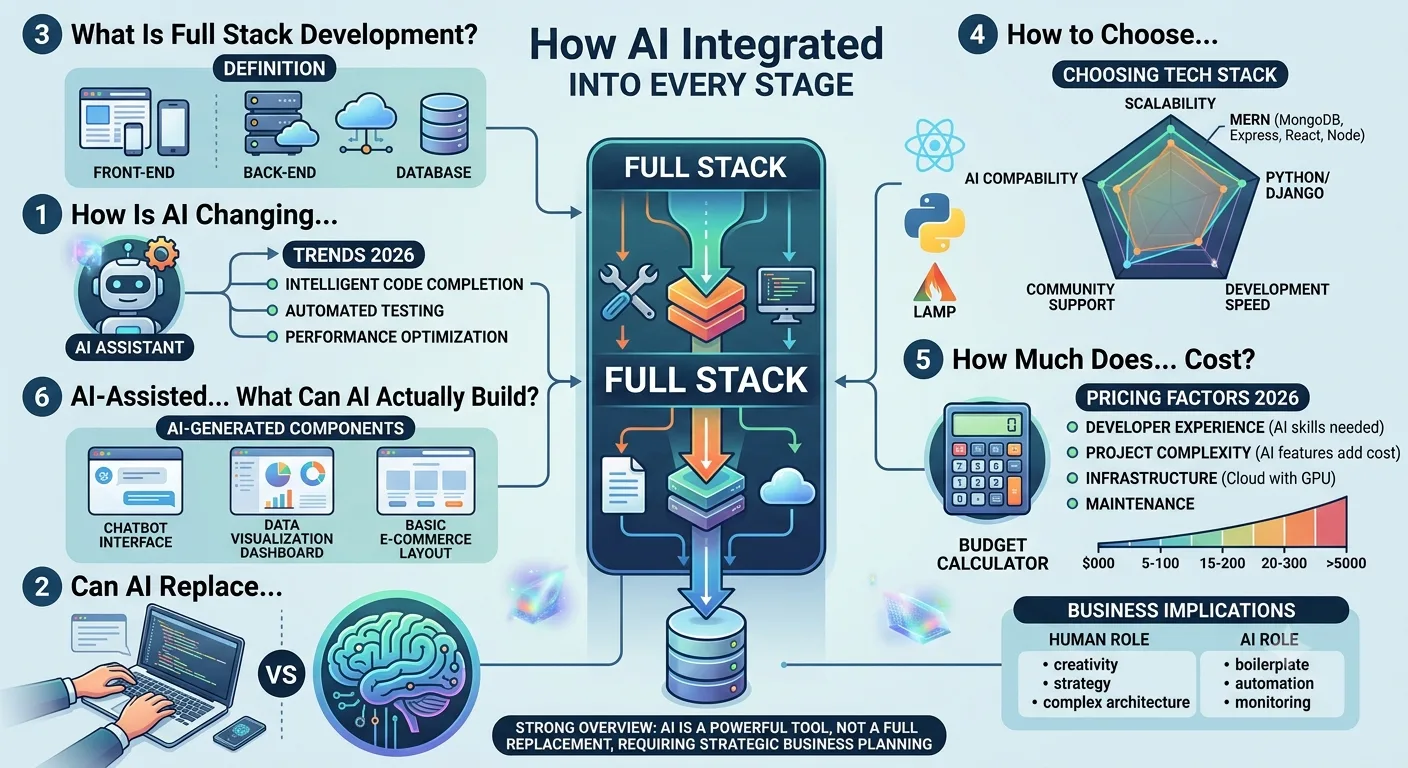
A huge percentage of the internet still runs on Linux, Apache, MySQL, and PHP. Not because those teams made a bad decision. Because it works, the developer talent is widely available, and the operational behavior is completely understood after two-plus decades. WordPress alone runs on this stack and powers something like 43% of websites. If you're maintaining a LAMP-based application, the smart move is usually to improve it, not immediately rewrite it on something newer.
For new projects in 2026, LAMP is rarely the recommended starting point. But the instinct to dismiss it entirely reflects a certain kind of developer snobbery more than it reflects practical engineering judgment.
So What Should You Actually Choose?
Look, if you're asking me to just give you an answer, here's what I'd say.
For a SaaS product with relational data and a team that knows JavaScript: Next.js with PostgreSQL, probably with Prisma as the ORM. It's not exciting but it's solid. You'll be able to hire for it. You'll find answers to your problems quickly because the combination is documented everywhere.
For a product where AI features are core to the value: React or Next.js on the frontend, Python with FastAPI on the backend, PostgreSQL or a combination of PostgreSQL with a vector database like pgvector for similarity search. This is the fastest-growing combination right now for real reasons.
For a startup that needs to move fast and stay small for the first year: Next.js with Supabase (which is managed PostgreSQL with a nice API layer). You're not managing infrastructure, your team focuses on product, and you can always migrate off later if you outgrow it.
For enterprise: talk to your legal and compliance teams before you talk to your engineers. The infrastructure constraints often determine the technology choices more than the product requirements do.
Working with a dedicated full stack development team changes this calculation slightly. A good team should push back if you're choosing a stack that doesn't fit your actual problem. If they just agree with whatever you suggest without asking hard questions about your data model and scaling requirements, that's worth noticing.
A Few Questions That Come Up a Lot
Does the technology stack affect how fast we can ship?
Yes, but not in the way most people expect. The stack that's fastest for initial development isn't always the fastest for sustained development six months in. A framework with more conventions (more decisions made for you) can slow you down early and speed you up later. A more flexible setup is faster at the start and requires more discipline to stay fast as the codebase grows.
Should we use the same stack as a company we admire?
Not unless your scale, team structure, and product requirements are similar to theirs. Netflix built a distributed microservices architecture to solve problems at a scale that almost no other organization faces. Copying their infrastructure choices when you have a fraction of their traffic and engineering headcount doesn't give you their benefits. It gives you their operational complexity without the load to justify it.
How do we know if we picked the wrong stack?
Usually you find out gradually rather than suddenly. It shows up as a specific class of features that's always harder to ship than it should be. Or a performance problem that keeps returning in the same part of the system. Or the realization that you're fighting your framework instead of using it. The right response is almost never an immediate full rewrite. It's usually a careful, incremental migration toward something that fits better, with parts of the system rebuilt as you touch them.
What's full-stack AI development, exactly?
It's building applications where AI capabilities aren't a separate feature but are integrated throughout the product. An LLM-powered assistant in the UI, vector search powering recommendations in the backend, ML models influencing business logic in the application layer. It's not a different stack so much as a set of additional capabilities woven into a conventional stack. The main implication for technology choice is that Python on the backend becomes much more attractive, because the AI tooling ecosystem there is significantly ahead of other languages.
How much should the team's existing skills influence the stack choice?
More than most technical decision-making frameworks acknowledge. A team that deeply knows one stack will outperform a team learning a theoretically superior stack for at least the first six months. That said, "we know it" isn't a good enough reason to choose a stack that genuinely can't support what you're building. The honest thing is to separate which parts of your decision are about fit and which are about familiarity, and make sure you're not pretending familiarity is fit.